

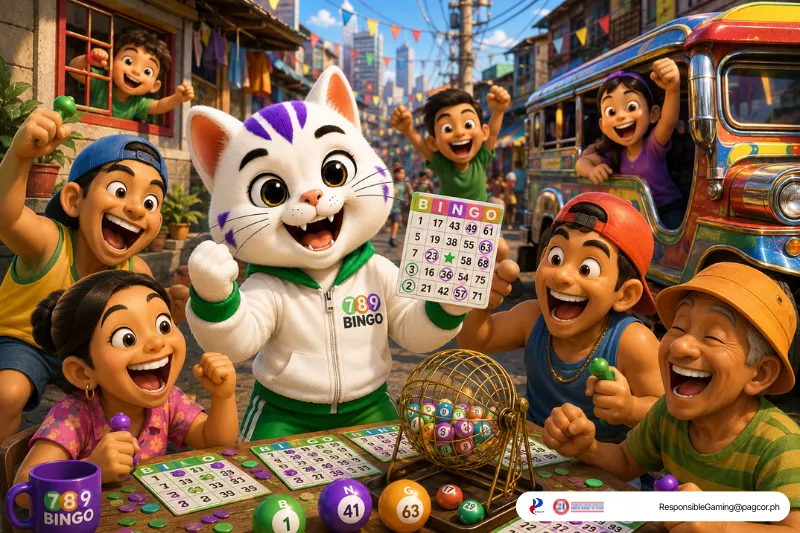
Bingo Filipino traditions include balato (sharing winnings), unique number callouts (25 = Pasko), and community atmosphere. 789Bingo brings these online with PAGCOR license.
Our local game flavor is not the same as American. Or British. Or Australian. According to our analysts, local traditions add layers of humor, generosity, and community spirit that other cultures miss. From “balato” (sharing winnings) to creative number callouts (25 = Pasko), our local game turns a simple number-matching game into a social event. This guide highlights 7 cultural quirks that make the game special. We also explain how 789Bingo preserves these traditions online while adding PAGCOR licensing and GCash convenience. Whether you play in a local hall or online, the game remains uniquely ours.
Bingo Filipino: Cultural Quirks at a Glance
Quirk | Description | Where It Appears |
Balato | Sharing winnings with spectators | Traditional halls |
Number Callouts | “25 = Pasko,” “1 = Unat” | Traditional + Online |
Community Atmosphere | Families, friends, even strangers | Traditional halls |
Free Space Superstition | Tapping the center square | Traditional + Online |
Wakes & Fiestas | Bingo at funerals and festivals | Traditional |
Multi-Card Mastery | Playing 10-20 sheets at once | Traditional + Online |
“Sayang” Culture | Staying after losing | Traditional + Online |
1. Balato: Sharing the Win
Balato is the most beautiful bingo Filipino tradition. When someone wins, they share a portion of their winnings with others. Not just family. Not just friends. Everyone nearby.
How it works: A winner shouts “Balato!” and hands out ₱20, ₱50, or ₱100 bills to spectators, other players, and even the tindera (vendor) selling snacks. No one asks. The winner offers.
Why it matters: Balato transforms individual success into communal celebration. Everyone feels like they won. Jealousy disappears. The atmosphere remains positive.
Online adaptation: 789Bingo cannot physically hand you cash. But the chat room allows winners to share “virtual balato” through tip bots or by announcing their win and sending good vibes. Some players organize “balato rounds” where winners buy bonus cards for others.
The local flavor without balato is like adobo without soy sauce. Possible. But wrong.
2. Number Callouts: “25 = Pasko”
Bingo Filipino number callouts are legendary. The caller does not simply say “B12” or “O75.” They say a phrase. Often humorous. Often rhyming. Often referencing Filipino culture.
Classic callouts:
- 1: Unat (stretch) – New Year, new beginnings
- 2: Cavite (province) – Geographic luck
- 3: Kulot (curly) – Playful energy
- 6: Seksi (sexy) – Attraction luck
- 7: Palakol (axe) – Cutting through bad luck
- 8: Otso (eight) – Twisting luck
- 9: Bulag (blind) – Unpredictable luck
- 11: Uhog (snot) – Unusual, but memorable
- 12: Patrimonio (inheritance) – Wealth luck
- 13: Hudas (Judas) – Lucky despite Western associations
- 15: Sweldo (salary) – Money luck
- 20: Binti (leg) – Strength luck
- 22: Dalawang baklang nakaluhod (two kneeling gays) – Memorable
- 25: Pasko (Christmas) – Festive luck
- 33: Doble kulot (double curly) – Strong playful luck
- 44: Pokpok (slang) – Memorable
- 50: Pera (money) – Wealth luck
- 55: Sardinas (sardines) – Packed luck
- 60: Buntis (pregnant) – Fertility luck
- 66: Doble seksi (double sexy) – Double attraction
- 69: Baliktaran (reversed) – Playful
- 70: Kalbo (bald) – Clean luck
- 75: Matanda (old) – Wisdom
One Redditor confirmed: “25 is Christmas.” Another noted: “It probably depends on the place what the other numbers are called.”
Bingo Filipino callouts vary by region. In Pampanga, 2 might be “Dos Por Dos.” In Cebu, 20 might be “Binti” (leg) more strongly associated with boxing icon Manny Pacquiao.
Online adaptation: 789Bingo’s automated callers use digital voices. But players in chat rooms still type “Pasko!” when 25 appears. The tradition lives on.
3. Community Atmosphere: Barkada Bingo
The game is not a solitary activity. It is barkada bingo. Families sit together. Friends tease each other. Strangers become acquaintances by the third round.
What you see in local halls:
- Lola (grandma) managing 20 cards while eating pandesal.
- Tatay (dad) shouting “Bingo!” then immediately offering balato.
- Kids running between tables, delivering extra daubers.
- Vendors walking aisles selling chips, drinks, and lucky charms.
Why it works: The house edge does not matter when you are having fun. Losing ₱100 feels fine because you spent 3 hours laughing with friends.
Online adaptation: 789Bingo offers chat rooms. Players can type “Good luck!” before rounds. They can celebrate wins together. They can commiserate losses. Not the same as physical presence. But closer than playing alone.
Bingo Filipino communities online have their own inside jokes. Regular players recognize each other’s usernames. Friendships form.
4. Free Space Superstition: The Ritual Tap
Almost every player performs the free space ritual. Before the first number is called, they tap the center square. Sometimes once. Sometimes three times. Sometimes with the dauber cap off.
Origin: Unknown. But common across all Philippine halls. Some say it “activates” the card. Others say it brings luck. Many do it because everyone else does.
Variations:
- Tap with dauber: Standard method.
- Tap with fingernail: For players who forgot their dauber.
- Kiss the free space: Reserved for high-stakes games.
- Draw a small cross: In predominantly Catholic areas.
Does it work? No. The free space is already marked. Tapping does nothing. But players do it anyway. Tradition trumps logic.
Online adaptation: 789Bingo cannot sense physical taps. But some players type “tap” or “free” in chat before rounds. The ritual continues digitally.
5. Wakes & Fiestas: Bingo Everywhere
Bingo Filipino appears at events where other cultures would never consider it.
- Wakes (lamay): When someone passes away, the family holds a multi-night vigil. Between prayers and eating, they play the game. Small stakes. Mostly for entertainment. Winners often donate balato back to the family for funeral expenses.
- Fiestas: Town festivals always include the game. The parish church organizes it. The barangay captain calls numbers. Prizes include rice, canned goods, and cash.
- Birthdays: Any Filipino birthday party lasting more than 4 hours will eventually feature the game. Usually after karaoke. Before lechon.
The Philippine game adaptation is not a separate activity. It is woven into social life.
Online adaptation: 789Bingo cannot replicate the wake atmosphere. But the platform is available 24/7 for fiestas, birthdays, and random Tuesdays when you feel like playing.
6. Multi-Card Mastery: The Art of Chaos
Players buy many cards. Not 1 or 2. Often 10, 15, or 20 sheets per round. Spread across a folding table. Arranged by color. Managed with military precision.
How they do it:
- Arrange cards in rows of 4 or 5.
- Use different colored daubers for different card groups.
- Develop a scanning pattern (left to right, top to bottom).
- Never miss a number.
Beginners: Buy 1-2 cards. Manage them slowly. Call bingo late because they missed a number.
Experts: Buy 20 cards. Dauber in each hand. Call bingo 2 seconds after the number is announced.
Masters treat card management as a competitive sport.
Online adaptation: 789Bingo automates the process. You can buy 24 cards. The system marks them instantly. No scanning. No missed numbers. But also no physical skill. Some traditional players miss the tactile experience.
7. “Sayang” Culture: Playing Until the End
Sayang means “what a waste” in Tagalog. Bingo Filipino players hate wasting cards. Even if the round is clearly lost, they continue marking numbers. “Sayang naman” (what a waste) if they stop early.
- Why this matters: In a traditional game, a card that needs 10 numbers with only 5 balls left cannot win. Mathematically impossible. But the player continues. Not because they expect to win. Because stopping feels wrong.
- Positive side: Players stay engaged until the final call. No one leaves early. The atmosphere remains full.
- Negative side: In online, “sayang” culture leads to watching dead cards instead of buying new ones. Time wasted.
Game wisdom: Know when to abandon a card. Protecting “sayang” feelings costs opportunities.
Online adaptation: 789Bingo’s auto-daub lets you step away from dead cards without guilt. The system continues marking. You focus on active cards.
Is Bingo a Filipino Game?
No. The game originated in Italy in the 16th century (as “Lo Giuoco del Lotto D’Italia”). It spread to France, Germany, and the United States. The modern version (75-ball) was standardized in 1929 by Edwin S. Lowe.
But: Bingo Filipino is uniquely ours. The callouts. The balato. The community atmosphere. The integration into wakes and fiestas. No other country plays the game like the Philippines.
Why Is Bingo Called Bingo?
The name comes from a 1929 incident. Edwin S. Lowe heard a player accidentally shout “Bingo!” instead of “Beano” (the game’s temporary name). Lowe liked the sound. He adopted it.
Bingo Filipino kept the name. But added the cultural quirks.
What Is Bingo Also Called?
Different names across cultures:
- UK: Housey-Housey (older generation)
- Italy: Lo Giuoco del Lotto D’Italia (original)
- Japan: Bingo (same, but with 90-ball format)
- Philippines: Bingo (with cultural additions)
The Rise of Online Bingo Filipino (789Bingo)
Traditional halls still exist. But online platforms like 789Bingo have grown rapidly.
Advantages of online:
- Play anytime (not just weekends or fiestas).
- GCash deposits (no need to carry cash to halls).
- Higher card limits (buy up to 24 cards).
- Auto-daub (never miss a number).
- Chat rooms (still social).
Disadvantages:
- No balato (cannot physically share cash).
- No creative callouts (digital voices are boring).
- No physical atmosphere (cannot smell pandesal).
The online version preserves the spirit. But purists miss the traditions.
Concerns About Online Gambling
Redditors express concerns about online bingo Filipino platforms. One user wrote: “Will never be a fan of endorsers. It makes sense that after years and years in showbiz, they only got rich now because of gambling. Never forget lives ruined because of gambling.”
Another noted aggressive advertising: “Report that sub! I’m really pissed off because I said no to gambling ads for my account settings and then I see that damn thing making money off this fcking hooker.”*
Our response: 789Bingo takes responsible gaming seriously. Deposit limits. Self-exclusion. PAGCOR oversight. We want players to enjoy traditions safely. Not ruin lives.
Why 789Bingo Preserves Bingo Filipino Traditions
789Bingo operates under a license and is PAGCOR Guaranteed. The platform offers multiple titles (iRich, Fortune, Carnaval, etc.). Chat rooms allow players to type “balato” when they win. The number callouts appear on screen (25 = Pasko).
Online is not the same as traditional. But it is the next best thing. And for players who cannot attend physical halls (due to distance, disability, or schedule), 789Bingo keeps the tradition alive.
ALSO READ:
Bingo PH: The Ultimate Resource Hub for Bingo Players at 789Bingo
Paano Maglaro ng Bingo: Ang Kumpletong Gabay para sa mga Baguhan sa 789Bingo
Pinoy Bingo Patterns: Strategic Tips for Identifying Common Winning Shapes
Frequently Asked Questions
Is bingo a Filipino game?
No. The game originated in Italy in the 16th century. However, the game is uniquely Filipino due to cultural additions like balato (sharing winnings), creative number callouts (25 = Pasko), and integration into wakes and fiestas. The core game is international. The traditions are ours.
Why is bingo called bingo?
The name comes from a 1929 incident. Edwin S. Lowe heard a player accidentally shout “Bingo!” instead of “Beano” (the game’s temporary name). Lowe liked the sound and adopted it. The name stuck. Bingo Filipino kept the name but added local quirks.
What is bingo also called?
Different names across cultures: Housey-Housey (UK), Lo Giuoco del Lotto D’Italia (Italy), and simply Bingo (Philippines, US, Japan). Bingo Filipino has no separate name.
What is balato in bingo Filipino?
Balato is the tradition of sharing winnings with others. When someone wins, they hand out ₱20, ₱50, or ₱100 bills to spectators, other players, and vendors. No one asks. The winner offers. Balato transforms individual success into communal celebration. Online, players announce wins in chat as a virtual balato.
What are common bingo Filipino number callouts?
Examples: 1 = Unat, 2 = Cavite, 3 = Kulot, 6 = Seksi, 7 = Palakol, 8 = Otso, 9 = Bulag, 11 = Uhog, 12 = Patrimonio, 13 = Hudas, 15 = Sweldo, 20 = Binti, 22 = Dalawang baklang nakaluhod, 25 = Pasko, 33 = Doble kulot, 50 = Pera, 55 = Sardinas, 60 = Buntis, 69 = Baliktaran, 70 = Kalbo, 75 = Matanda. Callouts vary by region.
Experience Bingo Filipino Online at 789Bingo
Missing the traditions? Relive them at 789Bingo. Deposit via GCash. Play iRich Bingo or Bingo Carnaval. Type “balato” in chat when you win. Shout “Pasko!” when 25 appears. Buy 24 cards and let auto-daub handle the work. Experience bingo Filipino online. Join 789Bingo today.






Leave a Reply