
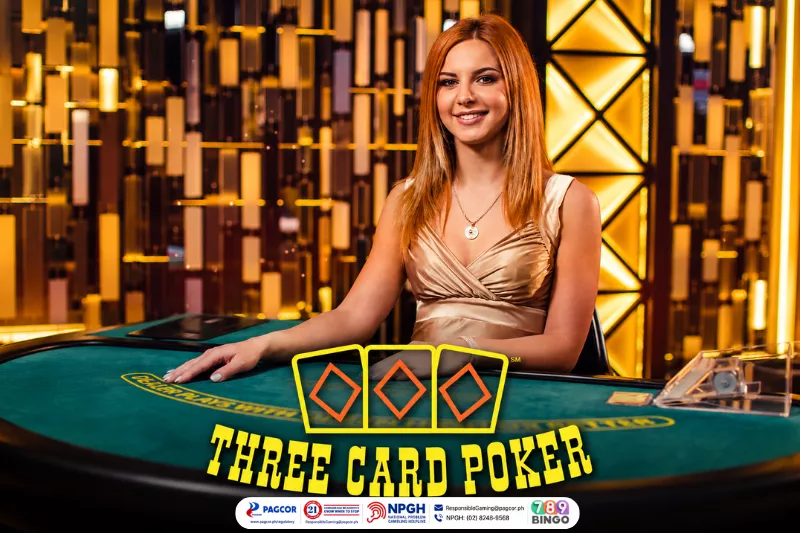
Learn how Three Card Poker by Evolution works at 789Bingo, with Ante, Play, Pair Plus, 6 Card Bonus, and 96.63% optimal Ante RTP.
Three Card Poker by Evolution reduces a poker hand to three cards and one main decision: continue against the dealer by matching the Ante with a Play wager, or Fold and surrender the Ante. The shorter hand changes traditional poker rankings too, because a three-card Straight ranks above a Flush, while optional Pair Plus and 6 Card Bonus wagers create completely separate payout paths.
The dealer must reach Queen High or better to qualify, so winning the main game depends on more than simply forming a stronger-looking combination. A player can also receive an Ante Bonus on a Straight or better, while the 6 Card Bonus combines all six cards on the table to create a separate five-card poker hand with payouts reaching 1,000:1.
Three Card Poker Creates a Different Hierarchy
Quick Stats: Evolution uses one standard 52-card deck without Jokers, shuffles after each completed round, and publishes a 96.63% optimal RTP for the Ante wager. The dealer needs at least Queen High to qualify, while optional Pair Plus and 6 Card Bonus bets have separate published returns of 95.51% and 91.44%.
Three Card Poker is a house-banked poker game rather than a player-versus-player poker room. Every participant plays against the dealer’s three-card hand, so there is no bluffing, pot building or attempt to force another player to fold.
Evolution provides its live version through a partnership covering the Three Card Poker title, and the product has appeared in the provider’s live poker portfolio for years. The game keeps the poker-hand concept recognizable but simplifies the round into three cards, an Ante, one Play-or-Fold decision and two optional bonus wagers.
This structure makes Three Card Poker a relatively direct casino game online for players who want poker-style hand comparison without the multiple betting streets used in Texas Hold’em. The important differences sit in the dealer qualification rule, the altered three-card hand ranking and the independence of the bonus wagers.
One Deck, Three Cards and Three Separate Bet Types
Specification | Details |
Software Provider | Evolution |
Game Type | Live dealer poker table game |
Deck | One standard 52-card deck |
Jokers | None |
Shuffling | After every game round |
Main Bets | Ante and Play |
Optional Bets | Pair Plus and 6 Card Bonus |
Dealer Qualification | Queen High or better |
Ante RTP | 96.63% |
Pair Plus RTP | 95.51% |
6 Card Bonus RTP | 91.44% |
The player begins the main game by placing an Ante. Pair Plus and 6 Card Bonus may also be selected before the cards are dealt, but these bets do not replace the main Ante-and-Play comparison.
Each player receives three cards, while the dealer also receives three cards that remain face down until the main decision has been made. After seeing the player’s three-card hand, the player either places a Play wager equal to the Ante or Folds.
Choosing Play therefore doubles the amount committed to the head-to-head main game. A ₱100 Ante becomes ₱200 of main-game exposure once another ₱100 is placed in the Play position, before accounting for any Pair Plus or 6 Card Bonus stakes.
Folding ends the Ante portion of the round and forfeits the Ante. It does not automatically cancel an already accepted Pair Plus or 6 Card Bonus wager, because Evolution evaluates those optional bets independently.
Why a Straight Beats a Flush With Only Three Cards
Five-card poker normally ranks a Flush above a Straight, but Three Card Poker reverses those two categories. Evolution explains that a three-card Straight is less common than a three-card Flush, so the Straight receives the higher ranking.
The three-card hierarchy runs from stronger combinations down toward ordinary high-card hands. Evolution identifies Mini Royal, Straight Flush, Three of a Kind, Straight, Flush, Pair and High Card among the relevant three-card results.
A Mini Royal consists of:
Ace + King + Queen of the same suit.
A Straight Flush contains three sequential cards of one suit, while Three of a Kind uses three cards sharing the same rank. A Straight uses three sequential ranks in at least two suits, and a Flush uses three cards of one suit that do not form a sequence.
A Pair contains two cards of the same rank plus one different card. Everything that does not meet one of those combinations becomes a High Card hand, where the highest individual rank becomes the first comparison point.
The Ace can operate at either end of a Straight. Evolution permits Ace-King-Queen at the top and 3-2-A at the bottom, which matters when comparing apparently similar three-card sequences.
Understanding this reordered hierarchy is essential when treating Three Card Poker as a casino game online, because applying ordinary five-card poker rankings would lead to the wrong decision between some Straight and Flush hands. The three-card probability structure determines the ranking rather than familiarity with Texas Hold’em.
The Dealer Needs Queen High to Qualify
After the player chooses Play, the dealer reveals the three hidden cards. The dealer needs at least Queen High to qualify for the normal Ante-and-Play showdown.
If the dealer fails to qualify, the Ante pays 1:1 and the Play wager pushes. The Play stake is therefore returned rather than receiving another 1:1 win in that situation.
Suppose the player has:
King-8-4
and the dealer reveals:
Jack-9-5
The dealer does not have Queen High or better, so the qualification condition fails. The player’s Ante receives the 1:1 payout while the Play stake is returned.
If the dealer qualifies and the player has the stronger hand, both Ante and Play pay 1:1. If the qualified dealer has the stronger hand, both main wagers lose, while an exact tie pushes both wagers.
The qualification rule therefore affects settlement even before comparing the complete strength of the two hands. A dealer with Jack High can fail to qualify despite having three legitimate cards, while a Queen-high dealer reaches the minimum threshold and proceeds to the normal comparison.
This distinction also explains why simply asking whether the player’s cards “look good” is not enough. The value of continuing depends on both the player’s hand strength and the mathematical consequences of dealer qualification.
Q-6-4 Is the Main Ante Decision Threshold
The principal decision in Three Card Poker is whether to Fold or place the Play wager equal to the Ante. Mathematical analysis of the standard rules identifies Queen-6-4 or better as the optimal threshold for continuing the main game.
That means a hand such as:
Q-6-4
meets the threshold, while:
Q-6-3
falls just below it.
Hand comparison follows normal high-card logic within the same category. A Queen-7-3 is stronger than Queen-6-4 because the Queens tie and the second-highest card, 7, beats 6, so Queen-7-3 is a Play hand under that threshold.
Likewise, King High and Ace High hands exceed the Queen-6-4 boundary. Any Pair, Flush, Straight, Three of a Kind or Straight Flush also ranks well above that simple high-card threshold.
The threshold does not guarantee that a hand will win. It identifies the point where placing the additional Play wager has a better expected mathematical result than immediately forfeiting the Ante through a Fold.
That is an important distinction for a casino game online involving a genuine player decision. Strategy can reduce avoidable errors in the Play-or-Fold choice, but it cannot reveal the dealer’s hidden cards or remove the built-in house advantage.
Ante Bonus Rewards a Straight or Better
The main Ante structure includes an additional Ante Bonus for qualifying strong three-card hands. Evolution’s current rules state that a player who places the Play wager and holds a Straight or better receives the applicable bonus even if the dealer ultimately wins the main comparison.
The Ante Bonus paytable is:
Hand | Ante Bonus |
Straight Flush or higher | 5:1 |
Three of a Kind | 4:1 |
Straight | 1:1 |
A Straight therefore carries two possible sources of value in the same completed round. It can help beat the dealer in the Ante-and-Play comparison and also qualify for its separate 1:1 Ante Bonus.
Three of a Kind receives 4:1 on the Ante Bonus, while a Straight Flush or higher receives 5:1. Evolution’s rules describe the top line as “Straight Flush or higher,” which covers the strongest qualifying three-card outcome without requiring a separate Ante Bonus line for every higher named hand.
The bonus should not be confused with Pair Plus. Ante Bonus is connected to the main Ante-and-Play structure, whereas Pair Plus is a separately funded optional wager with its own paytable and RTP.
Pair Plus Ignores the Dealer's Hand
Pair Plus focuses only on the player’s original three cards. A Pair or better produces a payout according to the relevant line, and Evolution states that the optional bet can still win even when the player Folds the main hand or the dealer wins the head-to-head comparison.
The published Pair Plus paytable is:
Player Hand | Pair Plus Payout |
Mini Royal, suited A-K-Q | 100:1 |
Straight Flush | 40:1 |
Three of a Kind | 30:1 |
Straight | 5:1 |
Flush | 4:1 |
Pair | 1:1 |
The top Pair Plus result is the Mini Royal at 100:1. That figure belongs specifically to the Pair Plus side wager and should not be presented as a universal maximum payout for the main Three Card Poker game.
A Pair Plus stake also loses when the player’s three cards do not contain at least a Pair, regardless of what happens to the Ante and Play wagers. A player can therefore win the main comparison while losing Pair Plus, or lose the main comparison while receiving a strong Pair Plus payout.
This independent settlement is especially important when calculating total exposure in a casino game online session. A ₱100 Ante plus ₱100 Pair Plus is already ₱200 committed before the Play decision, and choosing Play adds another ₱100 to the round.
The 6 Card Bonus Uses Both Hands Together
The 6 Card Bonus changes the perspective completely. Instead of comparing the player’s three-card hand against the dealer, it combines the player’s three cards with the dealer’s three cards and forms the strongest possible five-card poker hand from those six available cards.
The published 6 Card Bonus paytable is:
Five-Card Result | Payout |
Royal Flush | 1,000:1 |
Straight Flush | 200:1 |
Four of a Kind | 100:1 |
Full House | 20:1 |
Flush | 15:1 |
Straight | 10:1 |
Three of a Kind | 7:1 |
The headline 1,000:1 payout belongs to a Royal Flush produced from the six combined cards. A Straight Flush pays 200:1, Four of a Kind 100:1, Full House 20:1, Flush 15:1, Straight 10:1 and Three of a Kind 7:1.
This bonus does not require the player’s own three cards to contain the final five-card hand by themselves. Dealer cards can complete the qualifying combination because all six available cards are examined for the best five-card poker result.
For example, the player might hold three cards that look ordinary in isolation, yet the dealer’s revealed cards could combine with them to create a Straight or Flush for the 6 Card Bonus. Conversely, a strong three-card main hand does not guarantee that the six-card combination will reach Three of a Kind or better.
The wager also remains independent after a Fold. Evolution states that the 6 Card Bonus can still pay even if the player does not place the Play wager and even if the dealer wins the main round.
Three Published RTP Figures Belong to Three Different Bets
Evolution publishes different theoretical returns for each major wager rather than assigning one percentage to the entire table. The Ante is listed at 96.63%, Pair Plus at 95.51%, and the 6 Card Bonus at 91.44% under the documented paytables.
That corresponds to approximate theoretical house edges of:
Ante: 3.37%
Pair Plus: 4.49%
6 Card Bonus: 8.56%
The figures show why the largest possible payout does not equal the strongest theoretical return. The 6 Card Bonus can reach 1,000:1, yet its 91.44% RTP is lower than both the main Ante game and Pair Plus.
The Ante produces the highest published theoretical return of the three at 96.63%. That percentage assumes appropriate main-game decisions rather than mechanically playing or folding every hand.
Players comparing this casino game online with other poker-based live tables should therefore separate payout potential from expected return. Pair Plus and 6 Card Bonus can create larger individual payouts, but each additional side bet also increases the amount wagered and uses a different mathematical profile.
One Strong Hand Can Produce Several Different Results
Three Card Poker can settle several wagers differently during the same round. Consider a player who places ₱100 on Ante, ₱100 on Pair Plus and ₱100 on 6 Card Bonus, then receives a qualifying hand and adds the required ₱100 Play wager.
Total round exposure becomes:
₱400
before any settlement occurs.
Suppose the player’s three cards form a Straight. The hand qualifies for the Ante Bonus, earns a Pair Plus payout if that optional bet was placed and still competes with the dealer in the main showdown.
The 6 Card Bonus is evaluated separately using all six cards. It may win or lose independently of every other result.
A single round can therefore contain:
a main-game win or loss
an Ante Bonus
a Pair Plus result
a 6 Card Bonus result
Treating those components separately makes the balance movement easier to understand. Seeing one winning animation does not necessarily mean every stake placed during the round was profitable.
A Mini Royal and a Royal Flush Are Not the Same Bet
The terminology can be confusing because both use royal-card sequences. In the three-card section, a Mini Royal is A-K-Q of one suit and pays 100:1 on Pair Plus under Evolution’s documented table.
The Royal Flush on the 6 Card Bonus is the conventional five-card A-K-Q-J-10 combination in one suit. It uses the best five cards from the player’s and dealer’s combined six cards and pays 1,000:1.
The two outcomes therefore use different card counts, different wagers and different payouts. Calling both simply “Royal” without identifying the bet can create inaccurate game-page copy.
The distinction also reinforces why Three Card Poker cannot be summarized with one maximum multiplier. A 100:1 Pair Plus result and 1,000:1 6 Card Bonus result belong to different separately funded wagers.
Starting a Three Card Poker Round
Open 789Bingo and locate Three Card Poker within the live casino area. Check the active PHP betting limits before selecting a stake because operator-level minimum and maximum values should come from the current table rather than another casino’s configuration.
Begin by placing the required Ante, then decide whether Pair Plus or 6 Card Bonus fits within the amount you planned to risk on that round. Those optional positions increase total turnover immediately, even before the Play decision appears.
The dealer then distributes three cards to the player and three face-down cards to the house. Review the player’s hand according to the three-card hierarchy rather than ordinary five-card poker order.
Choose PLAY 1x to continue by matching the Ante or Fold to surrender the main Ante. As a practical mathematical reference, Queen-6-4 or better is the standard optimal continuation threshold for the documented rules.
After a Play decision, the dealer reveals the hidden cards and checks qualification. Queen High or better qualifies; below Queen High, the Ante pays 1:1 while the Play wager pushes.
If the dealer qualifies, the two three-card hands are compared. The better hand wins, equal hands push, and the bonus wagers are then settled according to their independent conditions.
Pro Tip: Set your round budget using the amount that can actually reach the table, not only the Ante chip. A ₱100 Ante can become ₱200 after Play, and adding ₱100 Pair Plus plus ₱100 6 Card Bonus raises total exposure to ₱400 before the dealer’s hand is resolved.
Why Folding Does Not Cancel Every Wager
Folding only ends the main Ante-and-Play contest. The player forfeits the Ante and does not place a Play wager, but Evolution explicitly states that an accepted Pair Plus or 6 Card Bonus can still settle according to its own cards and paytable.
That means a Fold can coexist with a side-bet win. For example, a player could fold a weak high-card hand yet later discover that the combined player and dealer cards create a qualifying 6 Card Bonus result.
This does not make unnecessary folding beneficial. The Fold decision should still be based on the main-game hand, while the side wagers simply continue because their conditions were fixed when the initial bets were accepted.
That separation is one reason Three Card Poker works differently from a simple winner-takes-all casino game online. Each wager has its own trigger, RTP and settlement path, even though all of them use cards from the same physical round.
Managing Ante, Play and Side-Bet Exposure
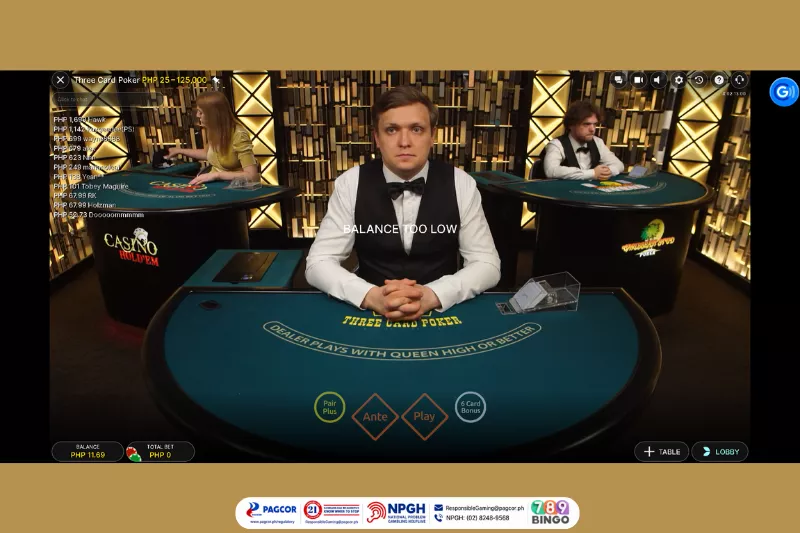
Three Card Poker can look inexpensive when attention stays on the first Ante chip. The final amount wagered in one round can be considerably larger because continuing requires an equal Play bet and the two optional bonuses add separate stakes.
Set one maximum figure for the complete round before placing the Ante. If the planned limit is ₱400, for example, account for the possibility of Ante + Play + Pair Plus + 6 Card Bonus rather than committing ₱400 to the Ante alone.
Do not increase the next wager because you folded a hand that would later have beaten the dealer. Decisions must be made with the information available at the time, and the next shuffled round does not compensate for the previous result.
Evolution states that a standard 52-card deck is shuffled after each game round. Previous Straights, dealer qualifications, Mini Royals or 6 Card Bonus outcomes therefore do not create a requirement for a particular hand to appear next.
This is especially relevant in a fast casino game online where repeated short hands can increase turnover quickly. Set deposit and session limits, use disposable entertainment funds, take timeouts when needed and avoid trying to recover previous losses by escalating the next Ante.
Gambling can be addictive; know when to stop.
Frequently Asked Questions
What is the RTP of Three Card Poker?
Evolution publishes 96.63% for the Ante, 95.51% for Pair Plus and 91.44% for the 6 Card Bonus. The percentages belong to separate wagers, so 96.63% should not be presented as though every betting position on the table shares the same return.
The Ante carries the highest documented theoretical return among those three options. RTP remains a long-run mathematical measure rather than a prediction of what one player will receive during a session.
Why does a Straight beat a Flush in Three Card Poker?
With only three cards, there are fewer possible Straights than Flushes, so Evolution ranks the Straight higher than the Flush. This reverses the familiar five-card poker relationship where a Flush normally outranks a Straight.
Applying standard five-card rankings to the three-card showdown can therefore produce the wrong conclusion. Always use the ranking table specific to Three Card Poker.
Can Pair Plus or 6 Card Bonus win after I Fold?
Yes, provided those optional wagers were placed before the deal and their qualifying card conditions are met. Evolution states that Pair Plus and 6 Card Bonus are evaluated independently even when the player Folds the main hand or the dealer wins the Ante-and-Play comparison.
The Ante Bonus is different because the published rules connect it to placing the Play wager with a Straight or better. Folding therefore should not be treated as preserving every possible bonus associated with the main game.
Three Card Poker at 789Bingo
Three Card Poker earns its own page because the important mechanics are more specific than simply “poker with fewer cards.” The meaningful structure is three-card ranking → Queen-high dealer qualification → Play or Fold → independent Ante Bonus, Pair Plus and 6 Card Bonus settlement.
Its most distinctive rule is easy to remember: a Straight beats a Flush because three-card probabilities differ from conventional five-card poker. From there, the game separates a relatively straightforward Ante-and-Play decision from optional bonus wagers carrying progressively lower published RTP figures and larger headline payouts.
Players who prefer house-banked poker rather than peer-to-peer tournaments can compare Three Card Poker with Casino Hold’em, Ultimate Texas Hold’em and other dealer-led titles in the live casino collection. The provider’s broader poker portfolio also identifies Three Card Poker as one of Evolution’s live poker titles, alongside its other house-banked table variants.
The central lesson remains simple. Play-or-Fold strategy belongs to the Ante game, Pair Plus judges only the player’s initial three cards, and the 6 Card Bonus uses all six cards to find the best five-card combination, so each wager should be evaluated on its own mathematics rather than the size of its largest possible payout.
789Bingo promotes Responsible Gaming for players aged 21+ only. Gambling can be addictive; know when to stop. For help, contact NPGH: (02) 8248-9568 or [email protected]












Leave a Reply