

Casino Hold’em by Evolution turns Texas Hold’em-style community cards into a house-banked game where you compete against the dealer rather than other players. This casino game online begins with an Ante, reveals your two cards plus the three-card Flop, then asks you to make the round’s defining decision: Fold or commit a Play wager worth twice your Ante.
The Turn and River arrive only after that decision, so you must assess the first five available cards without knowing the complete board or the dealer’s hidden cards. Evolution publishes a 97.84% optimal theoretical RTP for the Ante wager, while the optional Bonus bet has a lower 93.74% RTP.
Casino Hold'em at a Glance
Quick Stats: One 52-card deck, Play bet equals 2× Ante, and the dealer needs a Pair of Fours or higher to qualify. Casino Hold’em uses one deck without Jokers and reshuffles the cards after every completed game round.
Unlike player-versus-player Texas Hold’em, there is no need to read another player’s betting pattern or build a pot against several opponents. Every participating player is trying to build a stronger five-card poker hand than the dealer using two player cards and the five shared community cards.
The round starts with an Ante wager, while an optional Bonus wager can also be placed once the Ante is active. Evolution’s official description identifies the Bonus as a separate wager that rewards a Pair of Aces or higher among the first five cards available to the player, which means the player’s two initial cards plus the three-card Flop.
That first-five-card restriction is important because the later Turn and River can improve the main poker hand without improving the already determined Bonus combination. Someone comparing this casino game online with regular poker should therefore separate the main seven-card comparison from the five-card Bonus calculation.
One Deck, 97.84% RTP and Main Game Data
Game Detail | Casino Hold’em |
Software Provider | Evolution |
Game Type | Live dealer Casino Hold’em poker |
Opponent | Dealer / house |
Deck | One standard 52-card deck |
Jokers | None |
Shuffle | After every game round |
Player Cards | Two face-up cards |
Dealer Cards | Two face-down cards initially |
Community Cards | Five |
Flop | Three community cards |
Turn | Fourth community card |
River | Fifth community card |
Initial Main Bet | Ante |
Decision | Play 2X or Fold |
Play Bet | 2× Ante |
Dealer Qualification | Pair of Fours or higher |
Ante RTP | 97.84% optimal theoretical RTP |
Bonus RTP | 93.74% |
Bonus Trigger | Pair of Aces or better in first five cards |
Highest Listed Ante Payout | 100:1 for Royal Flush |
Highest Listed Bonus Payout | 100:1 for Royal Flush |
Bet Range | Check the active 789Bingo table |
Evolution’s published rules confirm that the game uses one standard deck, excludes Jokers and reshuffles after each round. They also confirm that an unlimited number of players can participate simultaneously, while each player occupies only one game position.
The 97.84% figure applies specifically to the Ante under optimal theoretical play, while the Bonus side wager is published at 93.74%. These figures should not be merged into one universal RTP because each wager follows a separate paytable and mathematical model.
The Flop Creates the Main Play-or-Fold Decision
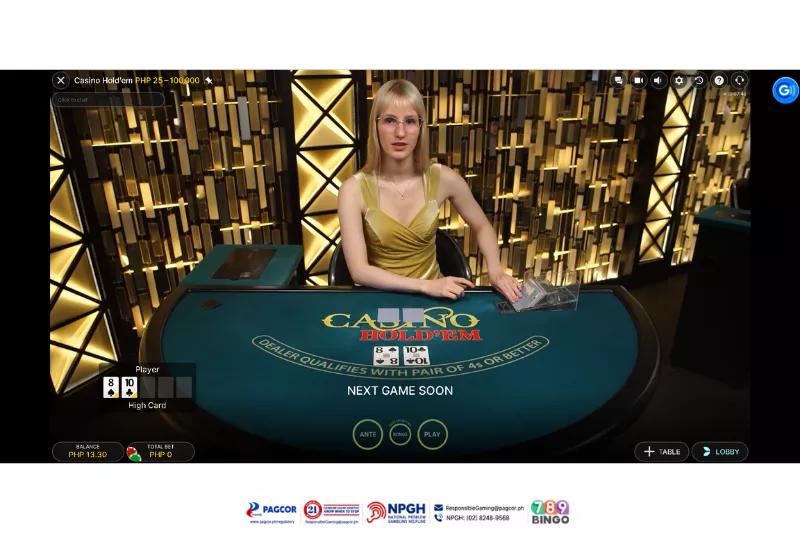
The dealer begins by giving you two face-up cards and taking two face-down cards for the house. Three community cards are then placed face up in the center of the table, creating the Flop that both sides will eventually use when forming their best five-card hands.
At this stage, you know five cards that may contribute to your final hand: your two private cards and the three community cards. You still do not know the Turn, River or either of the dealer’s hidden cards, so this is where Casino Hold’em places its only central main-game decision.
You can choose PLAY 2X to remain in the round or FOLD and surrender the Ante. Choosing Play automatically requires a wager exactly twice the size of the original Ante, while folding ends your participation in the main hand.
For example, a ₱100 Ante requires another ₱200 when Play is selected. Your total main-game commitment for that continuing hand therefore becomes ₱300 before considering any optional side wager.
That additional exposure is one of the most important details for anyone approaching Casino Hold’em as a casino game online rather than conventional poker. The opening chip does not represent the maximum amount needed to complete the main hand because continuing always requires another two Ante units.
Casino Game Online Mechanics: Play 2X or Fold
Casino Hold’em does not allow the variable raise sizes found in some other Hold’em-based casino games. Once you see the Flop, the choice is binary: Fold or continue with a Play wager fixed at exactly 2× the Ante.
After the decision phase ends, the dealer adds the fourth community card, called the Turn, followed by the fifth community card, called the River. The dealer then reveals the two previously hidden house cards, leaving seven cards available to each side: two private cards plus the five shared community cards.
The game software then constructs the best possible five-card poker hand for both Player and Dealer. You do not have to use both of your private cards, and the final five-card hand can use whichever combination of the seven available cards creates the strongest valid poker ranking.
Suppose your two cards are A♠ and K♠ while the board finishes Q♠, J♠, 10♠, 4♦ and 2♣. Your best five-card result is a Royal Flush because the A♠, K♠, Q♠, J♠ and 10♠ form the strongest possible standard poker combination.
The dealer builds a hand in exactly the same way using its two private cards and the same five-card community board. This shared-board structure means the Turn and River may improve both sides simultaneously, so one strong community-card sequence does not necessarily belong exclusively to the player.
Dealer Qualification Starts at a Pair of Fours
Once all seven cards are available, the dealer first has to qualify. Evolution’s published rules require the dealer to hold a Pair of Fours or a stronger poker hand before the normal head-to-head Play wager settlement applies.
This qualification rule creates several possible outcomes beyond simply asking whether the player’s hand is higher. A dealer with only Ace High, King High, or even a Pair of Twos or Threes fails to qualify.
If the dealer does not qualify and the player’s hand remains in play, the Ante wins according to the Ante paytable while the Play wager pushes and is returned. The 2× Play stake therefore does not receive a 1:1 win when the dealer fails to qualify.
If the dealer qualifies and the player’s five-card hand is stronger, the Ante again pays according to its hand-specific table and the Play wager pays 1:1. If the qualified dealer has the stronger hand, both Ante and Play lose.
An exact tie between qualified hands produces a push on both wagers. Because the rules compare complete five-card hands, matching hand categories do not automatically create a tie; ranks and kickers are compared until a winner is found whenever possible.
This dealer qualification system is one of the main ways Casino Hold’em differs from another casino game online based on Texas Hold’em cards. The dealer is not simply another poker opponent, because the Pair-of-Fours threshold directly changes how the Play wager settles.
Ante Payouts Depend on Your Final Poker Hand
The Ante does not always pay even money when you defeat the dealer. Evolution uses a graduated Ante paytable that gives larger rewards to stronger final five-card combinations.
Winning Ante Hand | Payout |
Royal Flush | 100:1 |
Straight Flush | 20:1 |
Four of a Kind | 10:1 |
Full House | 3:1 |
Flush | 2:1 |
Straight | 1:1 |
Three of a Kind | 1:1 |
Two Pairs | 1:1 |
One Pair or lower | 1:1 |
The Play wager is simpler because it pays 1:1 when the dealer qualifies and your hand wins. The graduated payouts belong to the Ante, so the 100:1 Royal Flush amount should not be described as a universal 100× multiplier on every wager placed in the round.
Consider a ₱100 Ante followed by the required ₱200 Play wager. If the dealer qualifies and you win with an ordinary Pair, the Ante pays 1:1 and the Play also pays 1:1, whereas winning with a Royal Flush applies the 100:1 schedule to the Ante while the Play remains an even-money wager.
That difference matters when reading a headline such as “payouts up to 100:1.” The figure describes the Ante paytable for the strongest listed hand rather than multiplying the entire ₱300 main-game exposure by 100.
The Bonus Uses Only Your First Five Cards
The optional Bonus wager is determined from your two private cards plus the three-card Flop. The later Turn and River are not included when determining whether this side wager has produced its qualifying Pair of Aces or better.
This creates an unusual separation between the two parts of the game. Your Bonus result can already be mathematically established while the main Casino Hold’em hand still has two community cards remaining.
For example, imagine your two cards are A♠ and A♥ while the Flop is 7♣, 4♦ and 2♠. The first five cards already contain a Pair of Aces, which reaches the lowest qualifying Bonus tier, while the main hand could still develop into Three of a Kind, Two Pairs or another result when the Turn and River arrive.
The opposite situation can also occur. A weak first five cards may fail to qualify for the Bonus, but the Turn and River could later complete a strong main hand such as a Straight, Flush or Full House.
That independence makes the Bonus structurally different from the main Ante wager in this casino game online. It also explains why the Bonus has its own 93.74% theoretical RTP rather than inheriting the 97.84% figure associated with optimal Ante play.
Bonus Payouts Range From 7:1 to 100:1
Evolution’s published Casino Hold’em rules list the following Bonus payouts for qualifying first-five-card combinations. A Pair lower than Aces does not reach the published Bonus threshold.
First Five Cards | Bonus Payout |
Royal Flush | 100:1 |
Straight Flush | 50:1 |
Four of a Kind | 40:1 |
Full House | 30:1 |
Flush | 20:1 |
Straight | 7:1 |
Three of a Kind | 7:1 |
Two Pairs | 7:1 |
Pair of Aces | 7:1 |
A Royal Flush receives the same 100:1 headline payout as the highest Ante tier, but the intermediate Bonus payouts are substantially different. A Straight Flush, for example, pays 50:1 on the Bonus but 20:1 on the Ante, while Four of a Kind pays 40:1 on the Bonus and 10:1 on the Ante.
The larger side-bet rewards should not be interpreted as a stronger theoretical return. Evolution‘s rules publish 93.74% RTP for the Bonus compared with 97.84% for optimal Ante play, which means the higher individual payout ladder comes with a larger mathematical house advantage over repeated wagering.
Poker Hand Rankings Determine the Final Comparison
Casino Hold’em follows standard poker hand rankings when comparing the player’s best five cards with the dealer’s. From highest to lowest, the hierarchy is Royal Flush, Straight Flush, Four of a Kind, Full House, Flush, Straight, Three of a Kind, Two Pairs, Pair and High Card.
The Ace can work at either end of a Straight. It is high in A-K-Q-J-10 and can also serve as the low card in 5-4-3-2-A, while suits do not act as tie breakers when two otherwise equal poker hands are compared.
When both sides hold the same category, card ranks determine the stronger hand. Two Pairs compare the highest pair first and then the lower pair, while matching pairs move to the kickers until the game can identify a stronger complete five-card hand.
A Flush is compared from its highest card downward. If both Flushes share the same top card, the next card is compared, and that process continues until a difference is found or the five-card combinations are completely equal.
These standard poker comparisons give the casino game online familiar Hold’em terminology without turning it into player-versus-player poker. The cards may look like Texas Hold’em, but there is no bluffing, pot building or opponent betting sequence after the deal.
Casino Hold'em Is Not Ultimate Texas Hold'em
Casino Hold’em and Ultimate Texas Hold’em both use two private cards and five community cards, but the betting structures are materially different. Ultimate Texas Hold’em lets the player choose when to raise, with the available raise multiple changing according to whether the decision is made before the Flop, after the Flop or later.
Casino Hold’em waits until the two private cards and three-card Flop are already visible. At that point, there is one fixed continuation price: the Play wager is always 2× the Ante.
The opening wagers also differ. Casino Hold’em begins with the Ante and optional Bonus, while Ultimate Texas Hold’em uses its own Ante, Blind and optional Trips structure.
Those differences make the search intent separate even though both use Hold’em-style community cards. A guide for Casino Hold’em should therefore focus on dealer qualification and the fixed Play 2X decision instead of importing Ultimate Texas Hold’em’s 3× or 4× early-raise rules.
Casino Hold'em Is Not 2 Hand Casino Hold'em
Evolution also offers 2 Hand Casino Hold’em, which allows a player to operate one or two individual hands during the same round. Each hand has its own Ante, optional Bonus and Play/Fold decision, although both hands share the community board and the same dealer hand.
Standard Casino Hold’em gives each player only one player hand for the round. The content on this page should therefore not describe a second set of hole cards, two independent Ante wagers or separate Play decisions.
The distinction is especially important for closely related game pages on the same site. Both versions can use the same Pair-of-Fours dealer qualification and similar poker paytables, but the one-hand versus two-hand architecture gives them different bankroll exposure and different user intent.
Someone researching the standard casino game online usually wants to understand one Play-or-Fold decision against the dealer. A player searching for the 2 Hand edition is specifically looking for the additional second-hand option and its two simultaneous decision paths.
What Happens When the Dealer Does Not Qualify?
The Pair-of-Fours threshold creates an outcome that does not exist in ordinary Texas Hold’em. Even when your hand beats the dealer, the Play wager’s settlement depends on whether the dealer first reaches the required qualifying hand.
Suppose your final hand is Two Pairs while the dealer finishes with only Ace High. The dealer does not qualify, so your Ante wins according to its applicable payout while the Play wager is returned as a push.
Now imagine the dealer has a Pair of Fives and you hold Two Pairs. The dealer qualifies, your stronger hand wins, the Ante pays from its paytable and the Play wager now receives its separate 1:1 payout.
The same qualification rule applies even when the dealer’s hand is weak by ordinary poker standards. A Pair of Fours is enough, while a Pair of Threes is not.
This is why the dealer’s final five-card category should be checked before interpreting the payout. Winning the poker comparison and qualifying the dealer are two related but separate parts of settlement.
Starting a Casino Hold'em Round at 789Bingo
Begin by opening Casino Hold’em from the 789Bingo live casino selection and checking the active PHP limits shown inside the table. Bet limits can vary by operator deployment, so values from another Evolution casino should not be copied into the 789Bingo page.
Place the Ante before betting closes, then decide whether you also want the optional Bonus wager. Remember that the side bet uses separate mathematics and a lower published RTP, so adding it changes both total round exposure and the types of payouts being pursued.
After the cards appear, read your two private cards together with the Flop. The next decision is whether the visible five-card position justifies committing the required Play wager, which is always twice the Ante.
If you continue, the game adds the Turn and River before revealing the dealer’s two cards. Both sides then use the best five-card combination available from their respective seven cards, and the dealer must reach a Pair of Fours or higher to qualify.
For a player learning a poker-based casino game online, the easiest bankroll calculation is to plan for the Play wager before placing the Ante. A ₱200 Ante means you may need another ₱400 to continue, so the potential main-game commitment is ₱600 rather than only the ₱200 shown at the beginning.
Pro Tip: Set your Ante according to the amount you can comfortably commit after a Play decision, not according to the opening wager alone. The compulsory 2× continuation bet means choosing PLAY triples the total main-game stake relative to the original Ante.
Managing Ante, Play and Bonus Exposure
Casino Hold’em can make a small starting wager appear cheaper than the completed hand actually is. The Ante is only the first stage, because continuing requires another two units and an optional Bonus adds another independent wager.
Set a maximum total round commitment rather than focusing only on the opening chip. If your budget allows ₱600 of main exposure per round, for example, an Ante of ₱200 already uses that full allowance once the ₱400 Play wager is added.
Do not increase the next Ante because a strong Flop failed to improve on the Turn or River. Likewise, a sequence of dealer non-qualifications does not make a qualifying hand more likely simply because several weak dealer results have appeared consecutively.
The Bonus wager should also remain part of the same bankroll calculation. Its 93.74% published theoretical return is lower than the Ante’s 97.84%, so the larger side-bet paytable does not remove the mathematical house advantage.
Use disposable entertainment funds, deposit limits, session limits, timeouts and self-exclusion tools when appropriate. Gambling can be addictive; know when to stop.
Common Questions About Casino Hold'em
What is the RTP of Casino Hold'em?
Evolution’s published rules give the Ante an optimal theoretical RTP of 97.84%, while the optional Bonus wager has an RTP of 93.74%. These are separate figures because the wagers use different qualification conditions and payout structures.
The RTP is a long-run mathematical measure rather than a prediction for one session. A short sequence can return substantially more or less than either theoretical percentage.
What does the dealer need to qualify?
The dealer needs a Pair of Fours or better. A Pair of Twos, Pair of Threes or High Card does not qualify, while a Pair of Fours, higher pair, Two Pairs or any stronger poker hand satisfies the requirement.
When the dealer fails to qualify and the player wins, the Ante pays according to its paytable while the Play wager pushes. When the dealer qualifies and loses, the Play wager instead pays 1:1.
How much is the Play bet in Casino Hold'em?
The Play wager is always twice the Ante. A ₱100 Ante therefore requires an additional ₱200 Play wager to continue after the Flop, creating ₱300 in total main-game exposure for that hand.
You cannot choose a smaller Play amount to reduce risk after seeing the Flop. The decision is to accept the fixed 2× continuation amount or Fold the main hand.
Why Casino Hold'em Works as a Casino Game Online
Casino Hold’em condenses familiar Hold’em card structure into one clear player-versus-house sequence. You place the Ante, receive two cards and the Flop, decide whether to risk another 2× Ante, then watch the Turn and River determine how your final five-card hand compares with the dealer.
Its defining details are equally specific: the dealer needs a Pair of Fours to qualify, the Play wager pays 1:1 when a qualified dealer loses, and the Ante can rise from 1:1 to 100:1 depending on the winning hand. The optional Bonus then creates a separate first-five-card proposition with payouts from 7:1 for a Pair of Aces through 100:1 for a Royal Flush.
That combination separates Casino Hold’em from both player-versus-player poker and other Evolution Hold’em variants. Players who prefer community-card decisions against the house can compare it with other poker and dealer-led titles in the 789Bingo live casino collection.
The most important rule is still the simplest one to remember before placing the Ante. Seeing the Flop does not complete the main wager; continuing means committing another two Ante units, so every session should be budgeted around the complete Ante-plus-Play structure rather than the first chip alone.
Responsible Gaming
789Bingo promotes Responsible Gaming for players aged 21+ only. Gambling can be addictive; know when to stop. For help, contact NPGH: (02) 8248-9568 or [email protected].












Leave a Reply