

Key Takeaways
- Online slots use Pseudo-Random Number Generators (PRNGs) that produce unpredictable outcomes.
- Every spin is independent — previous results don’t influence the next one.
- PAGCOR requires certified RNGs and regular audits for all licensed operators.
- 789Bingo’s games undergo independent testing to ensure fairness.
You’re playing a slot at 789Bingo. You hit spin. The reels turn. Symbols land. Win or lose, you probably don’t think about what just happened behind the screen.
But maybe you’ve wondered: Is this rigged? Can the casino control the outcome? Does the machine know when to pay out?
These questions matter. Understanding how slot RNG works separates informed players from those trapped by myths. Let’s break down the actual technology.
What Is an RNG in Slot Games?
A Random Number Generator (RNG) is software that produces sequences of numbers with no discernible pattern. It runs constantly — even when nobody’s playing. When you hit “spin,” the RNG picks the latest number. The game maps that number to a specific reel position. That’s your outcome.
Two types exist:
True Random Number Generators (TRNGs) use physical phenomena — electronic noise, radioactive decay — to generate genuine randomness. You’ll find these in high-security environments.
Pseudo-Random Number Generators (PRNGs) use complex mathematical formulas. They’re not truly random. But they’re statistically indistinguishable from randomness for practical purposes. Slots use PRNGs.
The seed concept: A PRNG starts with a seed value — often derived from the current time in milliseconds. The algorithm transforms this seed into a sequence of numbers. Given the same seed, you’d get the same sequence. But the seed changes constantly. Predicting it is impossible.
The number mapping: A three-reel slot with ten symbols per reel has 1,000 possible combinations. The RNG assigns a value to each. The number generated at spin determines your outcome.
How RNGs Ensure Fair Play
The technology itself doesn’t guarantee fairness. The regulation does.
Independent testing: Licensed casinos must have their RNGs certified by independent labs. Organizations like eCOGRA, Gaming Laboratories International (GLI), and iTech Labs conduct rigorous testing. They verify:
- Output distribution matches expected probabilities.
- No bias exists in the sequence.
- Outcomes can’t be predicted from prior results.
- The advertised Return to Player (RTP) matches actual math.
PAGCOR’s role: The Philippine Amusement and Gaming Corporation (PAGCOR) requires all licensed operators to use certified RNGs. According to PAGCOR Technical Standards, the RNG “shall be cycled continuously in the background between games”. This prevents any external influence on outcomes.
The testing process: Labs run statistical analyses — chi-square tests, Kolmogorov-Smirnov tests — looking for patterns. They verify the entropy source and seeding process. They confirm the payout math matches the advertised RTP. And they reassess periodically after game updates.
What certification tells you: A certificate from an approved lab (for example, GLI or iTech Lab) means the game passed independent scrutiny. At 789Bingo, every game carries this certification. Our PAGCOR license requires it.
The Cold/Hot Slot Fallacy
This is where most players get caught.
The Gambler’s Fallacy: Believing that a slot is “due” for a payout after a losing streak. The machine hasn’t paid in 100 spins. It must be about to pay, right?
Wrong.
Each spin is an independent event. The RNG doesn’t track history. It doesn’t adjust probabilities based on previous outcomes. The machine has no memory.
What the math actually says: Let’s say a slot has a 1 in 100 chance of hitting a jackpot. On any given spin, the probability is exactly 1 in 100. It doesn’t matter if you’ve had 99 losses. Spin 100 has the exact same odds as spin 1.
The real mechanism: PAGCOR’s technical standards explicitly prohibit game adjustment based on history. The regulations state: “The game shall not adjust the likelihood of a bonus occurring, based on the history of prizes obtained in previous games”. Casinos cannot adapt theoretical RTP based on past payouts.
Why players believe it: Humans are pattern-seekers. We see streaks and invent explanations. But slots don’t have “hot” or “cold” cycles. That’s a cognitive illusion.
Can Casinos Control Online Slot Payouts?
Short answer: No. Not legally. Not in regulated markets.
The regulatory barrier: PAGCOR-licensed operators cannot manually adjust RNG outputs. The system is certified. The game math is fixed. Any change requires recertification.
The RTP misconception: Return to Player (RTP) is a long-term statistical average. It’s calculated over millions of spins. A 96% RTP doesn’t mean you’ll get 96% of your money back in a session. It means over an infinite number of spins, the machine returns 96% of all wagered amounts.
What happens in practice: The RNG executes the game’s programmed math. The casino doesn’t choose winners. The algorithms do. And those algorithms are fixed, audited, and verified.
PAGCOR’s RTP requirements: Philippine regulations require electronic gaming machines to maintain a minimum theoretical RTP of 75% and a maximum of 98%. PAGCOR ensures compliance through regular audits.
Progressive jackpots: These work differently. A portion of each bet contributes to the jackpot pool. The jackpot triggers when the RNG generates the required number. The operator cannot predict or control when this happens.
Who Tests Online Slot RNG Fairness?
Independent testing labs:
- eCOGRA — Certifies RNGs for many international operators. Tests for randomness, bias, and integrity.
- Gaming Laboratories International (GLI) — Widely recognized in regulated markets. Their GLI-19 standard covers interactive gaming systems.
- iTech Labs — Provides testing for game providers and operators globally.
The testing process: Labs don’t just run a quick check. They analyze the algorithm, test output distribution, verify seeding, and confirm no prediction is possible. They also test the payout math. Any game must pass before going live.
PAGCOR’s role: PAGCOR itself performs regulatory oversight. Operators must submit game certifications. The regulator can audit games at any time.
What this means for you: When you play at 789Bingo, you’re playing certified games. Our PAGCOR license requires it. Independent labs verify our RNGs. No shortcuts. No hidden manipulation.
How Do Online Slot Machines Generate Outcomes?
The technical sequence:
- Continuous generation: The RNG produces thousands of numbers per second. This happens in the background at all times.
- The spin event: You hit “spin.” The system captures the most recent number.
- Number mapping: The software maps that number to a reel position. Different numbers correspond to different symbols.
- Reel display: The game displays the corresponding symbols. The result is instantaneous.
What determines the number: The seed. Modern PRNGs use seeds from system time, mouse movements, or other unpredictable sources. This ensures each generated number is unique and unpredictable.
The algorithm: Most slot RNGs use algorithms like Mersenne Twister or Linear Congruential Generators. These are well-studied, mathematically robust, and widely used across computing.
The speed: RNGs generate numbers in milliseconds. Your spin outcome is determined faster than you can blink.
Debunking Common Myths
Myth: “A slot is due for a payout after losses.”
Truth: Every spin is independent. The machine doesn’t remember previous outcomes. The Gambler’s Fallacy is mathematically incorrect.
Myth: “Casinos can change RNGs in real time.”
Truth: Certified RNGs are fixed. Operators can’t adjust them. Any change requires recertification by an independent lab.
Myth: “The time of day affects wins.”
Truth: RNGs operate 24/7. Time has no impact on outcomes. Playing in the morning versus evening yields identical odds.
Myth: “Bet size influences outcome.”
Truth: The RNG doesn’t track bet amounts. Your wager size doesn’t affect symbol selection. Higher bets just increase your potential payout — but don’t change your odds.
Myth: “Online slots are rigged.”
Truth: In regulated markets, rigging is illegal. Operators face massive penalties and license revocation. Independent testing ensures fairness.
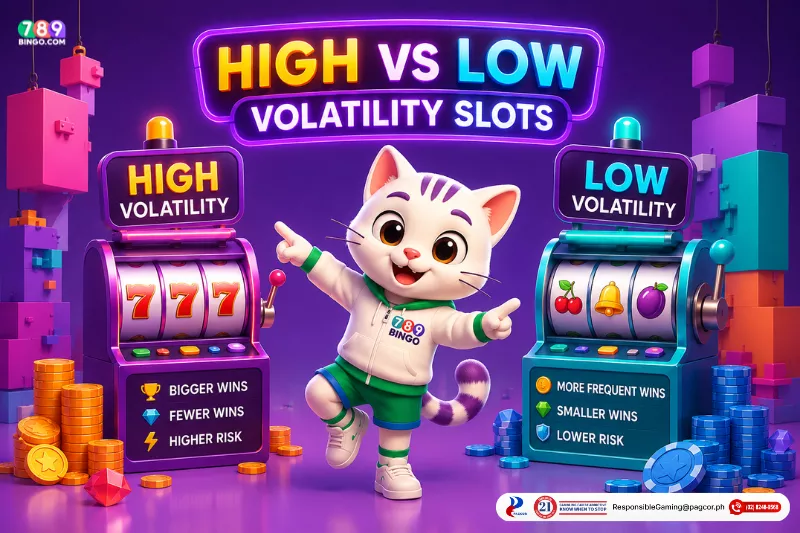
While the RNG ensures your spin is completely random, it is the game’s volatility setting that dictates the size of your potential rewards. Check out our guide on high vs. low volatility slots to see how these settings impact your hit frequency.
PAGCOR and the Philippine Regulatory Framework
PAGCOR provides robust oversight for all licensed operators in the Philippines.
Key requirements:
- All games must use certified RNGs.
- Operators must submit marketing programs for approval.
- Regular audits ensure compliance.
- Player funds are segregated from operational accounts.
- Responsible gambling tools are mandatory.
PAGCOR Technical Standards:
The regulator’s standards mandate:
- The RNG must operate continuously between games.
- Games cannot adjust likelihood based on past outcomes.
- Maximum advertised payout must occur at least once in 100,000,000 games statistically.
- Theoretical RTP must fall between 75% and 98%.
The “PAGCOR Guarantee“: The regulator provides a platform for players to verify if an operator is licensed. This builds transparency and accountability.
Why This Matters for 789Bingo Players
At 789Bingo, we operate under PAGCOR’s strict regulatory framework.
What this means for you:
- Certified games: Every slot uses an RNG tested by independent labs.
- Transparent terms: We don’t hide conditions or manipulate outcomes.
- Player protection: Your funds are safe. Your play is fair.
- Responsible tools: Deposit limits, time limits, self-exclusion options.
Our game providers: We partner with JILI, Pragmatic Play, CQ9, and others. These providers are industry leaders. Their RNGs are certified. Their games are audited.
Your experience: When you spin at 789Bingo, you’re playing certified, regulated, and independently verified games. The outcome is random. The math is fair. The operator can’t interfere.
Final Thoughts
Understanding how slot RNG works isn’t just technical trivia. It protects you from myths and misconceptions. It helps you play with confidence. The underlying math is the first step toward playing smarter. Return to our main Gambling Slots Hub for a full directory of game mechanics and expert reviews.
At 789Bingo, we believe in transparency. Our games are certified. Our RNGs are tested. Our PAGCOR license ensures compliance. You’re not guessing about fairness. You’re playing a system designed and regulated to be fair.
Key takeaways:
- Every spin is independent. No “due” payouts.
- Certified RNGs guarantee randomness.
- PAGCOR regulates and audits all licensed operators.
- Play with confidence at 789Bingo.
The next time you spin, you’ll know exactly what’s happening behind the screen. And you’ll know it’s fair.
By 789Bingo Team
Frequently Asked Questions
How do online slot machines generate outcomes?
They use a Pseudo-Random Number Generator (PRNG). The system continuously generates numbers. When you hit spin, the latest number maps to a reel position. The result displays instantly. Previous outcomes don't affect future spins.
Who tests online slot RNG fairness?
Independent labs like eCOGRA, GLI, and iTech Labs. They verify randomness, bias, and integrity. They also test payout math. PAGCOR requires certification for all licensed operators.
Can casinos control online slot payouts?
No. Not in regulated markets. RNGs are certified and fixed. Operators can't adjust outcomes. Any change requires recertification.
Are online slots rigged?
No. Rigging is illegal in regulated markets. Operators face severe penalties. Independent testing ensures fairness. PAGCOR oversees compliance.
What's the difference between RNG, RTP, and volatility?
| Concept | What It Controls | Player Impact |
|---|---|---|
| RNG / PRNG | Generates raw numerical combinations per millisecond. | Guarantees every single spin is 100% random and independent. |
| RTP (Return to Player) | Statistical payout percentage calculated over millions of spins. | Determines the theoretical long-term house edge (e.g., 96% RTP = 4% edge). |
| Volatility / Variance | Measures payout frequency and distribution size. |
High Volatility: Rare, large payouts. Low Volatility: Frequent, smaller payouts. |
- RNG: Determines each spin's random outcome.
- RTP: Long-term payback percentage. A 96% RTP means the game returns 96% of all bets over infinite spins.
- Volatility: Describes win patterns. Low volatility means frequent small wins. High volatility means rare large wins.
Does playing at a certain time improve odds?
No. RNGs work 24/7. Time has no impact on outcomes.











Leave a Reply