

D Sic Bo is a live dealer dice game by SA Gaming available through 789Bingo. Players predict the results of three six-sided dice using betting options such as Big, Small, Odd, Even, exact totals, pairs and triples. This guide explains the rules, payouts and the provider’s published maximum RTP of 97.22%.
Each round uses three six-sided dice inside a shaker. Before betting closes, players select predictions from the available betting board. Winning conditions depend on the dice total, individual faces, matching numbers or specific combinations.
This exception affects the theoretical return of the four main 1:1 bets and helps explain the published 97.22% maximum RTP.
Why D Sic Bo Works as a Casino Game Online
Quick Stats: Three six-sided dice | Maximum RTP 97.22% | Specific Triple pays 180:1
SA Gaming identifies the specific D Sic Bo table as Sic Bo D, Host ID 925 in its official host mapping. The same provider documentation separately lists Sic Bo M as Host ID 532, confirming that D is a distinct table instance even though SA Gaming publishes one common Sic Bo ruleset for the underlying game.
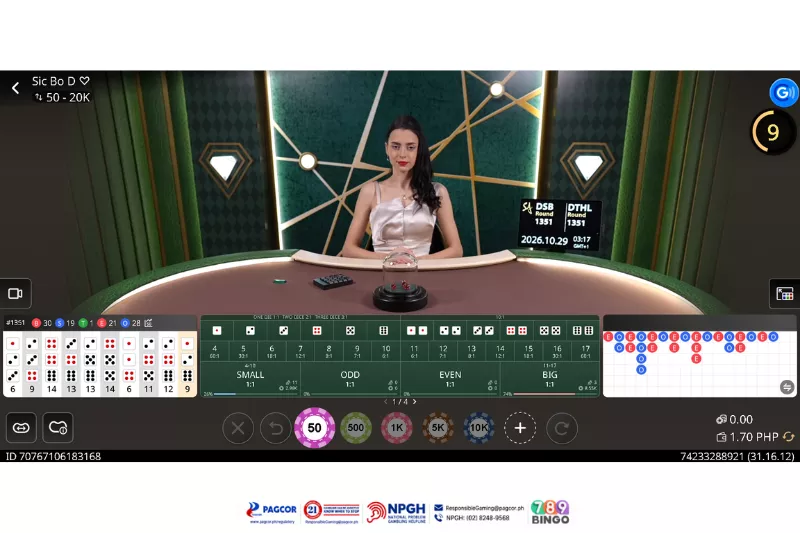
Each round begins with a betting countdown, during which multiple predictions can be placed across the board. After betting closes, the dealer activates the dice shaker, the three dice tumble, and their individual values from 1 to 6 determine both the total and any qualifying combination bets.
The total can range from 3 to 18, but many wagers care about more than the sum. A 4-4-4 result, for example, totals 12 but is also a Triple, while 1-4-5 totals 10 and can simultaneously satisfy specific total and three-number combination conditions depending on the bets placed.
This layered settlement makes Sic Bo different from a simple high-low dice game. One three-dice result can contain information about total, parity, repeated numbers and exact combinations at the same time, which is why the table supports a much larger group of betting positions than the four main Big, Small, Odd and Even options.
Three Dice, Bet Types and Maximum RTP
Specification | Details |
|---|---|
Software Provider | SA Gaming |
Game Type | Live dealer dice game |
Table | D Sic Bo |
SA Gaming Host ID | 925 |
Dice | Three standard six-sided dice |
Possible Total | 3 to 18 |
Main Even-Money Bets | Small, Big, Odd and Even |
Highest Published Payout | 180:1 on a Specific Triple |
Maximum Published RTP | 97.22% |
Bet Range | Verify inside the active 789Bingo table |
SA Gaming states that the maximum RTP for its Sic Bo game is 97.22%. The provider does not state that every position on the board shares that return, and the paytable clearly shows why different wagers cannot be treated as mathematically identical.
The four broad bets sit at the top of the theoretical-return range because they cover many possible dice outcomes. Narrower predictions such as exact triples or specific totals pay much more when successful, but their qualifying outcomes occur less frequently.
That distinction is useful when evaluating any casino game online with several wager types. A larger displayed payout measures how much one successful result can return, while RTP measures theoretical value across repeated wagers; those are related concepts, but they are not interchangeable.
SA Gaming does not publish one universal volatility label for D Sic Bo, so assigning the game a fixed low, medium or high volatility rating would be misleading. The practical risk profile depends heavily on whether the player uses broad 1:1 bets or concentrates on rarer 30:1, 60:1 or 180:1 outcomes.
Small and Big Both Lose on Triples
Small wins when the three dice total 4 through 10, provided the result is not a Triple. Big covers totals 11 through 17 under the same exception, and both positions pay 1:1 when successful.
The Triple rule is what prevents these two wagers from acting like a simple fifty-fifty division of the possible totals. A result such as 2-2-2 has a total of 6, which falls inside the normal Small range, but Small loses because all three dice match.
Similarly, 4-4-4 totals 12 and would ordinarily fit Big. Because the result is a Triple, the Big wager loses instead.
Three six-sided dice create 216 equally possible ordered outcomes, calculated as 6 × 6 × 6. Small wins on 105 of those outcomes and loses on the remaining 111; Big has the same mathematical structure on the opposite side of the total distribution.
At a 1:1 payout, 105 successful outcomes out of 216 produce a theoretical return of approximately 97.22%. That directly matches SA Gaming’s published maximum RTP and explains why Big and Small are among the strongest-return positions on the table.
A streak of Small or Big results does not change those underlying rules. Previous outcomes can be displayed in the game statistics, but the next three dice still need to complete a new valid result before any wager settles.
Odd and Even Use the Same Triple Except
Odd wins when the sum of the three dice is an odd number, while Even wins when the sum is even. Both pay 1:1, but SA Gaming again excludes all Triple results from winning either position.
For example, 1-2-4 totals 7 and qualifies as Odd. A result of 2-4-6 totals 12 and qualifies as Even, but 3-3-3, despite totaling 9, causes the Odd wager to lose because it is a Triple.
That rule gives Odd and Even the same 97.22% maximum theoretical return structure as Big and Small. Each parity group would contain half of all dice outcomes without the exception, but removing the relevant Triple wins leaves 105 successful outcomes from the 216 possible combinations.
This is another reason the simple wagers deserve more explanation than their 1:1 payout suggests. In this casino game online, the word “Odd” does not mean every mathematically odd total wins, and “Even” does not mean every mathematically even total wins; the Triple override always comes first.
When reading a completed round, identify whether all three dice match before classifying the main wagers. If they do, Small, Big, Odd and Even all lose regardless of the numerical total or parity.
Specific Number Bets Count Repeated Dice
Specific Number allows a player to choose one face from 1 through 6 and win according to how many times that number appears. SA Gaming pays 1:1 when the chosen number appears once, 2:1 when it appears twice and 3:1 when all three dice show it.
Suppose the selected number is 4. A result of 4-1-6 contains one 4 and pays 1:1, while 4-4-2 contains two and pays 2:1; 4-4-4 contains three matching dice and reaches the 3:1 tier for that Specific Number wager.
The Triple result does not invalidate a Specific Number prediction. The Triple exception applies specifically to Small, Big, Odd and Even, so different wagers can respond differently to the exact same roll.
A 4-4-4 outcome can therefore lose a Big wager while simultaneously winning a Specific Number 4 position and a Specific Triple 4 position if those wagers were placed before the roll. Sic Bo settlement depends on each selected betting condition rather than assigning one universal meaning to the dice result.
This is also why spreading money across multiple sections of the table increases total round exposure quickly. A player may have several chances to match one roll, but every chip placed remains a separate wager with its own payout and house edge.
Specific Triple Pays the Highest Listed 180:1
A Specific Triple predicts that all three dice will show one exact number, such as 1-1-1, 3-3-3 or 6-6-6. SA Gaming publishes a 180:1 payout for a successful Specific Triple.
There are six different Specific Triple choices because there are six possible die faces. Each individual triple corresponds to only one ordered outcome among the 216 combinations available from three dice.
For example, a bet on Triple 5 wins only on:
5-5-5
A result of 5-5-4 does not qualify, even though it contains two selected numbers. The payout is much larger because the condition is substantially narrower than a Big, Small or Specific Number wager.
The 180:1 figure should not be presented as a universal “maximum win” for D Sic Bo. It is the highest published single-bet payout in SA Gaming’s Sic Bo paytable, and actual cash winnings still depend on the amount wagered and the active 789Bingo table limits.
A casino game online can display a large payout without that wager having the highest RTP. Specific Triple illustrates the distinction clearly: the potential reward is much larger than 1:1, but the qualifying outcome is only one exact result from the full three-dice sample space.
Any Triple Covers All Six Matching Results
Any Triple is broader than a Specific Triple. Instead of choosing one exact number, the bet wins if all three dice match each other, regardless of which face appears.
The six winning possibilities are:
1-1-1, 2-2-2, 3-3-3, 4-4-4, 5-5-5 and 6-6-6
SA Gaming pays 30:1 for Any Triple.
Because six of the 216 possible dice outcomes qualify, Any Triple occurs more often than one Specific Triple but pays less. The relationship is logical: expanding the group of winning outcomes reduces the payout attached to each success.
Any Triple also demonstrates why one roll can settle several positions at once. A result of 6-6-6 can qualify for Any Triple, Specific Triple 6, Pair 6 and Specific Number 6 while simultaneously making all Small, Big, Odd and Even wagers lose.
The dice are not rerolled separately for each position. Every active bet is evaluated against the same final three-dice result.
Exact Totals Pay From 6:1 to 60:1
Specific Total bets predict the combined score of the three dice. SA Gaming offers wagers from total 4 through 17, with payouts increasing as the selected total becomes less common.
Totals 4 or 17 pay 60:1, while 5 or 16 pay 30:1 and 6 or 15 pay 18:1. Totals 7 or 14 pay 12:1, 8 or 13 pay 8:1, 9 or 12 pay 7:1, and the central totals 10 or 11 pay 6:1.
The changing payout follows the shape of the three-dice probability distribution. Middle totals such as 10 and 11 can be produced by many more combinations than extreme totals such as 4 and 17, so their successful payout is lower.
For example, total 4 can be produced only by:
1-1-2, 1-2-1 and 2-1-1
while total 10 has many more possible ordered combinations. The exact faces may differ, but every qualifying combination contributes to the same Specific Total wager.
This structure is one reason Sic Bo can look complicated at first. The board contains many payouts, yet most of them come from a simple principle: the more narrowly a bet defines the next three-dice result, the less frequently it can qualify and the larger its listed payout tends to become.
Pairs and Two-Number Combinations Are Not the Same Bet
SA Gaming publishes a Pair wager that predicts one selected number appearing on at least two of the three dice. A Pair of 3s, for example, wins on results containing at least two 3s and pays 10:1.
This should not be confused with the provider’s Specific Double category. SA Gaming describes Specific Double as selecting a combination of two different numbers, with 15 available combinations such as 1&2, 2&5 or 3&6, and pays 5:1.
A result can therefore satisfy one category without satisfying the other. 3-3-5 contains a Pair of 3s, while 3-5-6 contains several different-number relationships but no repeated 3.
These labels matter when comparing the betting grid with another Sic Bo implementation because providers sometimes use terms such as Double, Combination or Two Dice differently. The SA Gaming rules should control the terminology on the D Sic Bo page rather than importing labels from another casino game online.
The same caution applies when explaining payouts. A 10:1 Pair payout should not be attached to a different-number combination, and the 5:1 Specific Double figure should not be described as the payout for two identical dice.
Three Single and Double-Single Bets Add Exact Combinations
The 3 Single wager predicts a particular set of three different numbers. SA Gaming lists 20 such bets, with examples including 1-3-4, 4-5-6 and 1-4-5, and pays 30:1 when the three dice match the selected combination.
Because all three numbers are different, their physical order in the shaker can vary while still representing the same selected set. A 1-3-4 prediction, for example, can be produced in several arrangements such as 1-3-4, 4-1-3 or 3-4-1.
Specific Double and Single goes in another direction. The player predicts one repeated pair plus one particular different number, such as 2-2-3, 4-4-5 or 6-6-3, and SA Gaming lists a 60:1 payout.
There are 30 Specific Double and Single betting positions in the official rules. A wager on 2-2-3 does not win when the dice show 2-2-4 because the single die is part of the required prediction.
These exact-combination wagers can produce visually large payouts, but they also narrow the set of acceptable outcomes. Treating them as alternatives to broad Big or Small predictions makes more sense than ranking them by payout alone.
All Odd, All Even and Mixed-Parity Bets
SA Gaming also allows predictions about the parity pattern of the individual dice, not only the parity of their total. All Odd wins when all three dice are odd, while All Even requires three even dice, and both pay 6:1.
The table also offers 2 Odd 1 Even and 2 Even 1 Odd at 3:2. These positions classify each die separately rather than asking whether the sum itself is odd or even.
For example:
1-3-6 contains two odd dice and one even die.
Its total is 10, which is Even, but the individual-dice pattern qualifies as 2 Odd 1 Even.
A player could therefore have an Even total wager and a 2 Odd 1 Even wager active on the same roll, and both can qualify if no separate rule invalidates them. This illustrates how a casino game online can create multiple betting layers from the same three physical dice without changing the underlying result.
The broader lesson is to read the condition written on the betting position rather than infer it from a similar-sounding name. “Odd” describes the total, while “All Odd” and “2 Odd 1 Even” describe the individual dice.
Four Number Bets Cover Selected Number Groups
SA Gaming lists four 4 Number positions: 1-2-3-4, 2-3-4-5, 2-3-5-6 and 3-4-5-6. The provider publishes a 7:1 payout for this category.
This is a provider-specific part of the board, so the exact qualifying display should be read directly from the active table. The important editorial point is not to replace SA Gaming’s published terminology with a superficially similar Sic Bo bet from another studio.
Different providers can organize combination wagers differently even when their games all use three dice. D Sic Bo should therefore use SA Gaming’s own names and payouts consistently throughout the page.
That also helps distinguish this page from other Sic Bo variants at 789Bingo. If another provider offers a different combination grid, the pages should explain those actual differences rather than sharing one generic Sic Bo paytable.
What Happens When the Dice Do Not Settle Properly?
SA Gaming publishes specific handling rules for an invalid physical dice state. If dice overlap or one or more dice are not lying flat after the shake, the dealer performs a re-shake rather than treating the unclear position as the final result.
The provider also requires the dice to tumble sufficiently inside the shaker. If they tumble fewer than three times, a re-shake is performed.
Confirmed bets remain tied to the round during these procedural corrections. The objective is to obtain a valid three-dice result that can be read and settled consistently, not to allow wagers to be changed after the betting window has already closed.
If a wider system or game issue cannot be resolved quickly, SA Gaming states that the round can be cancelled and the bets returned. These procedures matter in a live casino setting because the game depends on physical dice rather than an animation alone.
Starting a D Sic Bo Round on 789Bingo
Open the 789Bingo live casino section and locate D Sic Bo. Check the current PHP minimum and maximum inside the live table because SA Gaming supports operator-specific bet-limit configurations and another casino’s limits should not be copied onto the 789Bingo page.
Start by choosing which type of outcome you actually want to predict. Big, Small, Odd and Even are broad 1:1 positions, while totals, pairs, combinations and triples require more specific results and carry different payouts.
Place the selected wagers before the countdown ends, then wait for the dealer to activate the dice shaker. Once betting closes, the confirmed positions remain active until the valid result is determined.
When the dice settle, first check whether the result is a Triple if you have Big, Small, Odd or Even wagers. Then evaluate the total, individual faces, repeated numbers and exact combinations for any other positions.
A casino game online with this many bet types can make total exposure easy to underestimate. Five ₱100 wagers across different sections mean ₱500 has been committed to the same roll even if each individual chip still appears small on the layout.
Pro Tip: Use the published 97.22% maximum RTP as a reminder that wager choice matters. Broad 1:1 positions and rare exact combinations do not have the same mathematical profile, so decide the total amount you are willing to risk per roll before spreading chips across the board.
Statistics Track the Previous 50 Rounds
SA Gaming states that the Sic Bo statistics chart reflects results from the previous 50 rounds. The display can help players review recent Big, Small, Odd, Even, total or combination patterns depending on what the interface chooses to show.
Those statistics are historical information, not a guarantee about the next dice result. A sequence of Small outcomes does not force Big to appear, and a long period without a Triple does not make a Triple mathematically due on the next shake.
The gambler’s fallacy becomes especially tempting in Sic Bo because the result history can form visible streaks. The three dice still need to produce a new physical outcome, and previous rounds do not create a debt that the next roll must repay.
This applies equally to exact totals. If 10 has appeared several times recently, that history alone does not prove that another 10 is more likely or less likely on the next completed shake.
Managing a D Sic Bo Session Responsibly
D Sic Bo can move quickly because players make all decisions before the dice are shaken and no additional Hit, Stand or card-drawing decisions interrupt the round. Fast settlement can increase the number of wagers placed during a session even when the stake per chip remains unchanged.
Set both a per-roll limit and a session limit before starting. If the budget is ₱500 per round, spreading five ₱100 chips across the board already reaches that amount, regardless of whether the selections cover Big, totals, pairs or triples.
Avoid increasing stakes because an exact total nearly matched or because a Triple has not appeared recently. Near misses do not change the probability of the next result, and historical statistics do not guarantee that a missing outcome is about to occur.
The same rule applies after a winning high-payout combination. One 30:1, 60:1 or 180:1 result does not make another rare outcome more likely on the following shake, so it should not be used as a reason to increase the next wager automatically.
Use disposable entertainment funds rather than money reserved for bills, savings, debt or essential expenses. Deposit caps, session reminders, timeouts and self-exclusion tools can help keep play within predetermined limits.
Gambling can be addictive; know when to stop.
D Sic Bo Frequently Asked Questions
What is the RTP of D Sic Bo?
SA Gaming publishes a maximum RTP of 97.22% for its Sic Bo rules. That figure aligns with the broad Big, Small, Odd and Even wagers when the provider's Triple-loss rule is included, but it should not be applied automatically to every exact total, pair or triple bet.
Different betting positions have different winning conditions and payouts, so their theoretical returns vary. The safest technical wording is therefore Maximum Published RTP: 97.22% rather than suggesting the whole board uses one fixed RTP.
Why do Big and Small lose on a Triple?
SA Gaming explicitly states that all Small, Big, Odd and Even wagers lose when the result is a Triple. A 2-2-2 roll therefore does not win Small even though its total is 6, and 4-4-4 does not win Big even though its total is 12.
That exception creates the casino advantage on these 1:1 bets. Without it, the broad sides of the three-dice distribution would behave much closer to an even division of outcomes.
What is the highest payout in D Sic Bo?
The highest payout listed in SA Gaming's current Sic Bo rules is 180:1 for a Specific Triple. The player must correctly choose the exact number that appears on all three dice, such as 5-5-5.
Any Triple pays less at 30:1 because it accepts six possible matching results instead of only one. The 180:1 figure should be described as the highest listed bet payout, not as a universal maximum cash win.
Compare D Sic Bo with Other Casino Game Online Formats
D Sic Bo‘s identity comes from turning one three-dice shake into several different types of predictions. A player can focus on broad totals and parity, choose an individual number, predict an exact total or move toward increasingly narrow pair, combination and Triple conditions.
That structure separates it from roulette, baccarat and blackjack even though all appear within the same live casino category. Players who prefer dice-based outcomes can also compare D Sic Bo with other Sic Bo, Thai HiLo and dice-table formats through the 789Bingo live casino collection.
The most important rule remains the simplest one to remember: Big, Small, Odd and Even all lose on a Triple. From there, every other wager can be understood by asking what exactly the three dice must show and what SA Gaming pays when that condition occurs.
D Sic Bo also should not be treated as mechanically different from Sic Bo M unless the live interface shows a verified table-specific distinction. SA Gaming’s official host mapping identifies D Sic Bo as Host ID 925 and Sic Bo M as Host ID 532, while its current rules page provides one shared Sic Bo ruleset rather than separate mathematical rules for each studio table.
For anyone evaluating a casino game online through its mathematics rather than only its largest payout, D Sic Bo offers a clear trade-off. The broadest wagers reach SA Gaming’s 97.22% maximum published RTP, while narrower predictions trade frequency for higher listed payouts that can reach 180:1 on one exact Triple.
Gambling can be addictive; know when to stop.
789Bingo promotes Responsible Gaming for players aged 21+ only. Gambling can be addictive; know when to stop. For help, contact NPGH: (02) 8248-9568 or [email protected]











Leave a Reply