
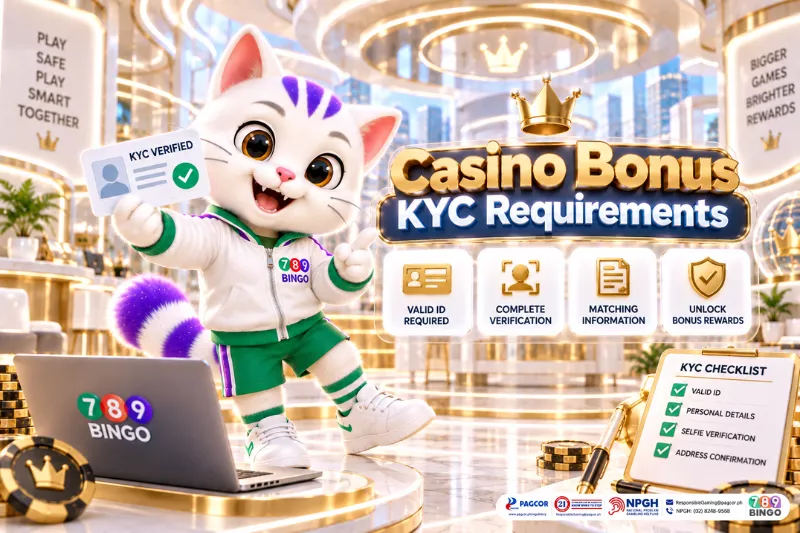
Casino bonus KYC requirements connect two parts of online gambling that players sometimes treat as separate: identity verification and promotional eligibility.
They are not the same rule.
Know Your Customer, or KYC, establishes who owns an account, whether that person meets the legal age requirement, and whether the information submitted during registration can be verified. A casino bonus then adds its own eligibility conditions, such as first-deposit status, one-account restrictions, valid betting activity or reward-specific qualification.
One can affect the other.
A player may qualify for a bonus mathematically yet remain unable to receive, use or withdraw the resulting reward because identity verification remains incomplete. Another player may pass KYC but fail the promotion rules because the account already claimed a new-player offer.
For PAGCOR-regulated online gaming in the Philippines, KYC is not merely an optional casino preference. PAGCOR’s Gaming System Administrator framework, effective October 2, 2025, requires KYC for all players as a continuing process. Full identity verification must occur before the first withdrawal or cash-out request, or within three days from registration, whichever happens first. Failure to complete KYC within that period results in account suspension until verification finishes.
That timing answers a common question.
You should not assume that being allowed to register, deposit or receive a promotional message means the account has completed KYC.
Verification remains its own process.
For a wider look at 789Bingo promotions and bonus types, see the 789Bingo bonus and promo guide.
Casino Bonus KYC Requirements at a Glance
KYC check | What it generally confirms | Why it can affect a bonus |
Legal identity | The account belongs to a real person | Prevents false or duplicate claims |
Date of birth | Player meets the age requirement | Underage players cannot qualify |
Government-issued ID | Registration details match official identification | Helps validate account ownership |
Selfie or identity image | Person presenting the ID matches the account holder | Helps detect stolen or borrowed identities |
Restricted-person screening | Player is not listed as restricted | Restricted persons cannot use eligible gaming accounts |
Account information | Name and other details remain consistent | Mismatches can delay reward review |
Payment ownership | Funding and withdrawal details may need verification | Helps reduce third-party payment risk |
Continuing KYC | Information may require review after registration | Verification does not necessarily end after one check |
The exact documents or extra checks can depend on the operator, risk assessment and applicable rules.
Do not treat a generic international KYC checklist as an automatic list of documents every Philippine player must submit.
PAGCOR’s rules come first.
What Does KYC Mean in an Online Casino?
KYC means Know Your Customer.
The process allows a gaming operator to establish that the person using an account matches the identity information attached to it.
PAGCOR’s current Gaming System Administrator framework requires initial player information that includes the person’s full name, date of birth, contact information, a valid government-issued ID and a selfie holding the submitted ID, or another verification method PAGCOR’s Electronic Gaming Licensing Department accepts as compliant.
The regulator also requires KYC as a continuing process rather than a single checkbox completed once and forgotten.
That matters.
An account can pass initial registration checks and still face another identity review later if the casino needs to resolve a mismatch, withdrawal request or other compliance issue.
Industry identity-verification provider IDnow describes KYC more broadly as a system used by online gambling companies to check a customer’s identity and age, assess whether identity documents appear legitimate and identify relevant risk factors. It also notes that casinos may request identification documents and, in some cases, photographs or video selfies.
Those are industry practices, not a substitute for Philippine rules.
For 789Bingo content, use PAGCOR’s requirements as the regulatory reference and vendor material only to explain how modern identity technology works.
When Does PAGCOR Require Full KYC?
This is where older casino articles can easily publish stale information.
An earlier PAGCOR remote-gaming framework stated that full KYC had to occur before the first withdrawal or within seven days after registration, whichever came first.
The newer Gaming System Administrator framework effective October 2, 2025 uses a three-day period.
Under that newer document, full KYC and identification verification must occur:
before the player’s first withdrawal or cash-out request
or
within three days from registration or sign-up
whichever comes first.
Consider two simple cases.
A player registers Monday and tries to withdraw on Tuesday.
The first withdrawal arrives before the three-day deadline. Full KYC therefore becomes relevant before that cash-out proceeds.
Another player registers Monday and does not request a withdrawal.
The three-day KYC period still applies. The player does not gain an indefinite verification window merely because no withdrawal has been requested.
PAGCOR states that failing to complete the process within the prescribed period results in account suspension until KYC verification finishes.
That’s more precise than saying:
“Casinos only ask for KYC when you withdraw.”
For PAGCOR-regulated platforms operating under the cited framework, that statement would be incomplete.
Why Do Players Associate KYC With Withdrawals?
Because withdrawal is often the moment identity verification becomes impossible to ignore.
A long Bitcointalk discussion supplied for this article shows the frustration clearly. Forum users described gambling sites that allowed registration and deposits with limited information, then presented full identity requirements when users attempted withdrawals. Several posters argued that casinos should disclose those requirements earlier because players may otherwise assume that no identity check will happen.
Those posts are personal opinions and anecdotes.
They do not establish Philippine law.
Still, they identify a genuine communication problem: registration friction and withdrawal verification can happen at different stages, which can make KYC feel like a newly invented restriction even when the requirement already existed in the operator’s terms.
PAGCOR’s newer framework addresses part of that concern. It places responsibility on the Gaming System Administrator to notify prospective players about the three-day continuing KYC process to reduce problems caused by a later failed registration.
We think that distinction belongs near the top of any bonus guide.
A player should know the verification deadline before depositing, wagering or earning a promotional balance.
Not after.
Why Does KYC Affect Casino Bonuses?
A bonus often depends on who the player is.
Welcome offers illustrate the problem.
Suppose an operator gives one first-deposit reward per eligible player. Without identity checks, one person might try to create several accounts using different email addresses, phone numbers or payment methods.
The account names look different.
The person behind them may be the same.
Industry verification provider iDenfy identifies multi-accounting and promotional abuse among the fraud risks that gaming companies use identity checks to detect. It also notes that operators may compare account information and other signals when investigating whether several accounts belong to one person or connected users.
The important qualification: KYC does not automatically prove bonus abuse.
It provides information that helps the operator determine whether the account holder satisfies the rules.
A mismatch needs investigation.
It is not itself a mathematical verdict.
KYC and Bonus Eligibility Are Different Tests
This distinction deserves its own section because casino copy frequently mixes the two.
KYC asks:
Who is this player?
Bonus eligibility asks:
Does this verified player satisfy this promotion?
A player could pass KYC but still fail bonus eligibility.
Examples may include:
- the promotion only applies to new players
- the account already claimed the offer
- the qualifying deposit did not meet the stated amount
- the promotion had already expired
- required valid betting activity was not completed
- the account failed another stated promotion condition
The reverse can also happen.
A player might apparently meet the promotional conditions based on deposit or wagering activity but remain unable to receive the benefit because required identity verification remains unfinished.
Do not collapse these questions into one.
It makes customer-support disputes harder to diagnose.
What Information Does PAGCOR Require for Player Registration?
PAGCOR’s current Gaming System Administrator framework identifies several initial registration items.
These include:
- full name
- date of birth
- contact information
- valid government-issued ID
- a selfie holding the submitted government-issued ID, or another accepted verification method
The framework also requires the Gaming System Administrator to connect its system with PAGCOR’s National Database of Restricted Persons, or NDRP.
A separate PAGCOR framework for gaming affiliates and support-service providers states that only people aged 21 or above, who are not among prohibited personalities under the applicable rules, may register. It likewise requires use of the NDRP to prevent registration or continue-account access for listed persons.
That gives KYC several jobs at once.
It checks identity.
It verifies age.
It supports restricted-person screening.
And for promotional programs, it helps the operator confirm that the person claiming the reward actually qualifies.
Why Does a Casino Need a Selfie With an ID?
An ID document alone can answer only part of the identity question.
A stolen ID still contains genuine-looking information.
The operator therefore needs a method to check whether the person presenting the document matches the claimed identity.
PAGCOR’s current framework permits verification methods that can include identity technology such as automatic biometric identification, document scanning and validation, and liveness-detection tools.
Liveness checks try to determine whether the system is interacting with a real person rather than a static photograph or another basic presentation attack.
ID scanning performs a different job. It reads and tests information from the submitted document.
Face comparison can then help determine whether the submitted selfie and identity document correspond.
Technology provider IDnow describes this type of process as a way to verify identity documents and connect them with the person submitting them. iDenfy likewise describes identity, document, age and facial-verification checks as common tools in online gaming.
The technologies can work together.
They don’t answer the same question.
Does KYC Mean a Casino Can Ask for Any Document?
No sensible guide should claim that.
Identity requirements depend on the regulator, operator procedures, account circumstances and the type of review taking place.
IDnow says international gambling operators commonly request government-issued IDs and, depending on the jurisdiction and risk process, may also use proof-of-address or other information.
iDenfy describes broader international KYC checks that can involve identity, age, address and source-of-funds review.
Those examples explain global KYC practice.
They do not establish that every 789Bingo player must submit a utility bill, payslip, bank statement or source-of-funds record just to claim every bonus.
For Philippine-facing content, say only what the applicable PAGCOR framework or the operator’s current verification process supports.
If extra verification becomes necessary, the player should receive instructions through the official account or support channel.
Why Name Mismatches Cause Problems
A simple spelling mismatch can cause more friction than players expect.
Imagine these records:
Casino registration: Juan Miguel Dela Cruz
Government ID: Juan M. dela Cruz
GCash account: Juan Miguel Cruz
A verification system now has to decide whether the difference reflects normal formatting, incomplete data or a different person.
The player knows the answer.
The system doesn’t.
This becomes more serious if the date of birth differs, the payment method belongs to another person or the identity document does not match the account holder.
The clean approach is simple: register using accurate legal information.
Avoid nicknames when the form expects a legal name. Check the date of birth before submitting. Use contact and payment information that satisfies the operator’s account rules.
Fixing bad data later is usually more work.
KYC and the Legal Gambling Age in the Philippines
PAGCOR’s current electronic-gaming framework permits registration only for people aged 21 and above who are not among prohibited persons.
So age verification serves more than a marketing function.
A welcome bonus cannot lawfully turn an underage user into an eligible player.
“Free” does not change the age restriction.
Neither does a no-deposit structure.
Industry KYC providers make the same general point from a technology angle. IDnow lists age verification as a primary function of gambling KYC, while iDenfy identifies protection against underage access as one reason gaming operators verify identity.
For 789Bingo bonus content, keep the wording direct:
Promotional eligibility never overrides player eligibility.
KYC and the National Database of Restricted Persons
PAGCOR does not rely only on self-declared identity information.
Its current framework requires connection with the National Database of Restricted Persons.
The system helps identify people who should not register or whose gaming access requires suspension or cancellation under applicable rules.
That means identity verification has a second purpose beyond checking whether the ID looks real.
The operator also needs to determine whether that verified person may legally participate.
For bonuses, the logic follows.
A promotional banner cannot grant eligibility to someone whom the regulated gaming system may not serve.
Can KYC Detect Multiple Bonus Accounts?
Identity verification can help operators identify duplicate or suspicious account relationships.
It should not be described as a magic duplicate-account detector.
A KYC process starts with personal identity. Fraud systems may then compare other account and transaction signals according to the operator’s controls.
iDenfy specifically discusses multi-accounting in gaming, including attempts to create several accounts for promotional abuse. The company describes identity checks as one mechanism that can help operators detect such activity.
A reasonable bonus rule might therefore restrict a reward to one eligible account or one verified player.
The exact 789Bingo promotion terms still matter.
Don’t invent a household restriction, device restriction or IP rule unless the offer actually states one.
Why KYC Should Happen Before a Bonus Dispute
From a risk perspective, early verification reduces uncertainty.
Suppose a player registers, deposits, claims a welcome reward, completes 10x wagering and then discovers that the name on the account does not match the government ID.
Now several issues collide:
- deposited money
- bonus credit
- bonus-derived winnings
- account ownership
- withdrawal eligibility
- promotion qualification
Messy.
KYC before substantial promotional activity makes those questions easier to separate.
The Bitcointalk discussion shows why players dislike being surprised by identity requirements at cash-out. Several contributors said they preferred casinos to make KYC expectations clear early rather than allow prolonged play before requesting verification.
For PAGCOR-regulated Philippine platforms, the newer three-day KYC rule already pushes verification toward the beginning of the account relationship rather than leaving it indefinitely until a major withdrawal.
Does KYC Guarantee a Bonus Withdrawal?
No.
Passing KYC solves the identity-verification question.
It does not automatically satisfy:
- wagering requirements
- valid-game rules
- bonus expiration
- maximum cashout rules
- deposit requirements
- promotion-specific eligibility
- account-security reviews
Think of KYC as one gate.
A bonus can have several.
If identity verification has finished but a withdrawal remains unavailable, move to the next diagnostic question instead of resubmitting the same ID repeatedly.
The casino bonus withdrawal issues guide covers those causes separately.
What Happens If KYC Is Not Completed?
Under PAGCOR’s Gaming System Administrator framework effective October 2, 2025, failure to complete KYC within the prescribed period results in suspension of the account until verification finishes.
That is more precise than saying:
“Your bonus gets automatically confiscated.”
Do not make that universal claim.
Account suspension, bonus eligibility and treatment of particular funds are separate questions. The framework also contains procedures for certain non-qualified players, but the result depends on the player’s situation and regulatory review.
For an article about bonuses, the safe practical conclusion is this:
Incomplete KYC can prevent normal account use and can stop a player from reaching the stage where a bonus-related withdrawal can proceed.
Complete verification promptly.
Why "No KYC Casino" Claims Need Care
“No KYC” sounds convenient.
Less paperwork. Faster registration. No ID photo.
But a marketing phrase does not override a regulator’s rules.
iDenfy notes that some international platforms use partial or delayed verification, where a player may not complete document-based checks at account creation but can face them later, such as during withdrawal or a higher-risk event.
The Bitcointalk thread shows why users often interpret that structure as “no KYC” during registration, then feel misled when the withdrawal screen requests identity documents.
For PAGCOR-regulated platforms covered by the current framework, KYC is required for all players and remains continuous.
So “no KYC” should not be used casually in Philippine casino content where a regulated platform must conduct identity verification.
KYC Technology Does Not Remove Human Review
Automation makes verification faster, but it does not eliminate exceptions.
A system may read an ID automatically.
Then something fails.
Maybe glare hides part of the document. A selfie is blurry. A surname differs between records. The document has expired. The automated confidence score is too low.
Now a manual reviewer may need to check the case.
IDnow points out that operators need to balance security with an onboarding process that does not drive legitimate players away through unnecessary friction.
That is the technology problem in one sentence.
Strong checks matter.
Badly designed checks can still produce a lousy customer experience.
For bonus operations, the best process tells the player exactly what failed and what they need to correct.
What Players Should Check Before Submitting KYC
Use a short checklist.
- Make sure the account contains your correct legal name.
- Confirm the birth date matches your ID.
- Use a valid government-issued identification document accepted by the platform.
- Submit a clear image.
- Follow the selfie or liveness instructions exactly.
- Use the official casino verification page or authorized support process.
- Check whether your KYC status says pending, approved or rejected.
- If rejected, read the stated reason before uploading another file.
Randomly resubmitting five copies of the same bad photo rarely fixes anything.
Read the error first.
KYC Requirements for 789Bingo Level Up Rewards
A live 789Bingo promotion gives us a useful example of how verification and bonus eligibility can intersect.
The current 789Bingo Level Up Rewards page states that the program activates after the player’s first deposit and requires KYC verification for participation. The system tracks valid accumulated betting turnover, awards qualifying level-up bonuses and applies a stated 1x turnover condition to level-up bonus funds before withdrawal.
Those conditions perform different jobs.
First deposit: activates the progression structure.
Valid betting turnover: determines level progress.
KYC: establishes verified participation eligibility.
1x turnover: governs the stated playthrough for level-up bonus funds.
Do not merge them into one requirement.
A verified player still needs qualifying turnover to earn levels.
A player with enough turnover still needs KYC to participate under the published terms.
That is a clean example of why casino bonus KYC requirements deserve their own support article instead of being buried inside a generic wagering guide.
How Bonus KYC Differs From Wagering Requirements
Consider a ₱1,000 level-up bonus with a stated 1x turnover requirement.
The wagering calculation would be:
₱1,000 × 1 = ₱1,000 qualifying turnover
That equation answers only one question.
How much qualifying betting activity must the bonus receive?
It tells us nothing about who owns the account.
KYC answers that second question.
This separation matters for SEO too.
The Wagering Requirements article should own multiplier calculations.
This page should own identity verification, age, documentation, restricted-person screening and the connection between verification and promotional eligibility.
Clear topical boundaries reduce repetition across the bonus cluster.
Common Reasons Casino KYC Fails or Takes Longer
Not every delay signals fraud or misconduct.
Common practical problems can include:
- unreadable ID images
- incomplete registration information
- mismatching names
- incorrect birth dates
- expired identification
- failed selfie or liveness checks
- unsupported document formats
- information that requires manual review
Industry verification systems increasingly automate document and biometric checks, yet difficult cases still need additional review.
If the casino rejects KYC, ask for the specific reason.
“Verification failed” tells you almost nothing.
“ID image unreadable” tells you what to fix.
Can KYC Be Requested Again?
Yes, KYC should not be treated as permanently finished after one successful upload.
PAGCOR describes KYC as a continuous requirement.
That can matter when account information changes or when a later review requires refreshed verification.
An additional check does not automatically mean the casino accuses the player of wrongdoing.
The right question is whether the new request comes through the official platform, identifies what information is required and follows applicable account procedures.
Players should be careful with unsolicited messages asking them to send IDs through private social-media accounts, unknown chat profiles or unrelated upload links.
Use official channels.
Frequently Asked Questions
Do I need KYC to claim a casino bonus?
It depends on the promotion, but PAGCOR-regulated online gaming already requires KYC for players under the applicable framework. A specific bonus may also state completed verification as a condition of participation. 789Bingo's current Level Up Rewards program, for example, expressly requires KYC.
When must KYC be completed under current PAGCOR rules?
The Gaming System Administrator framework effective October 2, 2025 requires full KYC before the player's first withdrawal or cash-out request, or within three days from registration, whichever comes first.
Why do older articles say seven days?
Older PAGCOR material used a seven-day period. The newer 2025 Gaming System Administrator framework uses three days. Articles should identify which version of the rules they rely on rather than mixing the two timelines.
What identification information does PAGCOR require?
The newer framework identifies initial information including full name, date of birth, contact details, a valid government-issued ID and a selfie holding that ID, or another verification procedure accepted as compliant.
Can someone under 21 complete KYC and claim a bonus?
PAGCOR's current electronic-gaming framework permits registration only for eligible people aged 21 or above and not among prohibited persons. A promotional offer does not override that requirement.
Does successful KYC make bonus winnings immediately withdrawable?
No. KYC verifies the player. Wagering requirements, maximum cashout provisions, game eligibility and other promotion terms may still affect withdrawal.
Can KYC help stop multiple-account bonus abuse?
Identity verification can help an operator identify accounts that do not belong to separate legitimate players. Industry KYC providers also cite multi-accounting and promotional abuse among common gaming risks. The operator still needs to apply the actual promotion terms when deciding eligibility.
Is KYC only required when I win a large amount?
No. PAGCOR's current framework sets a full-verification deadline tied to the first withdrawal or the three-day registration period, whichever happens first. A large win is not the only trigger.
What Casino Bonus KYC Requirements Mean for Players
KYC and casino bonuses intersect because promotions need a verified person behind the account.
PAGCOR’s current rules require continuing KYC, set a three-day verification timeline or earlier verification before the first withdrawal, require identity information and support age and restricted-person screening.
The bonus adds another layer.
A promotion can require a first deposit. It can limit claims to qualified users. It can base rewards on valid turnover. It can set wagering before withdrawal.
Those conditions do not replace KYC.
KYC does not replace them either.
The cleanest approach is to verify early, enter accurate account information and read the promotion before placing money or substantial betting activity behind it.
For 789Bingo bonus options, return to the 789Bingo bonus and promo guide. If identity verification has finished but a cashout remains blocked, continue with the casino bonus withdrawal issues guide. Players interested in an active promotion where verification directly affects participation can review 789Bingo Level Up Rewards, which currently lists KYC among its qualification conditions.
Know who owns the account first.
Then work out whether that verified account qualifies for the reward.
Responsible Gaming
789Bingo is committed to Responsible Gaming. Underage gambling is prohibited; gaming is strictly for eligible persons aged 21 and above. If you or someone you know has a gambling problem, contact the 24/7 National Problem Gambling Helpline at (02) 8248-9568 or PAGCOR at [email protected] . Gambling can be addictive; know when to stop.












Leave a Reply