

Learn how Dragon Tiger by Evolution works at 789Bingo! Explore a fast-paced live card game with eight decks, Dragon and Tiger bets, and Tie side wagers.
This casino game online from Evolution reduces a live card round to two face-up cards. One goes to Dragon, one goes to Tiger, and the higher rank determines the winner without additional draws, hand building, or player decisions after the cards leave the shoe.
That simplicity makes the Tie rule especially important. Dragon and Tiger both pay 1:1, but when the cards have equal ranks, half of an existing Dragon or Tiger main wager is lost rather than receiving a full push.
Two Cards Define the Entire Dragon Tiger Round
Quick Stats: Eight 52-card decks, Dragon and Tiger pay 1:1, Suited Tie pays 50:1.
Evolution deals Dragon Tiger from an eight-deck shoe without Jokers. Each round requires only one card for Dragon and one card for Tiger, while card ranks run from Ace as the lowest through King as the highest.
Players can wager on Dragon, Tiger, Tie, or Suited Tie. The main comparison ignores suits completely, so a Queen of Clubs and Queen of Hearts remain equal in rank and produce a Tie rather than allowing one suit to outrank another.
The limited number of decisions separates Dragon Tiger from baccarat even though Evolution describes the game as a two-card relative of baccarat. There are no third-card rules, no Player-versus-Banker drawing table, and no need to calculate totals modulo 10 before deciding which hand wins.
That makes Dragon Tiger straightforward for players who want to understand the complete result from a single comparison. The small betting grid does not mean every wager has the same mathematical return, because the treatment of equal-ranked cards changes the RTP significantly between Dragon, Tiger, Tie, and Suited Tie.
Eight Decks, Four Bets and Different RTP Values
Software Provider: Evolution. Game Type: Live dealer card-comparison game. Decks: Eight standard 52-card decks with Jokers excluded.
Main Bets: Dragon and Tiger. Side Bets: Tie and Suited Tie. Card Ranking: Ace low, followed by 2 through 10, Jack, Queen, then King as the highest card.
Dragon Payout: 1:1. Tiger Payout: 1:1. Tie Payout: 11:1. Suited Tie Payout: 50:1.
Evolution’s published theoretical returns are 96.27% for Dragon or Tiger, 89.64% for Tie, and 86.02% for Suited Tie. These figures show why the page does not publish one universal Dragon Tiger live casino RTP without identifying which betting position it describes.
The main-side return is therefore materially higher than either Tie proposition. A larger payout such as 50:1 can look more attractive on the table, but payout size and long-run theoretical return measure different things.
Ace Is Low and King Is High
Dragon Tiger uses one direct ranking ladder. Ace counts as the lowest card, followed by 2, 3, 4, 5, 6, 7, 8, 9, 10, Jack, Queen, and King.
Suppose Dragon receives an Ace and Tiger receives a 4. Tiger wins because 4 outranks Ace, even though an Ace can hold a high value in other card games.
If Dragon receives a Queen and Tiger receives a 10, Dragon wins. If Dragon receives a King and Tiger also receives a King, neither side wins the card comparison because equal ranks create a Tie.
Suits do not break that equality. A King of Spades remains tied with a King of Diamonds for the main Dragon-versus-Tiger comparison, although the exact suits matter when determining whether an equal-ranked result also qualifies as a Suited Tie.
Dragon and Tiger Are Symmetrical Main Bets
Dragon and Tiger use the same payout and the same theoretical return. Each wins when its single card has the higher rank, and both pay 1:1 on an ordinary successful main wager.
Neither side receives a special drawing rule or structural advantage. One card comes from the same shoe for Dragon and one for Tiger, so swapping from one side to the other does not create a better theoretical main bet.
The house edge comes from what happens when equal ranks appear. Instead of returning the full Dragon or Tiger stake, Evolution’s rules return only half of the main wager when the result is a Tie, meaning the other half is lost.
This rule explains why Dragon Tiger has a theoretical RTP of 96.27% on its main betting positions, despite offering even-money payouts.
Why a Tie Costs Half the Main Wager
Imagine placing ₱100 on Dragon. Dragon receives an 8 and Tiger receives a Queen, so the full ₱100 main wager loses because Tiger has the higher card.
Now suppose both sides receive an 8. The result is a Tie, but an existing Dragon main bet does not receive the same treatment as a full push.
Half of the Dragon stake is returned and half is lost. On a ₱100 Dragon bet, that means approximately ₱50 comes back while ₱50 is forfeited under the standard rule.
Tiger works identically. A Tie therefore affects the two main wagers symmetrically, which is why Dragon and Tiger share the same published 96.27% theoretical return.
The 96.27% RTP Comes Directly From Tie Probability
The eight-deck shoe contains 416 cards and 32 cards of each rank. After the first Dragon or Tiger card is dealt, 415 cards remain, including 31 cards with the same rank as the first card.
The mathematical probability of the second card matching that rank is therefore:
31 ÷ 415 ≈ 7.47%
That figure represents the probability of a Tie before considering suit. Because every non-tied outcome is symmetrical, Dragon and Tiger each account for roughly half of the remaining 92.53% of results.
That gives each side an approximate outright-win probability of:
46.27%
and an approximately equal outright-loss probability. The win and loss components cancel each other at 1:1, leaving the casino advantage almost entirely in the half-stake loss when the approximately 7.47% Tie occurs.
Half of 7.47% is approximately:
3.73%
which produces:
100% − 3.73% = 96.27% RTP
That matches Evolution’s published Dragon/Tiger return.
Tie Pays 11:1 but Has a Lower Return
The Tie wager predicts that Dragon and Tiger will receive cards of the same rank. Suits do not need to match, so a 7 of Hearts against a 7 of Clubs is enough to qualify for the standard Tie condition.
Evolution pays a successful Tie wager at 11:1.
Using the approximately 7.47% Tie probability, the theoretical return can be understood directly. A successful one-unit wager receives 11 units of profit plus the original unit back, producing 12 units of total return on the qualifying outcomes.
Multiplying:
12 × 7.47% ≈ 89.64%
gives the published Tie RTP.
The payout is much larger than the 1:1 Dragon or Tiger result, yet the theoretical return is lower. For a player comparing a casino game online based on RTP rather than headline payouts, this is one of the most important distinctions on the Dragon Tiger live casino table.
Suited Tie Requires an Exact Rank-and-Suit Match
Suited Tie narrows the Tie requirement further. Dragon and Tiger must receive the same rank and the same suit, such as two 9s of Hearts from different decks.
Because eight decks are used, multiple identical copies of a particular card exist in the shoe. After one specific card is dealt, seven identical rank-and-suit copies remain among the other 415 cards.
The probability of a Suited Tie is therefore approximately:
7 ÷ 415 ≈ 1.69%
Evolution pays this result at 50:1.
A one-unit winning Suited Tie bet returns 51 units including the original wager. Multiplying the approximately 1.69% success probability by 51 produces a theoretical return close to Evolution’s published 86.02% RTP.
This explains the relationship between rarity and payout. Suited Tie pays much more because the required event is more specific, but the increased payout still does not produce a higher theoretical return than Dragon or Tiger.
Every Suited Tie Is Also a Tie
A Suited Tie necessarily satisfies the standard Tie condition because two cards cannot have identical rank and suit without also having identical rank. The reverse is not true because cards can tie in rank while showing different suits.
For example, Dragon 10♥ against Tiger 10♥ is a Suited Tie. Dragon 10♥ against Tiger 10♠ is only a normal Tie.
That relationship is useful when reading the betting grid. The 50:1 Suited Tie position targets a subset of all Tie results rather than a completely unrelated event.
Players should still treat the positions as separate wagers. Putting money on Suited Tie does not automatically create a standard Tie wager unless the interface separately records money on both betting areas.
One Card Means No Mid-Round Player Decision
Blackjack gives the player several decisions after cards appear. Baccarat has no player decisions after betting closes but still follows a multi-card drawing procedure based on Player and Banker totals.
Dragon Tiger removes both layers. Once betting closes, the dealer gives one card to Dragon and one card to Tiger, and the final result can be determined immediately from those ranks.
There is no Hit, Stand, Double, Split, Fold, or third-card table. That means every strategic choice happens before the cards are dealt and concerns only which betting position to use and how much money to commit.
The simpler procedure can also make rounds feel faster than more decision-heavy tables. Faster comprehension does not change the house edge, so session limits still matter even when the rules of a casino game online can be understood within a few rounds.
A Higher Card Is the Only Main-Bet Requirement
Suppose Dragon receives a 3 and Tiger receives a Jack. Tiger wins because Jack ranks above 3, and an existing Tiger wager pays according to the standard 1:1 main-bet rule.
If Dragon receives a King and Tiger receives a Queen, Dragon wins. A King is the highest possible rank in Evolution Dragon Tiger, while Ace is the lowest.
There are no card totals to add together and no poker combinations to rank. Two consecutive cards of the same suit do not create a flush, while two face cards do not create a separate hand category.
This prevents a common misunderstanding among players moving from baccarat or poker. Dragon Tiger compares individual card rank only, except when suit becomes necessary to identify the optional Suited Tie result.
Roads and Statistics Show History, Not a Guaranteed Pattern
Evolution’s Dragon Tiger live casino interface includes statistics and Baccarat-like roads for reviewing previous outcomes. The provider specifically describes these displays as part of the live interface, giving players a structured way to see earlier Dragon, Tiger, and Tie results.
A road does not change the rank of the next card. Five Dragon wins in succession do not require the following round to become Tiger, and five alternating Dragon/Tiger results do not establish that another alternating result must follow.
The displays are therefore historical tools rather than guaranteed prediction systems. They can organize completed outcomes, but a previous sequence is not a method for removing the casino advantage from the next wager.
This distinction is especially important in Dragon Tiger because the small number of visible outcomes can make patterns look stronger than they are. Human attention naturally notices streaks and alternations even when the next result is not obligated to preserve them.
Dragon Tiger vs Lightning Dragon Tiger
Evolution also offers Lightning Dragon Tiger, but it is a different product and does not share the same rule description. The Lightning version adds a 20% fee to the wager structure and randomly selects a Lightning Suit with multipliers from 2x to 8x.
Standard Dragon Tiger does not use that 20% Lightning fee. Its normal side bets remain Tie at 11:1 and Suited Tie at 50:1, rather than Lightning Dragon Tiger’s multiplier-dependent payout ranges.
Someone searching for standard Dragon Tiger wants the straightforward one-card comparison, while Lightning Dragon Tiger adds a separate fee-and-multiplier layer before the cards settle. Players comparing versions of the same casino game online should therefore check the actual title before relying on a payout or RTP figure. Do not confuse the Lightning fee, Lightning Suit, or 1,280:1 Suited Tie ceiling into the standard Dragon Tiger.
Dragon Tiger vs First Person Dragon Tiger
First Person Dragon Tiger is another separate Evolution product. It uses an RNG-driven virtual environment rather than the live-dealer presentation of standard Dragon Tiger, although the familiar Dragon, Tiger and Tie concept remains recognizable.
Evolution allows First Person users to deal free hands for viewing trends and provides a GO LIVE function that can move players from the virtual version into the live table. The availability of that bridge confirms that Evolution treats First Person and Live Dragon Tiger as separate products rather than being similar games with different camera angles.
Starting a Dragon Tiger Live Casino Round
Open the live casino section on 789Bingo and locate Dragon Tiger. Check the active PHP minimum and maximum before placing the first wager because limits can vary by table deployment and should not be based on another Evolution operator.
Choose Dragon if you expect the Dragon card to outrank Tiger, or choose Tiger for the opposite comparison. Both wagers pay 1:1 on an outright win and use the same published 96.27% theoretical return.
Tie can be selected when predicting equal card ranks, while Suited Tie requires the ranks and suits to match. Those positions pay 11:1 and 50:1 respectively, but they also carry lower published RTP values than either main side.
Complete all wagers before the betting timer closes. Once the dealer reveals the two cards, the higher rank wins immediately unless their ranks match.
Pro Tip: Calculate a session budget from the total amount placed across Dragon, Tiger, Tie and Suited Tie rather than looking only at one chip. Spreading wagers across more positions increases total round turnover, and the side bets carry lower theoretical returns than the 96.27% Dragon/Tiger positions.
Covering Both Dragon and Tiger Does Not Remove the Edge
Suppose a player puts ₱100 on Dragon and another ₱100 on Tiger in the same round. If Dragon wins outright, the Dragon wager earns ₱100 while the Tiger wager loses ₱100, leaving the two main positions approximately balanced before considering a Tie.
The problem appears when equal ranks are dealt. Because each main wager loses half its stake on a Tie, ₱50 is lost from Dragon and another ₱50 from Tiger, producing a combined ₱100 loss on that round.
Covering both sides therefore does not manufacture a risk-free wager. The main bets cancel each other during ordinary Dragon/Tiger results and expose both stakes to the half-loss Tie rule.
This is another example of why increased coverage is not equivalent to eliminating the house edge. The payout rules still determine the theoretical cost of the combined position.
A 50:1 Payout Is Not a 50% Chance
Suited Tie’s 50:1 payout is visually the largest standard number on the Dragon Tiger grid. It should not be interpreted as evidence that the wager is more favorable than a 1:1 Dragon or Tiger position.
The approximate Suited Tie probability under the verified eight-deck structure is only 1.69%. That scarcity is the reason Evolution can attach a 50:1 payout while still publishing an RTP of 86.02%.
The same relationship appears on the standard Tie wager. It pays 11:1 because the event is less frequent than an outright Dragon or Tiger victory, but its 89.64% theoretical return remains well below the main bet.
For a casino game online, comparing RTP and payout separately gives a more accurate picture than choosing the position with the largest visible number. Potential payout describes what a successful wager can earn, while RTP describes theoretical long-run return across winning and losing outcomes.
The Main Bet House Edge Is About 3.73%
RTP can be converted into house edge by subtracting the theoretical return from 100%. Dragon and Tiger therefore carry a house edge of approximately:
100% − 96.27% = 3.73%
Tie carries approximately:
100% − 89.64% = 10.36%
while Suited Tie carries approximately:
100% − 86.02% = 13.98%.
These percentages do not predict what one session will lose. A player can finish ahead or behind over a short period, while RTP and house edge describe mathematical expectations over very large numbers of resolved wagers.
The comparison still helps explain the paytable. The biggest standard payout belongs to the wager with the highest published house edge, while the simplest 1:1 main positions carry the highest return.
Managing a Fast Two-Card Session
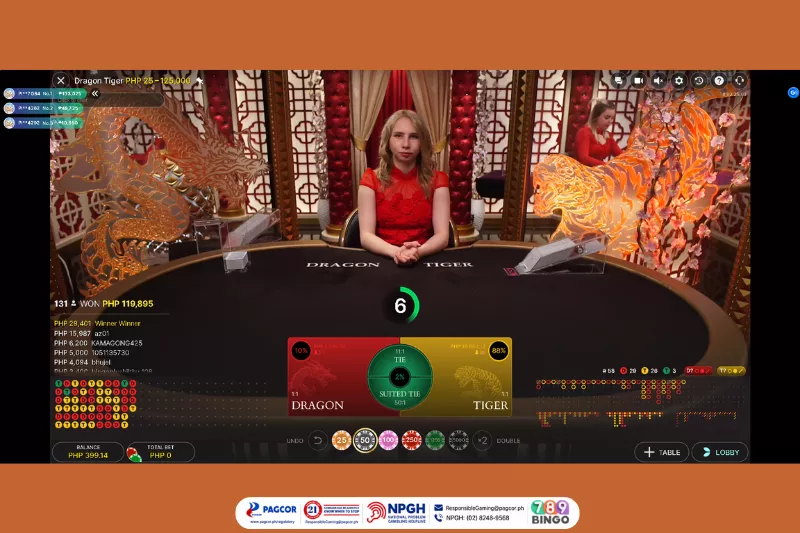
Dragon Tiger can move through rounds without the decision delays found in blackjack or poker. That convenience can increase the number of wagers placed during a fixed amount of time if a player repeatedly enters every available round.
Set both a bankroll limit and a session-time limit before starting. A small wager repeated many times can create substantial turnover even when no individual stake appears large.
Avoid increasing the next wager to recover half of a Dragon or Tiger stake lost on a Tie. The following deal is not required to compensate for the previous equal-ranked result, and a road showing several consecutive outcomes does not provide a guarantee about the next card.
Side bets deserve the same restraint. Tie and Suited Tie can produce larger individual payouts, but their published theoretical returns are lower than the main positions, so they should not be treated as a method for improving the mathematical return of the session.
Use disposable entertainment funds rather than money needed for food, housing, debt payments, savings, or other essential expenses. Deposit limits, session limits, timeouts, and self-exclusion controls can help when play begins to move outside the intended budget or time commitment.
Gambling can be addictive; know when to stop.
Frequently Asked Questions
What is the RTP of Dragon Tiger?
Evolution publishes 96.27% RTP for Dragon and Tiger, 89.64% for Tie, and 86.02% for Suited Tie. A single universal RTP would therefore be misleading because the theoretical return depends on which betting position is selected.
Dragon and Tiger share the same return because the two sides are mathematically symmetrical. The house advantage on those wagers comes from losing half the stake when the two cards tie in rank.
What happens when Dragon and Tiger receive the same rank?
An equal rank produces a Tie regardless of suit. Evolution's standard rules return half of an existing Dragon or Tiger main wager while the other half is lost, and a successful direct Tie wager pays 11:1.
If the two cards also have the same suit, the result qualifies as a Suited Tie. Evolution lists the Suited Tie payout at 50:1.
Is Dragon better than Tiger?
No theoretical advantage separates the two standard main bets. Both pay 1:1 and both have a published RTP of 96.27%.
Recent road patterns do not change that symmetry. A streak on one side does not make the opposite side mathematically due on the next deal.
Play Dragon Tiger Casino Game Online at 789Bingo
Dragon Tiger is one of Evolution’s simplest live card structures:
one Dragon card + one Tiger card → compare rank → settle Dragon, Tiger, Tie, or Suited Tie
There are no multiplier rounds in the standard version, no third cards, and no decisions after the initial wagers close. Evolution’s official Dragon Tiger live casino information confirms the standard 11:1 Tie and 50:1 Suited Tie payouts that distinguish this table from its Lightning counterpart.
That makes it a useful casino game online for comparing straightforward live card mechanics with baccarat, blackjack, Lightning Dragon Tiger, Sic Bo, and other dealer-led titles. Players who prefer the one-card-versus-one-card structure can browse related tables through the live casino collection.
The most important rule to remember is not simply that the higher card wins. Dragon and Tiger are equal 1:1 propositions, but an equal-ranked deal takes half of either main stake, which is the rule responsible for their published 96.27% theoretical return.
For direct provider information, the standard game is listed on the Evolution Dragon Tiger page. The live version should remain separate from:
- First Person Dragon Tiger
- Lightning Dragon Tiger
- Super Speed Dragon Tiger
- Dragon Tiger Phoenix
Because each variant adds its own mechanics, pacing, or payout structure.
Gambling can be addictive; know when to stop.
789Bingo is committed to Responsible Gaming. Underage gambling is prohibited; gaming is strictly for eligible persons aged 21 and above. If you or someone you know has a gambling problem, contact the 24/7 National Problem Gambling Helpline at (02) 8248-9568 or PAGCOR at [email protected] . Gambling can be addictive; know when to stop.










Leave a Reply