
TL;DR: Ready to learn the rules of Tongits? Grab a standard 52-card deck and two friends. No jokers needed. Draw, form sets and runs, and discard as you play this popular three-player Filipino card game!
Whether you’re at a gathering or simply looking for a pastime, Tongits is a familiar choice. Online versions also let players enjoy the game on their devices. Traditionally, Tongits is played by three people.
The goal is to use all your cards in valid combinations or lay them off on existing melds, with or without a final discard. You can also win by having the lowest qualifying total of unmatched-card points when the game ends.
The exact origins of Tongits remain uncertain. Its rules invite comparisons with the American rummy game Tonk and the Chinese tile game mahjong.
Mahjongero discusses Tonk’s historical popularity among Black communities in the American South, particularly jazz and blues musicians. It also explores possible connections between these games, but presents those connections as theories rather than a confirmed origin story.
Learn the Rules of Tongits Real Fast
The goal is to form melds, or sets and runs, by drawing and discarding cards. Along the way, try to reduce the point value of the unmatched cards in your hand.
You need three things to set up a quick game:
- One standard 52-card deck without jokers.
- Three players, including the dealer.
- A table or enough space to arrange your cards.
Choose the first dealer randomly. The dealer also plays and takes the first turn. For each following hand, the previous hand’s winner becomes the dealer.
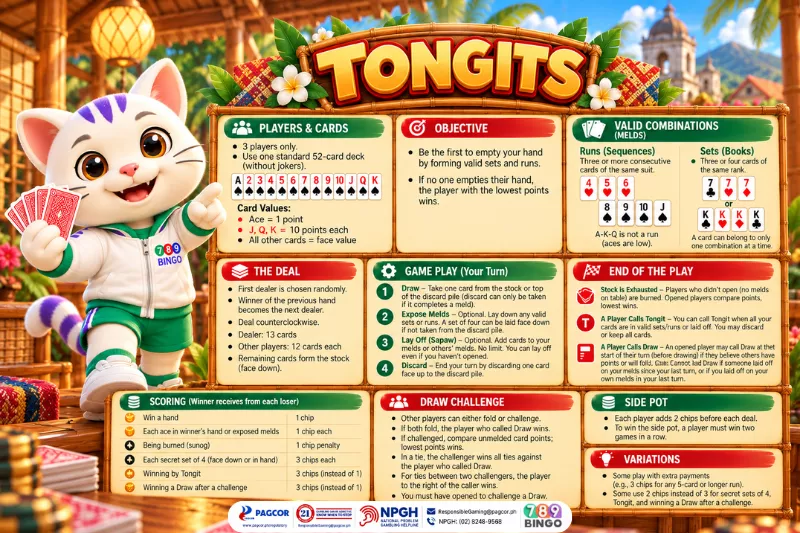
Shuffle the deck and deal one card at a time, counterclockwise, starting with the dealer. The dealer receives 13 cards, while each of the other two players receives 12.
Card Values
Each card has a corresponding point value:
Card | Points |
Ace | 1 |
Number cards, 2–10 | Face value |
Jack, Queen, or King | 10 |
For example, a 2 is worth 2 points, while a 9 is worth 9 points.
Sets and Runs
A run consists of three or more consecutive cards of the same suit, such as ♥7, ♥8, and ♥9. Aces are low, so A-K-Q does not form a valid run.
A set consists of three or four cards of the same rank, such as ♠7, ♥7, and ♦7.
You cannot count the same card toward both a set and a run. For example, the same ♥7 cannot belong to both a ♥7-♥8-♥9 run and a ♠7-♥7-♦7 set.
House rules and digital versions can differ, so agree on the rules before you begin.
Playing by the Rules of Tongits
Play begins with the dealer, who has 13 cards and does not draw on the first turn. The dealer may expose any valid melds before discarding one card to start the discard pile.
Place the remaining undealt cards face down in the center of the table. These cards form the draw pile, also called the stock.
The dealer’s discard ends the first turn. Play then moves counterclockwise to the player on the right.
After the dealer’s opening turn, a regular turn follows four steps: draw, expose any permitted melds, lay off any eligible cards, and discard.
1. Draw
Start your turn by taking the top card from either the draw pile or the discard pile.
If you take a card from the discard pile, you must use it to form a valid meld with at least two cards from your hand. You must then expose that meld.
If you draw from the stock, exposing a meld is optional. Keeping a meld concealed limits what your opponents can see and prevents them from laying cards off on that meld.
2. Expose
You may place valid melds face up on the table in front of you. Remember, exposing a meld is optional when you draw from the stock, but required for the meld you form using a card taken from the discard pile.
A player must place at least one meld on the table for their hand to be considered open.
Valid melds kept in your hand do not add to your unmatched-card total at the end of play. However, keeping all your melds concealed can leave you unopened.
There is also a special rule for a four-card set. If you complete the set without taking a card from the discard pile to do so, you may place it face down. This opens your hand while preserving the bonus for a secret four-card set.
The face-down option does not apply to a set completed using a discard.
3. Lay Off
Laying off, also called sapaw, means adding eligible cards to sets or runs that you or other players have already exposed.
For example, you can add ♣7 to a set of ♠7, ♥7, and ♦7. You can also extend a run of ♥7, ♥8, and ♥9 by adding ♥10.
Laying off is optional, and there is no limit to the number of eligible cards you may lay off during one turn. You do not need to open your own hand before laying off.
Adding a card to another player’s exposed meld prevents that player from calling a draw on their next turn.
4. Discard
To finish a regular turn, discard one card from your hand and place it face up on top of the discard pile.
Remember that you cannot take the top discard simply to add it to an existing meld. You must use it to form a new meld with at least two cards from your hand.
Normally, your turn ends with a discard. The exception is a Tongits win, which may be completed without a final discard.
The End of Play
A game ends in one of three ways: the draw pile runs out, a player calls Tongits, or a player calls a draw.
1. The Draw Pile Runs Out
When a player draws the last card from the stock, they complete their turn before play ends.
Any player who has not opened their hand automatically loses. The remaining players count the points of the unmatched cards in their hands, and the player with the lowest total wins.
If players tie for the lowest total, the player who drew the last card wins if they are part of the tie.
If the tied eligible players do not include the player who drew the last card, the winner is the player whose turn would have come next. This is the player to the right of the person who drew the final card.
2. A Player Calls Tongits
If you were able to use all cards in forming combinations (sets or runs) by laying them off on melds that are on the table. That’s when you can call Tongit, during or at the end of the turn. End the turn with a discard, or keep all cards without discarding if all remaining cards in your hand form valid sets and runs.
This time you use all cards in your hand to form melds and lay them off on the table on a clean sweep. That’s the time when you call Tongits, during or at the end of that turn. You may end the turn with a discard. It’s up to you if you want to keep all the cards and not discard anything as the remaining cards in your hand form valid melds.
3. A Player Calls a Draw
A player who has opened their hand may call a draw, or tawag, if they believe their unmatched-card total is lower than their opponents’ totals or expect their opponents to fold.
Call a draw at the start of your turn, before taking a card.
You cannot call a draw if someone has laid off a card on any of your melds since your previous turn. The same restriction applies if you laid off a card on your own meld during your previous turn.
When someone calls a draw, the other players may fold or challenge. If both opponents fold, the caller wins.
If a player challenges, the caller and eligible challengers compare their unmatched-card totals. The lowest total wins.
If the caller and a challenger tie for the lowest total, the challenger wins. If both challengers tie for the lowest total, the challenger to the caller’s right wins.
A player must have opened their hand to call or challenge a draw. If the caller is the only player who has opened, neither opponent can challenge.
Beginner tip: Consider exposing a meld early to avoid getting burned. Watch the discard pile, keep track of useful combinations, and look for opportunities to lay off cards. If you are likely to be left holding unmatched cards, lower-value cards reduce the points you carry.
How the Rules of Tongits Score Wins
Result or bonus | Payment |
Regular win | 1 chip |
Tongits win | 3 chips instead of the regular 1-chip win payment |
Winning a draw after a challenge | 3 chips instead of the regular 1-chip win payment |
Each secret four-card set belonging to the winner | 3 extra chips |
Each qualifying ace in the winner’s hand or their own melds | 1 extra chip |
Being burned | The burned player pays 1 extra chip |
This example treats the three-chip payment for a challenged-draw win as a replacement for the regular win payment.
A secret four-card set must be face down on the table or concealed in the winner’s hand.
For the ace bonus, do not count aces that the winner laid off on another player’s melds or aces that another player laid off on the winner’s melds. Aces belonging to other players do not add to the winner’s bonus.
Players may also create a side pot, with each player contributing two chips before every deal. A player must win two games in a row to claim that pot.
Some groups use additional bonuses, such as three chips for a run of five or more cards belonging to the winner. Others award two chips instead of three for secret four-card sets, Tongits wins, or wins following a challenged draw.
These are variations, so check which scoring system your group uses.
Rules of Tongits: Terms to Know
- Sets: Three or four cards of the same rank, such as ♠7, ♥7, ♦7, and ♣7.
- Runs: Three or more consecutive cards of the same suit, such as ♥7, ♥8, and ♥9.
- Melds or bahay: Valid sets or runs. Placing a meld on the table opens your hand.
- Draw pile: The face-down stack of undealt cards.
- Discard pile: The face-up pile where players place discarded cards.
- Tongits: A win in which all your cards are used in valid combinations or layoffs, with or without a final discard.
- Burn or sunog: The penalty for ending the game without opening your hand.
- Draw or tawag: A call to end play and let opponents fold or challenge.
- Challenge: Contesting a draw call by comparing eligible players’ unmatched-card totals.
- Sapaw or laying off: Adding eligible cards to an exposed set or run.
Frequently Asked Questions
How Do You Play Tongits with Two Players?
Traditional Tongits uses three players. Playing with two requires adapted house rules, so agree on the deal, turn sequence, and winning conditions first. Do not assume every rule remains unchanged.
Are There Any Free Tongits Games?
Yes. Free-play versions of Tongits are available online. Check whether your chosen game uses virtual credits or requires real-money stakes, and read its terms before starting.
For an introduction to a digital version, read the 789Bingo guide to Tongits Rush . Check the current game catalog and in-game options for availability.
Where Can I Download an Offline Tongits Game?
Search your device's app store for a Tongits app that specifically supports offline play. Check the app description, device compatibility, and internet requirements before downloading.
A downloadable app does not necessarily work offline, so confirm that feature first.
Ready, Set, Tongits!
The rules of Tongits become easier to follow with practice. With a standard 52-card deck, two friends, and a little space, you can enjoy a game during an overnight stay, a relaxed gathering, or a quiet afternoon at home.
Watch the table, build your combinations, and enjoy spending time with the people around you.
Ready to explore more? Browse the 789Bingo game catalog and follow our updates for more guides to casino games available in the Philippines. Learn the rules, play at your own pace, and keep the experience enjoyable.
789Bingo is committed to Responsible Gaming. Underage gambling is prohibited; gaming is strictly for eligible persons aged 21 and above. If you or someone you know has a gambling problem, contact the 24/7 National Problem Gambling Helpline at (02) 8248-9568 or PAGCOR at [email protected] . Gambling can be addictive; know when to stop.












Leave a Reply