

Learn how Ultimate Texas Hold’em by Evolution works at 789Bingo! Explore live dealer poker with up to 99.47% RTP under optimal play, Ante bets, and Play raises.
This Evolution live casino game online turns Texas Hold’em into a house-banked poker game where each player competes against the dealer instead of other players. Its defining decision comes before all five community cards are known because the Play wager can reach 4x the Ante before the Flop, but waiting reduces the available raise to 2x after the Flop and finally 1x after the River.
That changing Play wager creates the central risk-and-reward structure of the game. Ante and Blind begin at equal amounts, the dealer must qualify with a Pair or better for the Ante to remain in action, and an optional Trips wager can pay according to the player’s final poker hand regardless of whether the dealer wins.
What Defines Ultimate Texas Hold’em?
Quick Stats: One 52-card deck | Play wager ranges from 1x to 4x Ante | Total main-bet RTP 99.47% with optimal play
Evolution developed its live version of Ultimate Texas Hold’em online in partnership with Scientific Games. Unlike multiplayer Texas Hold’em, there is no competition for a pot against other players because every participating player compares a five-card poker hand directly with the dealer’s five-card hand.
One standard 52-card deck is used without Jokers, and the deck is shuffled after every completed round in the published Evolution rules. Each participant receives two starting cards, the dealer receives two cards, and five community cards eventually appear in the middle of the table.
The player and dealer each form the strongest possible five-card combination from seven available cards. That distinction matters because Ultimate Texas Hold’em strategy does not require the final hand to use both hole cards; the system evaluates the best five-card poker hand available from the complete seven-card set.
The basic hand-ranking order remains familiar: Royal Flush, Straight Flush, Four of a Kind, Full House, Flush, Straight, Three of a Kind, Two Pairs, Pair and High Card. An Ace can rank high in an A-K-Q-J-10 Straight or low in an A-2-3-4-5 Straight, while suits do not break an otherwise exact poker-hand tie.
For anyone comparing a casino game online with regular poker, that house-banked structure is the first difference to understand. You do not need to beat every other person at the table, read opponents or build a shared pot; you only need your final five-card hand to compare favorably with the dealer’s according to the published settlement rules.
Ante, Blind, Play and Trips Game Data
Ultimate Texas Hold’em begins with two compulsory main wagers of equal value. Placing an Ante causes an equal Blind wager to be placed, while Trips remains optional and operates independently from the main Player-versus-Dealer comparison.
Game Detail | Published Rule |
Software Provider | Evolution |
Game Type | Live dealer house-banked poker |
Deck | One standard 52-card deck |
Jokers | None |
Initial Main Bets | Equal Ante and Blind |
Optional Side Bet | Trips |
Earliest Play Bet | 3x or 4x Ante |
After Flop | 2x Ante |
After River | 1x Ante or Fold |
Raises Per Round | One |
Dealer Qualification | Pair or better |
Ante Win | 1:1 when dealer qualifies |
Play Win | 1:1 |
Highest Blind Payout | 500:1 Royal Flush |
Highest Trips Payout | 50:1 Royal Flush |
Total Main-Bet RTP | 99.47% with optimal play |
Initial Main-Bet RTP | 97.82% |
Trips RTP | 96.50% |
PHP Bet Range | Verify in the active 789Bingo table |
Evolution’s published rules distinguish between 99.47% total main-bet RTP, 97.82% initial main-bet RTP, and 96.50% Trips RTP. The percentages should therefore remain attached to the correct wager structure rather than presenting 99.47% as though every bet on the table carries the same theoretical return.
The exact PHP minimum and maximum should come from the active 789Bingo interface. Limits displayed in documentation for another operator or currency should not be converted and presented as permanent 789Bingo limits.
The Earlier You Raise, the Larger the Play Bet
The Play wager creates three decision points, but only one Play bet can be made during a round. Before the Flop appears, the player can Check or commit 3x or 4x the Ante, which is the largest raise available.
Suppose the Ante is ₱100 and the automatically matched Blind is another ₱100. Choosing Play 4x immediately adds ₱400, bringing the main-game exposure for that hand to ₱600 before considering an optional Trips wager.
If the player Checks before the Flop, three community cards are revealed. The next decision becomes Play 2x or Check, so that same ₱100 Ante can now support only a ₱200 Play wager rather than the earlier ₱300 or ₱400 choices.
Checking again reveals the Turn and River. At that final stage, the choice becomes Play 1x or Fold, meaning a ₱100 Ante can produce only a ₱100 Play wager if the player waits until all seven available cards are known.
The trade-off is deliberate. Earlier action provides less information but permits a larger wager, while later action provides more information but reduces the amount that can be committed to Play.
Only one raise is allowed. Once a 4x, 3x or 2x Play wager has been selected, there is no later opportunity to add another Play bet after more community cards appear.
That structure makes Ultimate Texas Hold’em strategy different from a conventional casino game online where the amount is fixed before any result information appears. Here, the timing of the decision changes both how much of the final board is visible and how much money can still be placed in the Play position.
Checking Does Not Mean Folding
A Check simply postpones the Play decision. It does not surrender the Ante or Blind, and it allows the hand to continue to the next decision stage without adding another main wager.
Before the Flop, checking moves the hand to the three-card community reveal. After the Flop, checking again moves the hand to the Turn and River, where the player must finally choose between a 1x Play wager and Fold.
Folding is much more final. If the player reaches the last decision and chooses Fold, the Ante and Blind are lost and no Play wager is placed.
The timer also matters. Evolution’s published rules state that an unanswered early decision becomes an automatic Check, but if the final Play 1x/Fold decision expires without input, the hand is automatically folded and the Ante and Blind are lost.
That makes the final timer operationally different from the earlier ones. Missing an early selection keeps the hand alive, while missing the final decision can end it.
Dealer Qualification Changes the Ante Settlement
The dealer needs a Pair or better to qualify. Qualification does not decide whether the dealer wins the complete hand; it determines how the Ante is handled when the final hands are compared.
If the dealer qualifies and the player has the better hand, the Ante pays 1:1 and the Play wager also pays 1:1. The Blind then settles according to its separate paytable.
If the dealer does not qualify and the player wins, the Ante pushes instead of paying. The Play still wins at 1:1, while the Blind uses its normal qualifying payout table based on the player’s hand.
The unusual result appears when the dealer fails to qualify but still has a better hand than the player. Evolution’s outcome table states that the Ante pushes, while the Blind and Play bets lose.
For example, imagine the dealer finishes with Ace-high and the player has King-high. The dealer does not have a Pair, so the dealer fails the qualification test, yet Ace-high still beats King-high in the actual hand comparison.
The Ante therefore pushes because the dealer failed to qualify. The Blind and Play can still lose because the dealer’s non-qualifying hand was nevertheless stronger than the player’s.
This is why “dealer does not qualify” should not be simplified to “player automatically wins.” Qualification and hand comparison are related but separate steps.
For players learning a poker-based casino game online, this rule deserves particular attention because it differs from some other house-banked poker games where dealer non-qualification automatically creates a more favorable settlement. Ultimate Texas Hold’em still compares both five-card hands before deciding every component.
Blind Payouts Start at a Straight
The Blind wager begins at the same amount as the Ante, but it does not simply pay 1:1 whenever the player beats the dealer. Its winning value depends on the strength of the player’s final five-card poker hand.
Player Hand | Blind Payout |
Royal Flush | 500:1 |
Straight Flush | 50:1 |
Four of a Kind | 10:1 |
Full House | 3:1 |
Flush | 1.5:1 |
Straight | 1:1 |
Less than Straight | Push when player wins |
A player can therefore beat the dealer with Three of a Kind, Two Pairs, a Pair or even High Card without receiving Blind winnings. In those winning situations, the Blind pushes because Evolution’s published paytable begins its positive payouts at a Straight.
This distinction prevents a common misunderstanding about the 500:1 figure. It is the top Blind paytable payout for a Royal Flush, not a universal maximum multiplier applied to the entire round.
The Ante and Play positions still use their own settlement rules. A Royal Flush does not turn a 1:1 Play bet into 500:1; the enhanced payout belongs specifically to the Blind.
The Blind also remains capable of losing when the dealer wins the hand. The “all other hands push” line in the Blind paytable applies to lower-ranking winning player hands, not to every Pair-or-lower result regardless of who wins.
Trips Pays on Your Hand, Not the Dealer Result
Trips is an optional side wager based on the rank of the player’s final five-card hand. It begins paying at Three of a Kind and can settle independently from the dealer comparison.
Player Hand | Trips Payout |
Royal Flush | 50:1 |
Straight Flush | 40:1 |
Four of a Kind | 30:1 |
Full House | 8:1 |
Flush | 7:1 |
Straight | 4:1 |
Three of a Kind | 3:1 |
The provider states that Trips pays according to the player’s best five-card hand regardless of the dealer’s hand. The Trips decision also remains independent from whether the player ultimately places a Play wager, so folding the main hand does not automatically erase a qualifying Trips result.
For example, suppose a player reaches the River, decides the main hand is not strong enough to justify Play 1x and folds. If the player’s seven available cards nevertheless form Three of a Kind or better, the Trips wager can still settle according to the Trips table.
This separation means one round can contain different outcomes at the same time. The Ante and Blind can lose because of a Fold, while Trips can still win because the completed seven-card set produces a qualifying poker combination.
Trips carries a published RTP of 96.50%, below the 99.47% optimal total-main-bet figure. A larger headline payout such as 50:1 therefore should not be interpreted as a stronger long-term theoretical return.
That difference is useful when evaluating a casino game online with several simultaneous betting positions. Optional side bets can offer larger individual payouts while carrying mathematics that differ materially from the core game.
Best Five Cards Come From Seven Available Cards
Both the player and dealer eventually have access to seven cards: two private starting cards and five shared community cards. The system then selects the strongest possible five-card combination from those seven.
This is important because not every final poker hand must use both hole cards. If the five community cards themselves form the strongest available hand, that board can determine the five-card result for both sides and the remaining private cards may serve only as potential tie breakers where applicable.
Hand ranking begins with Royal Flush and descends through Straight Flush, Four of a Kind, Full House, Flush, Straight, Three of a Kind, Two Pairs, Pair and High Card. When both sides have the same hand category, normal poker comparison rules determine whether one hand is stronger or whether the complete result is a tie.
For a Flush, cards are compared from the highest downward until a difference appears. For Two Pairs, the higher pair is compared first, then the second pair and finally the kicker if necessary.
For a Straight, the highest card determines the stronger sequence. Suits do not rank against each other, so two otherwise identical Straights using different suits remain tied.
If the player and dealer produce exactly equal final five-card hands, Ante, Blind and Play push. Neither side wins the main comparison.
Why a 4x Raise Creates More Exposure Than a Late Decision
Consider an Ante of ₱200. The equal Blind means the round begins with ₱400 already committed before Trips.
A pre-Flop Play 4x adds:
₱800
which takes the total main-game exposure to:
₱1,200
A pre-Flop Play 3x instead adds ₱600 for a total of ₱1,000. Waiting until after the Flop and selecting Play 2x creates ₱800 total main exposure, while waiting until the River and playing 1x creates ₱600.
These examples do not say which action should be selected for a particular hand. They simply show why the phrase “my Ante is ₱200” does not fully describe the amount that may eventually be placed during the round.
The decision structure matters to bankroll management because Play is calculated from the Ante, not from the combined Ante-and-Blind starting amount. Optional Trips adds another separate stake on top of that exposure.
A player using several rounds of this casino game online should therefore budget for the largest decision they are willing to make rather than looking only at the initial Ante selector. Early 4x decisions can create substantially more turnover than a session made mostly of late 1x decisions.
Starting a Round of Ultimate Texas Hold’em Online
Begin by opening Ultimate Texas Hold’em through the 789Bingo live casino section and checking the current PHP betting limits. The live table should always be the source for current minimum and maximum stakes because operator configurations can change.
Place an Ante first, and the system places an equal Blind according to the published rules. Add Trips only if you want the independent side wager, remembering that its 96.50% theoretical return differs from the optimal main-game figure.
After receiving the first two cards, decide whether to Check or make the one permitted early Play wager at 3x or 4x the Ante. Once an early Play wager is committed, no later Play decision is offered during that round.
If you Check, examine the three-card Flop when it appears. The next choice becomes Play 2x or Check again, and choosing 2x ends the decision process for that hand.
If you Check a second time, the Turn and River complete the five-card community board. You must then choose Play 1x or Fold, and allowing the final timer to expire results in an automatic Fold under the published rules.
After the decision process finishes, the dealer’s cards are revealed and both seven-card sets are reduced to their strongest five-card combinations. The system then checks dealer qualification and settles Ante, Blind, Play and Trips separately.
Pro Tip: Calculate the maximum cash exposure before placing the Ante. A ₱500 Ante automatically means another ₱500 Blind, and selecting Play 4x can add ₱2,000, producing ₱3,000 in main-game exposure before any Trips wager is counted.
Managing Raise Size and Side-Bet Exposure
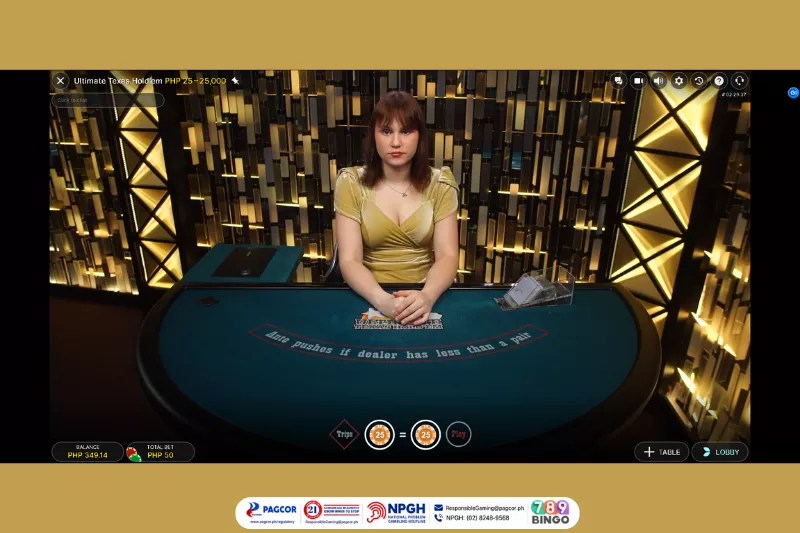
Ultimate Texas Hold’em online can create larger round exposure than the initial betting screen suggests. Ante and Blind already require two equal starting units, and Play can later add between one and four additional Ante units depending on when the decision is made.
Trips creates another independent wager. A session that regularly combines Ante, Blind, early 4x Play decisions and Trips can therefore produce much greater turnover than the original Ante amount alone would imply.
Set a per-round exposure limit rather than only a minimum-chip limit. If the bankroll cannot comfortably support the largest permitted Play decision you intend to use, reduce the starting Ante rather than assuming later wagers will not be needed.
Do not increase a future Ante because the previous hand folded, lost to the dealer or missed a Trips payout. Community cards and previous dealer results do not create a requirement for the next hand to compensate for earlier losses.
Likewise, a sequence of weak starting cards does not mean a premium starting hand is due. Decisions can influence how much is wagered and whether a hand continues, but they do not control the random order of cards in the shuffled deck.
Players comparing a poker-style casino game online should also distinguish strategic decision-making from guaranteed outcomes. Ultimate Texas Hold’em strategy permits meaningful choices about when to raise or fold, yet no correct decision can guarantee that the remaining community cards or dealer cards will produce a winning final hand.
Use disposable entertainment funds and set practical deposit and session limits before playing. Timeouts and self-exclusion tools are appropriate when spending or playing time moves beyond the limits originally set for the session.
Gambling can be addictive; know when to stop.
Frequently Asked Questions
What is the RTP of Ultimate Texas Hold’em?
Evolution’s published rules list 99.47% theoretical RTP for the total main bet under perfect play, while the initial main bet is listed at 97.82%. The optional Trips wager has a separate published RTP of 96.50%, so 99.47% should not be applied universally to every betting position.
RTP describes long-run theoretical mathematics rather than what one individual session must return. A player can finish well above or below the theoretical percentage over a short series of hands.
When can I raise 4x, 2x or 1x?
Before the Flop, the Play decision can be 3x or 4x the Ante. Checking moves the player to the Flop, where the available Play amount falls to 2x, while checking again moves the decision to the Turn and River, where the only choices are Play 1x or Fold.
Only one Play wager can be made per round. Once a player chooses 4x, 3x or 2x, later community cards are dealt without another opportunity to raise.
Does the dealer need to qualify for me to win?
The dealer needs a Pair or better to qualify for normal Ante settlement. If the dealer does not qualify and the player wins, the Ante pushes while Play pays 1:1 and Blind settles according to its paytable.
Dealer non-qualification does not automatically mean the player wins the complete comparison. If the dealer has less than a Pair but still outranks the player, the Ante pushes while Blind and Play lose.
Ultimate Texas Hold’em Casino Game Online at 789Bingo
Ultimate Texas Hold’em is defined less by its Texas Hold’em theme than by the timing of its single Play wager. The same starting Ante can support a 4x decision before the Flop, a 2x decision after three community cards or only a 1x commitment after all five community cards are visible.
That structure combines poker hand evaluation with changing financial exposure, while the Blind and Trips positions follow separate payout rules. Players who enjoy live poker formats can compare Ultimate Texas Hold’em with Casino Hold’em, 2 Hand Casino Hold’em and other table games through the 789Bingo live casino collection.
The most important rule is simple: you may raise only once, and waiting gives you more information but reduces the maximum Play wager available. Understanding that relationship, together with dealer qualification and the separate Blind and Trips paytables, gives a much clearer picture of how Ultimate Texas Hold’em actually works.
789Bingo is committed to Responsible Gaming. Underage gambling is prohibited; gaming is strictly for eligible persons aged 21 and above. If you or someone you know has a gambling problem, contact the 24/7 National Problem Gambling Helpline at (02) 8248-9568 or PAGCOR at [email protected] . Gambling can be addictive; know when to stop.












Leave a Reply