

Learn how D Dragon Tiger by SA Gaming works at 789Bingo, with Dragon, Tiger, and Tie bets, simple rules, and quick rounds.
D Dragon Tiger by SA Gaming is a live dealer card game available at 789Bingo. Each round features two cards, one for Dragon and one for Tiger. Players predict which card will have the higher rank or whether both cards will tie. The game also offers side bets based on card rank and color.
The “D” identifies a specific SA Gaming table rather than a separate card-game ruleset. SA Gaming’s own integration mapping lists Dragon Tiger D as host ID 922, while the provider’s public Dragon Tiger rules describe the shared mechanics used by the game.
How to Play D Dragon Tiger
Quick Stats: Eight standard 52-card decks without Jokers, King ranked highest at 13, and a maximum published RTP of 96.27%. Dragon Tiger does not ask players to build a poker hand, draw extra cards, or decide whether either side should Hit or Stand.
The dealer uses a multi-deck shoe and deals exactly two cards for the comparison, with the first card assigned to Dragon and the second to Tiger. Once betting closes, both cards are revealed and the side with the higher numerical rank wins the main comparison.
Ace ranks as 1, numbered cards use their printed values, Jack is 11, Queen is 12, and King is 13. Suits do not break an equal-rank main result, so a King of Hearts and a King of Clubs still create a Tie.
That stripped-down structure makes D Dragon Tiger a very different game from baccarat even though both use two named sides. Baccarat combines two- or three-card totals and fixed drawing rules, while Dragon Tiger normally resolves from only the two cards placed on the table.
D Dragon Tiger Game Data and Maximum RTP
Specification | Details |
|---|---|
Software Provider | SA Gaming |
Table | Dragon Tiger D |
SA Gaming Host ID | 922 |
Game Type | Live dealer card comparison |
Decks | Eight standard 52-card decks |
Jokers | None |
Main Bets | Dragon, Tiger, Tie |
Side Bets | Big, Small, Odd, Even, Red, Black for each side |
Maximum Published RTP | 96.27% |
Bet Range | Verify in the active 789Bingo table |
SA Gaming publishes 96.27% as the maximum RTP for Dragon Tiger. That figure should remain a maximum rather than being applied automatically to every side bet, because Big, Small, Odd, Even, Red, Black, and Tie use different payout structures.
The most direct way to understand the 96.27% figure is through the main Dragon or Tiger wager. With eight decks, an equal-rank result causes half of the Dragon or Tiger stake to be returned and half to be lost, creating the principal mathematical cost on otherwise symmetrical even-money sides.
Dragon and Tiger Pay 1:1 on a Higher Card
A Dragon wager wins when the Dragon card outranks the Tiger card, while a Tiger wager wins when Tiger outranks Dragon. SA Gaming pays either successful main-side result at 1:1, so a ₱100 winning main bet produces ₱100 in profit plus the return of the original ₱100 stake.
Neither side has a permanent ranking advantage. Dragon is not automatically stronger than Tiger, and Tiger is not the dealer hand in the blackjack sense; they are simply labels for the two positions receiving one card each.
Suppose Dragon receives Queen and Tiger receives 9. Dragon wins because Queen is ranked 12 while 9 remains 9, and the reverse result would settle a Tiger wager in exactly the same way.
The symmetry also means streaks do not transform one side into a stronger mathematical choice. A run of several Dragon results records past outcomes, but it does not alter the ranking rule used for the next two cards.
A Tie Costs Half of Dragon or Tiger
The Tie rule is the mechanic that deserves the most attention on the main bets. If Dragon and Tiger receive cards of equal rank, SA Gaming returns half of an existing Dragon or Tiger wager and retains the other half.
With a ₱100 Dragon bet, a Tie therefore returns ₱50 and produces a net loss of ₱50. The same half-loss treatment applies to Tiger, so a Tie is not a full push for either main side.
That rule explains why a 1:1 Dragon or Tiger wager can still carry a house edge even though the two sides are symmetrical. A Tie interrupts the otherwise balanced win-versus-loss relationship by converting equal ranks into a half-stake loss for both main positions.
This is one of the details that separates D Dragon Tiger from another casino game online that might return the full stake on an equal result. A player who assumes “equal cards means push” would misunderstand the settlement before even considering the separate Tie wager.
The Separate Tie Bet Pays 8:1
Tie is its own betting position and wins when Dragon and Tiger receive the same rank. SA Gaming lists the Tie payout at 8:1, so a ₱100 winning Tie bet produces ₱800 in profit plus the returned ₱100 stake.
The 8:1 payout should not be confused with the half-return rule on Dragon and Tiger. Those are two different settlements triggered by the same equal-rank result: the Tie position wins, while the two main-side positions each lose half their stake.
An equal-rank outcome does not require matching suits. Dragon 7 of Spades against Tiger 7 of Hearts still qualifies as a Tie because only rank determines the main comparison.
Likewise, two Kings tie even when their suits differ. The ranking system therefore remains simple: compare the numbers 1 through 13 first, then apply the selected wager’s payout rule.
Why 96.27% Matches the Half-Loss Tie Rule
Eight decks contain 416 cards, with 32 cards of each rank. After the first card is dealt, 415 cards remain and 31 of those remaining cards share the same rank as the first card, making the initial equal-rank probability approximately 31 divided by 415.
That works out to about 7.47% before considering the changing composition of later rounds in the shoe. On a Dragon or Tiger wager, half the stake is lost when that Tie occurs, so the theoretical cost is roughly half of 7.47%, or about 3.73%.
Subtracting that from 100% gives approximately 96.27%, matching SA Gaming’s published maximum RTP. This is a useful mathematical explanation because the main sides themselves are otherwise symmetrical and pay the same 1:1 amount.
The calculation also shows why “Dragon has been losing lately” is not a strategy argument. The house edge is built into the Tie treatment, not into a hidden preference for one named side over the other.
Big and Small Divide the Rank Range Around Seven
SA Gaming adds Big and Small side bets for both Dragon and Tiger. Big wins when the selected side receives a card ranked 8 or higher, while Small wins when the card is ranked 6 or lower.
The card ranked 7 belongs to neither group. A Dragon 7 therefore loses both Dragon Big and Dragon Small, which is an important exception to the idea that every card must be either Big or Small.
SA Gaming pays both Big and Small at 1:1. A player choosing one of these bets is predicting only the numerical range of a single card rather than which side wins the overall Dragon-versus-Tiger comparison.
That makes Big/Small a useful casino game online example of how one revealed card can support a separate prediction without changing the main winner. The side wager is settled from the selected card’s rank range, while Dragon versus Tiger still depends only on which of the two cards ranks higher.
This creates another way to read the same deal on a live card table. Dragon can lose the main comparison but still satisfy Dragon Big, or Dragon can win the round while a separate Dragon Small wager also succeeds if its card is 6 or below and Tiger is lower.
Odd and Even Use Unequal Payouts
Odd and Even side bets also look simple, but SA Gaming does not price them identically. Dragon Odd and Tiger Odd pay 0.75:1, while Dragon Even and Tiger Even pay 1.05:1.
The reason the payouts differ is visible in the rank set. Odd contains Ace, 3, 5, 7, 9, Jack, and King, while Even contains 2, 4, 6, 8, 10, and Queen, giving Odd one additional rank before shoe composition changes.
Ace counts as 1 and is therefore Odd. Jack counts as 11 and King as 13, so both are Odd, while Queen counts as 12 and belongs to Even.
A player should therefore not treat “Odd versus Even” as an automatic 50-50 choice simply because there are two labels. The game’s own payout table reflects the unequal number of ranks in the two groups.
Red and Black Ignore the Rank Entirely
Red and Black side bets evaluate suit color rather than numerical rank. Hearts and Diamonds are Red, while Spades and Clubs are Black, and SA Gaming pays both outcomes at 0.9:1.
A King of Hearts and a 2 of Hearts produce the same result for a Red side bet even though their main-game ranks are far apart. Likewise, a Black wager cares only that the selected side receives Spades or Clubs.
This means one card can settle several independent ideas at once. A Dragon King of Hearts is Dragon Big, Dragon Odd, and Dragon Red, while its main Dragon result still depends on whether that King outranks the Tiger card.
The side-bet menu gives D Dragon Tiger more depth than its one-card-versus-one-card core suggests. It remains simple to follow visually, but the betting grid lets players predict rank range, parity, or suit color without changing the actual dealing procedure.
Side Bets Can Become Unavailable After 25 Rounds
SA Gaming marks Big, Small, Odd, Even, Red, and Black with a maximum round availability of 25. The provider’s rules state that these option types become unavailable after the specified number of rounds in the shoe.
That limitation should be treated as a published table rule rather than expanded into an unsupported explanation. SA Gaming does not need the page to speculate about why the cutoff exists; the useful player-facing point is simply that these side bets may disappear later in the shoe.
Dragon, Tiger, and Tie remain the core game identities. If a side-bet button is no longer available after the stated number of rounds, that does not mean the table has malfunctioned.
That limited side-bet window also gives this casino game online a shoe-dependent interface without changing the card-ranking rules. The player can still understand the round from the same Dragon, Tiger, and Tie comparison even when the additional property bets are no longer offered.
The current interface should always be treated as the final source for what can be selected in a particular round. Betting limits and available side bets may vary by table. Check the active D Dragon Tiger game interface at 789Bingo for the current minimum and maximum wagers before playing.
The Shoe Uses a Burn and Cut-Card Procedure
At the start of each round, SA Gaming states that the facilitator discards one card from the shoe before dealing the two game cards face down. The first dealt card belongs to Dragon and the second belongs to Tiger, and both are revealed after the betting phase ends.
A cut card marks the final round of the current shoe. After that round, the decks are shuffled before play resumes.
SA Gaming also publishes a specific burn procedure for the new shoe. The facilitator reveals the first card, converts Ace to 1, cards 2 through 10 to face value, and Jack, Queen, or King to 10, then discards that number of cards face down.
This procedure is operational rather than a player decision. It clarifies that the shoe changes over time and is periodically reset, but it should not be presented as a system for predicting the next Dragon or Tiger card.
D Identifies the Table, Not a New Ranking System
SA Gaming’s integration documentation lists Dragon Tiger D as host ID 922 and Dragon Tiger M as host ID 534. The provider nevertheless publishes one current Dragon Tiger ruleset covering card ranking, bets, payouts, shoe procedure, and the 96.27% maximum RTP.
That means the D label should not be used to invent a separate King value, different Tie payout, or different side-bet mechanic. If 789Bingo also carries another SA Gaming Dragon Tiger table, any unique page content should come from verifiable table-level details such as host identity, studio presentation, availability, or displayed limits.
For the player, the important mechanical identity remains the SA Gaming rule set. Dragon Tiger D uses the same one-card comparison structure documented by the provider, with D identifying the specific table instance in the integration mapping.
This distinction also matters for search quality. Two similarly titled games that differ only by a studio letter should not claim contradictory game mathematics merely to look unique.
The safest distinction is factual rather than cosmetic. If the live D table exposes a different studio feed, language, availability schedule, or PHP limit, those details can help users choose the correct table without rewriting the underlying Dragon Tiger mathematics.
For someone comparing a casino game online across multiple SA Gaming tables, the verified rules should stay consistent unless the live table itself exposes a real configuration difference. Studio or host identifiers can distinguish access points without justifying invented changes to RTP, ranks, or payouts.
Dragon Tiger Is Not Baccarat With Fewer Cards
The two games share Dragon/Tiger-style visual simplicity only at a superficial level. Baccarat uses Player and Banker hands, modulo-10 totals, possible third cards, and fixed drawing rules, while Dragon Tiger compares one ranked card on each side.
A King is especially useful for seeing the difference. In baccarat it has a card value of zero, but in D Dragon Tiger it is ranked 13 and is the strongest card available.
Ace reverses that contrast as well. An Ace contributes one point in baccarat and is also ranked 1 here, but Dragon Tiger does not add it to another card because there is only one card per side.
Anyone moving from baccarat to D Dragon Tiger therefore needs to forget hand totals and focus on direct rank comparison. There is no natural 8 or 9, no third-card table, and no Banker commission to calculate.
Reading One Card Across Several Bets
Consider a round where Dragon receives 10 of Diamonds and Tiger receives 6 of Clubs. Dragon wins the main comparison because 10 outranks 6, while the same two cards also settle several independent side-bet properties.
Dragon is Big, Even, and Red. Tiger is Small, Even, and Black, so a player can have some side bets win even if another position on the same round loses.
Now consider Dragon 5 of Spades against Tiger 5 of Diamonds. The main result is a Tie, both Dragon and Tiger main wagers lose half, the Tie bet wins, Dragon is Small/Odd/Black, and Tiger is Small/Odd/Red.
This layered settlement is why total round exposure matters more than simply asking whether Dragon or Tiger won. Multiple chips can create multiple independent results from the same two physical cards.
Starting a D Dragon Tiger Round at 789Bingo
Open the 789Bingo live casino section and select D Dragon Tiger, then check the active table for the current PHP minimum and maximum. SA Gaming’s host mapping identifies the D table specifically, while the current in-game panel should govern stake limits and which side bets are still available in the shoe.
Choose Dragon when predicting the Dragon card will rank higher, Tiger when predicting Tiger will rank higher, or Tie when expecting equal ranks. If using Big, Small, Odd, Even, Red, or Black, remember that those bets evaluate only the selected card property and do not require that side to win the main comparison.
After wagers are confirmed, the facilitator deals the Dragon and Tiger cards face down and reveals them once betting closes. No additional card decision follows, so the round can settle quickly compared with games where players choose Hit, Stand, Double, or Split.
That short sequence is one reason this casino game online can generate a faster session rhythm than decision-heavy table games. Faster resolution does not change the published RTP, but it can increase how quickly total wagering accumulates when the same stake pattern is repeated.
Pro Tip: Calculate the total amount across all selected positions before confirming the round. A ₱100 Dragon bet plus three ₱100 side bets creates ₱400 in total exposure even though every chip individually looks small, and a Tie can still cost half of the main Dragon or Tiger stake.
Managing Fast Rounds and Multiple Side Bets
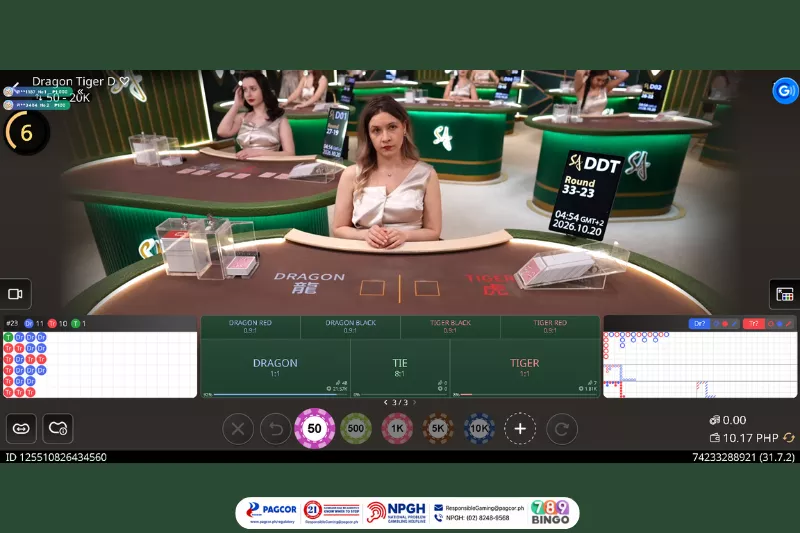
Dragon Tiger has very few gameplay steps, and that can make a session move quickly. A short decision cycle can increase turnover simply because more rounds may fit into the same amount of time, especially when multiple side bets are added to each deal.
Set a per-round budget before placing the first chip and count every side wager as part of that amount. If the goal is ₱300 maximum exposure per round, three separate ₱100 selections have already reached the limit even though none of the individual bets looks large.
Avoid increasing the next stake because a Tie caused a half-loss or because Dragon or Tiger has appeared repeatedly. Previous results do not create a requirement for the next card pair to reverse a streak.
The same principle applies to Big, Small, Odd, Even, Red, and Black patterns. Historical sequences can be displayed for reference, but they do not guarantee the next physical cards will complete or break a pattern.
Use disposable entertainment funds and decide on deposit, session, and time limits before play. Timeouts and self-exclusion tools should be used whenever continued wagering no longer fits the planned budget or time commitment, and gambling can be addictive; know when to stop.
Frequently Asked Questions
What is the RTP of D Dragon Tiger?
SA Gaming publishes a maximum RTP of 96.27% for Dragon Tiger. The figure aligns with the main Dragon/Tiger structure where a Tie returns half the wager, but it should not be assigned automatically to every side bet because their payouts and qualifying outcomes differ.
What happens to a Dragon or Tiger bet on a Tie?
Half of the main Dragon or Tiger wager is returned and the other half is lost when the cards tie. The separate Tie position wins at 8:1, so the Tie result creates different settlements depending on which betting area was selected.
Is Dragon Tiger D different from Dragon Tiger M?
SA Gaming's API mapping identifies Dragon Tiger D as host ID 922 and Dragon Tiger M as host ID 534. The provider publishes one general Dragon Tiger rule set, so no different ranking system, payout table, or RTP should be invented for D unless the live 789Bingo table explicitly shows a verified configuration difference.
Where D Dragon Tiger Fits at 789Bingo
As a casino game online, D Dragon Tiger is built around a compact sequence: select a card outcome, wait for two cards, compare their ranks, and settle any attached side properties. Its strongest distinguishing rule is the Tie treatment, because equal ranks return only half of Dragon or Tiger wagers while the dedicated Tie bet pays 8:1.
The side bets add another layer without making the card procedure more complicated. Big/Small, Odd/Even, and Red/Black let the same single card resolve several different predictions, while SA Gaming’s 25-round availability rule prevents those options from being assumed to remain open throughout every shoe.
D Dragon Tiger therefore gets most of its depth from the betting grid rather than from player decisions after the deal. The two-card reveal stays constant while the meaning of each chip depends on whether it targets the winner, an equal rank, a rank range, parity, or suit color.
Players who prefer fast live tables with no post-deal decisions can compare D Dragon Tiger with other dealer-led titles in the live casino collection. The key point is simple: the game is easy to read, but the settlement is not just “higher card wins,” because Ties and property-based side bets change how the same two cards affect the total round balance.
D Dragon Tiger keeps the card comparison short while making the betting interpretation more detailed. Gambling can be addictive; know when to stop.












Leave a Reply