

Play Speed Roulette by Evolution on 789Bingo! Live European single-zero roulette with 97.30% RTP, 2.70% house edge, and 25-second rounds.
Speed Roulette cuts the waiting between spins. It takes conventional live European roulette and removes much of the downtime between one result and the next. Evolution states that each round takes only 25 seconds from spin to spin, roughly half the duration of its standard Live Roulette and Immersive Roulette rounds.
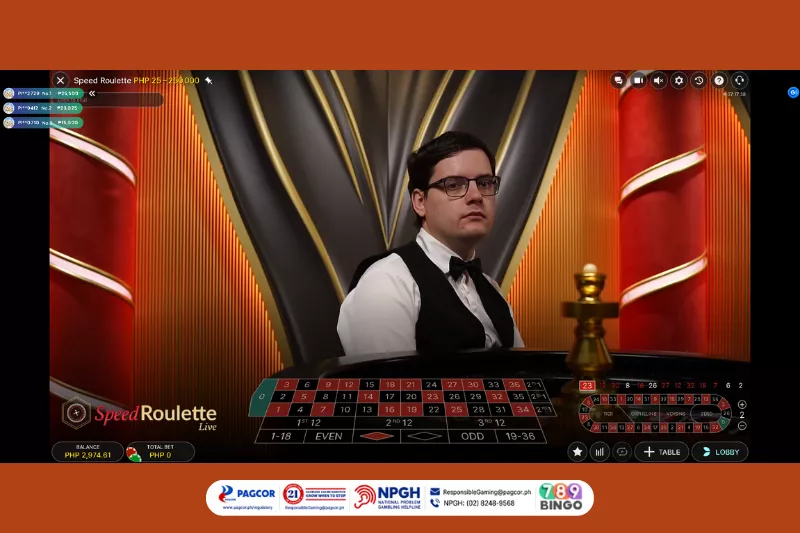
The casino game online does not achieve that pace by replacing the physical wheel with an RNG result or by adding a multiplier feature. A live dealer still operates a physical roulette wheel. The main difference is that betting occurs while the wheel is already spinning, removing a separate idle betting phase before each spin. Evolution also uses fast video-based winning-number recognition to settle the result and move quickly into the next round.
That distinction gives Speed Roulette a very specific identity.
It is not Lightning Roulette with faster animations.
It is not Speed Auto Roulette, which removes the human dealer.
It is not Instant Roulette, which uses multiple synchronised wheels.
Speed Roulette is conventional live single-zero roulette compressed into a faster round cycle.
European Wheel, RTP and Speed Roulette Game Data
Detail | Speed Roulette |
Software Provider | Evolution |
Game Type | Live dealer European roulette |
Wheel Format | Single zero / 37 pockets |
Numbers | 0 and 1–36 |
Round Duration | Approximately 25 seconds spin-to-spin |
RTP | 97.30% under standard single-zero roulette payouts |
House Edge | 2.70% |
Volatility | Not applicable as a slot-style specification |
Maximum Win | Depends on bet type and table betting limits |
Maximum Multiplier | Not applicable; Speed Roulette has no Lightning-style multiplier mechanic |
Ways to Win | Not applicable |
Bet Range | Verify in the active 789Bingo table |
Evolution directly confirms the 25-second round duration, live dealer, custom wheel and betting-during-the-spin structure.
Evolution’s standard European roulette design uses the familiar 1–36 plus one zero format. Its roulette material distinguishes this single-zero arrangement from American Roulette, which adds a second 00 pocket. Detailed Evolution roulette rules covering Speed Roulette also document the 37-pocket single-zero structure.
A single-zero wheel creates the familiar European roulette mathematical return.
Thirty-seven possible pockets.
A straight-up bet on one number pays 35:1, though the true probability of selecting the winning number is 1 in 37.
Resulting in:
House Edge = 2.70%
Subtract this from 100%:
Theoretical RTP = 97.30%
Both these percentages are long-term expectations, mathematically speaking. That is, the expected return for a gaming platform and the player across a large number of wagers in the long run. They do not mean a player will receive exactly 97.30% of an individual session’s stakes back.
Speed does not change the underlying wheel mathematics.
What speed can change is how much money gets wagered during a fixed period of time.
The Real Speed Mechanic Happens Before the Ball Stops
Ordinary live roulette usually follows a recognisable sequence:
betting opens, players place chips, the dealer prepares the spin, betting closes, the wheel resolves, winnings are settled, and another betting period starts.
Speed Roulette overlaps parts of that process.
Evolution says betting takes place during the wheel spin itself.
That detail is more important than simply writing that the game has “shorter rounds.”
A player is making selections while the physical wheel is already moving.
When the betting period closes, the round is already well underway.
Once the ball settles, Evolution’s video-based recognition system identifies the winning number quickly and allows the next round to begin without another long waiting period.
The core sequence becomes:
wheel begins spinning → betting remains open briefly → betting closes → ball settles → result recognised → payout → next spin
The speed therefore comes largely from overlapping the betting and spinning stages, not from changing the roulette result itself.
This also explains why a player has less time to analyse the previous history board, arrange several complex bets, or change stake sizes before the betting window closes.
A 25-Second Round Can Change Session Turnover
The most useful insight about Speed Roulette is not that it gives more “chances to win.”
It gives more opportunities to place a wager within the same amount of time.
At the theoretical maximum implied by 25 seconds per completed round:
60 minutes = 3,600 seconds.
3,600 ÷ 25 = approximately 144 round cycles per hour.
That does not mean every player will personally wager on exactly 144 spins. Connection delays, skipped rounds and individual decisions can reduce that number.
But it illustrates why pace matters.
Suppose one player stakes ₱100 per completed round.
At 50 wagers in a session:
₱100 × 50 = ₱5,000 total turnover
At 100 wagers:
₱100 × 100 = ₱10,000 total turnover
The stake has not changed.
The house edge per individual wager has not changed.
But total wagering volume has doubled.
Using the standard 2.70% single-zero house edge purely as a long-run mathematical illustration:
₱5,000 × 2.70% = ₱135 theoretical expected loss
₱10,000 × 2.70% = ₱270 theoretical expected loss
Neither figure predicts an individual session result. A player can finish above or below either number.
The example simply shows why the faster format deserves different bankroll planning even though the wheel mathematics remain those of single-zero roulette.
Inside Bets and Outside Bets Still Work Normally
Speed Roulette does not replace familiar roulette bets with a special Speed betting system.
The traditional distinction remains between inside bets, which cover individual numbers or small groups of numbers, and outside bets, which cover larger groups.
Evolution’s own roulette material identifies Straight Up, Split, Street, Corner and Line as inside bets, while columns, dozens, red/black, odd/even and high/low belong to the outside group.
Straight Up
A Straight Up wager covers one number.
In standard roulette it pays 35:1.
It has the largest regular payout because only one of the 37 pockets is covered.
Split
A Split covers two adjacent numbers.
Evolution’s standard roulette material lists the payout at 17:1.
Street
A Street covers three numbers in one horizontal row of the betting grid.
The standard payout is 11:1.
Corner
A Corner covers four numbers meeting at one point on the layout.
The standard payout is 8:1.
Six Line
A Six Line covers two neighbouring Streets, or six numbers.
The standard payout is 5:1.
Dozens and Columns
A Dozen covers either 1–12, 13–24 or 25–36.
A Column covers one of the three vertical 12-number columns.
Standard payouts are 2:1.
Even-Money Bets
These include:
Red / Black
Odd / Even
1–18 / 19–36.
A winning wager pays 1:1.
The zero is the reason these apparently “50/50” bets are not mathematically equal-probability events. There are 18 numbers on each side of the even-money division plus the additional green zero pocket.
Why Red or Black Is Not Exactly a 50/50 Bet
This is one of the simplest ways to understand the 2.70% house edge.
On a single-zero wheel:
18 numbers are red.
18 are black.
1 is green zero.
So the probability of Red is:
18 / 37 = approximately 48.65%
Black has the same probability.
The payout remains 1:1.
If roulette contained only the 36 red and black numbers, each colour would represent exactly half the wheel.
Zero changes the relationship.
The same issue applies to:
Odd / Even
1–18 / 19–36.
The green zero does not belong to either side.
This is also why American Roulette has a larger house edge. Evolution’s American table adds a second green 00 pocket, creating 38 possible outcomes rather than 37.
Speed Roulette does not add that second zero.
Its faster pace should therefore not be confused with American roulette’s different mathematical structure.
Speed Roulette Versus Standard Live Roulette
The main difference is straightforward:
standard Live Roulette = more time between rounds
Speed Roulette = approximately 25 seconds from spin to spin
Evolution says the Speed version operates at roughly 50% of the round duration of its standard Live Roulette and Immersive Roulette products.
What does not fundamentally change is equally important.
The player is still predicting where a physical ball will settle.
The traditional roulette betting grid remains relevant.
Inside and outside bets retain their normal purposes.
The wheel result remains the deciding event.
There are no built-in 500x Lightning Numbers merely because the word “Speed” appears in the title.
The speed format therefore changes round frequency, not the central roulette objective.
Speed Roulette Is Not Lightning Roulette
These two Evolution titles can easily be confused because both are modern live roulette variants.
Lightning Roulette changes the payout structure.
It randomly assigns between one and five Lucky Numbers with multiplied payouts that can reach hundreds of times the wager. Evolution’s current Lightning Roulette material describes multipliers from 50x to 500x.
Speed Roulette does none of that.
Its defining feature is pace.
There is no need for a Lightning Round.
There is no reduced standard Straight Up payout to fund large multiplier prizes.
There is no random set of Lucky Numbers before each result.
For a user deciding between the two:
Speed Roulette: conventional roulette payout structure at a quicker pace.
Lightning Roulette: modified Straight Up payout structure plus randomly selected multipliers.
Speed Roulette Is Also Different From Speed Auto Roulette
The names are close, but Evolution treats them as different products.
Speed Roulette uses a live dealer.
Speed Auto Roulette uses an automated precision wheel without a live dealer.
Evolution says standard Auto Roulette can produce 60–80 games per hour, while its Speed Auto Roulette variant can reach around 2,500 games per day.
Both remove unnecessary downtime, but the presentation is fundamentally different.
A user looking specifically for streamed dealer interaction should not be sent to an automated table simply because both include “Speed” in the name.
Instant Roulette Solves the Speed Problem Differently
Instant Roulette goes even further away from the conventional live-table format.
Evolution uses 12 synchronized Auto Roulette wheels spinning almost continuously. The player can take unlimited time to prepare a wager, then press Play Now. The system selects the wheel closest to producing the next result.
That approach separates decision time from result speed.
Speed Roulette does the opposite.
The player has less decision time because the game keeps a single live-wheel sequence moving rapidly.
So the three formats solve waiting time differently:
Speed Roulette compresses one live dealer wheel.
Speed Auto Roulette automates a fast physical wheel.
Instant Roulette keeps multiple wheels available so a near-instant result can be selected when the user is ready.
Reading the Result History Without Predicting the Wheel
Roulette interfaces commonly show recent numbers, colours and historical statistics.
These displays help answer questions such as:
Which number landed last?
How many recent results were red?
When did zero last appear?
They do not answer:
What number must come next?
Each legitimate roulette spin is a new physical outcome.
A sequence such as:
Red → Red → Red → Red → Red
does not create a rule requiring Black on the next spin.
Likewise, a number that has not appeared for many rounds does not become mathematically “due” simply because it is absent from recent history.
This misunderstanding is commonly called the gambler’s fallacy.
It can become particularly tempting in Speed Roulette because the history board fills quickly. More spins in a shorter period produce more streaks, reversals and visually interesting patterns.
Those patterns describe the past.
They do not change the number of pockets on the next spin.
Does a Martingale Work Better in Speed Roulette?
No betting progression changes the roulette wheel’s underlying probabilities.
Normally, a Martingale increases your next stake whenever you lose. It often doubles up until a winning even-money wager occurs.
Let’s take this as an example:
₱100 lost.
Bet becomes ₱200.
₱200 lost.
Bet becomes ₱400.
Then ₱800.
Then ₱1,600.
The amounts rise quickly.
Speed Roulette can make the risk particularly noticeable because another betting decision arrives roughly every 25 seconds.
A losing sequence can therefore escalate a progression much faster in clock time than it might on a slower table.
Table maximums and finite bankrolls also prevent unlimited doubling.
Betting systems can change the distribution and timing of wins and losses.
They do not remove the 2.70% mathematical house edge attached to standard single-zero payouts.
Starting a Speed Roulette Session at 789Bingo
Open the live casino section and locate Evolution’s roulette tables.
Before placing a wager, check the active table information panel. This matters because minimum and maximum PHP limits can be operator- and table-specific.
Then choose a chip value.
Place one or more bets on the betting layout while the wheel is spinning and before the betting timer closes.
Once betting ends, no additional wagers can be added to that result.
The ball eventually settles into one of the 37 numbered pockets.
If the result is covered by one or more of your wagers, the applicable standard payout is calculated.
Evolution’s fast video-recognition technology identifies the number so the table can move quickly into the next spin.
Pro Tip: Decide your normal chip size before entering a 25-second table. The shorter betting window is not a reason to raise the wager because there was insufficient time to reconsider it.
For other live dealer titles from the same provider, browse the Evolution collection. 789Bingo’s provider hub currently lists Evolution live casino titles and separates the provider from other game categories.
Why a Faster Table Needs a Time Limit as Well as a Money Limit
A bankroll limit answers:
How much can I spend?
A session-time limit answers:
How long will I keep making decisions?
Speed Roulette makes the second question especially important.
Twenty minutes on a fast table can contain substantially more wager opportunities than twenty minutes on a slower roulette presentation.
This means a player can stay within the same individual stake size but still generate much higher cumulative turnover.
An effective session plan can therefore set:
a normal wager amount;
a maximum session budget;
a stopping time;
and a rule against increasing stakes simply to recover earlier losses.
None of those controls changes the roulette probabilities.
Their purpose is to limit exposure.
What Actually Sets Speed Roulette Apart?
The strongest distinction is not improved odds.
The wheel does not become more favourable because the dealer works faster.
The 97.30% theoretical return of conventional single-zero roulette comes from the wheel structure and payout schedule.
What Evolution changes is the relationship between time and wagering opportunity.
A conventional table spends more time separating betting, spinning, settlement and preparation.
Speed Roulette overlaps those stages so that one result can follow another in around 25 seconds. Evolution states that betting occurs only while the wheel is spinning and that its video-based recognition system removes additional delay after the ball lands.
That creates the clearest article insight:
same basic roulette mathematics, substantially faster turnover potential.
Someone comparing live tables should therefore evaluate Speed Roulette not by asking whether it has “better odds,” but by asking whether they are comfortable making roulette decisions at a much faster pace.
Frequently Asked Questions
How long does one Speed Roulette round take?
Evolution states that Speed Roulette takes approximately 25 seconds from spin to spin.
The provider describes this as around half the duration of its standard Live Roulette and Immersive Roulette rounds. Betting takes place while the wheel is already spinning rather than through a long separate pre-spin phase.
What is the RTP of Speed Roulette?
Standard single-zero Speed Roulette uses the mathematics of European roulette, giving a theoretical RTP of approximately 97.30% and a house edge of 2.70% under normal payouts.
This is derived from the 37-pocket wheel and standard payout structure rather than from the game's faster round duration. The 25-second pace does not change the edge on each individual standard wager.
Is Speed Roulette better than Lightning Roulette?
They serve different preferences rather than forming a simple better-or-worse comparison.
Speed Roulette preserves conventional roulette payouts. It concentrates on faster rounds.
Lightning Roulette modifies the Straight Up payout system and introduces randomly selected Lucky Numbers with multiplier values.
Choose based on which rules and pace you want rather than assuming the larger headline multiplier produces a better mathematical result.
Bankroll and Session Limits for 25-Second Roulette
The speed of this table makes small per-spin decisions accumulate quickly.
Before starting, decide the maximum amount of disposable entertainment money available for the session.
Avoid using funds intended for personal expenses. It’s either for rent, food, savings, bills or debt payments.
Choose a stake that remains comfortable. This is important if many rounds occur in quick succession.
Do not chase losses by increasing wagers after Red, Black, Odd, Even or another selection misses repeatedly. Previous wheel outcomes do not force a future result.
A winning streak is also not evidence that the same pattern must continue.
If available, use deposit limits, session limits, timeouts or self-exclusion tools when they help maintain predetermined boundaries.
Taking a break can be especially useful on a fast game because the short interval between one result and another leaves little natural downtime.
Gambling can be addictive, know when to stop.
Compare More Live Casino Game Online
Speed Roulette is designed around conventional roulette bets delivered through a much faster live-wheel cycle. Users who prefer more time between decisions, multiplier-based roulette variants or automated wheels can compare other formats through the live casino collection.
For the provider’s own description of the 25-second format, see Evolution Speed Roulette.
789Bingo is committed to Responsible Gaming. Underage gambling is prohibited; gaming is strictly for eligible persons aged 21 and above. If you or someone you know has a gambling problem, contact the 24/7 National Problem Gambling Helpline at (02) 8248-9568 or PAGCOR at [email protected] . Gambling can be addictive; know when to stop.












Leave a Reply