

Read our War by Evolution review at 789Bingo. Learn its 96.56% optimal RTP, Surrender vs Go to War rules, doubled stake and Tie payouts up to 200:1.
War by Evolution reduces the opening game to a simple comparison: your card against the dealer’s, with the higher rank winning. The game’s defining mechanic appears when the two cards have the same rank, because a Tie requires a Main Bet holder to choose between Surrender and Go to War.
That decision changes more than the pace of the round. Evolution’s published figures distinguish a 96.27% theoretical return when surrendering from a higher 96.56% optimal return when choosing Go to War, while the separate Tie wager operates at 92.05%.
How War by Evolution Works: One Card Until a Tie Changes Everything
Quick Stats: Eight 52-card decks | 96.56% optimal main-bet RTP | Tie payouts from 10:1 to 200:1
Evolution’s War is a live dealer version of Casino War. Eight standard 52-card decks are used with Jokers excluded. Cards rank from 2 at the bottom through Ace at the top, and suits have no effect on the comparison.
The opening game has only two wager types:
Main Bet
Backs the Player card to outrank the dealer’s card.
Tie Side Bet
Backs the two cards to have the same rank.
The Tie wager can be placed without a Main Bet. A Main Bet, however, is required to receive the Surrender/Go to War decision after an equal-rank result. Evolution explicitly allows the main wager, side wager, or both to be selected before the deal.
One face-up card is then dealt to the Player side and another to the dealer.
If the Player card is higher, the Main Bet wins.
If the dealer’s card is higher, it loses.
If the ranks match, the ordinary comparison stops and War’s defining decision begins.
Eight Decks, Payouts and War RTP
Specification | Details |
Software Provider | Evolution |
Game Type | Live dealer card comparison game |
Decks | Eight standard 52-card decks |
Jokers | None |
Card Ranking | 2 low, Ace high |
Suit Ranking | None |
Main Bet Payout | 1:1 |
Tie Side Bet | 10:1 to 200:1 |
Main RTP, Go to War | 96.56% |
Main RTP, Surrender | 96.27% |
Tie RTP | 92.05% |
Maximum Published Side-Bet Payout | 200:1 |
Volatility | No universal provider-verified label used here |
Bet Range | Verify in the active 789Bingo table |
The distinction between those three RTP figures matters.
It would be incomplete to publish:
RTP: 96.56%
without explaining that 96.56% reflects the optimal main-game return when the player chooses Go to War after the first Tie.
Evolution’s published War factsheet lists:
Main Bet, Go to War — 96.56%
Main Bet, Surrender — 96.27%
Tie Side Bet — 92.05%.
The Tie bet therefore does not inherit the theoretical return of the Main Bet merely because both wagers appear on the same table.
Higher Card Wins Before War Begins
The normal round uses no poker hand rankings.
There are no pairs, straights, flushes or community cards to evaluate.
Only rank matters:
2 < 3 < 4 < 5 < 6 < 7 < 8 < 9 < 10 < J < Q < K < A
For example:
Player = Queen
Dealer = 9
Player wins.
Player = 6
Dealer = King
Dealer wins.
Player = Jack of Hearts
Dealer = Jack of Clubs
Neither suit breaks the tie. Because both cards are Jacks, the result is a Tie.
That last outcome is where Evolution’s version moves beyond a simple high-card comparison.
Surrender or Go to War?
When the initial cards tie, anyone with an active Main Bet receives two choices:
Surrender
or
Go to War.
Evolution makes Surrender the default if the decision timer expires without the player selecting an option.
These choices create two very different exposure profiles.
Surrender
Surrender ends the player’s participation in the round.
Half of the Main Bet is lost, while the other half is effectively preserved.
With a:
₱100 Main Bet
Surrender produces:
₱50 returned
₱50 lost
There is no second card comparison for that bettor.
Go to War
Going to War requires another wager equal to the original Main Bet.
For a:
₱100 original Main Bet
the player adds:
₱100 War wager
Total money committed to the ongoing round becomes:
₱200
Evolution then continues the game with another card comparison.
The original Main Bet remains a push if the player wins the War, while the added wager wins at 1:1. If the dealer’s card is higher, the player loses the amount committed to the War outcome.
This means Go to War should not be described merely as “trying again.”
The player has increased the amount exposed to the same round.
Why Surrender Returns 96.27%
The eight-deck structure gives a useful explanation for Evolution’s published Surrender RTP.
Eight decks contain:
416 cards
There are:
32 cards of each rank
After the first card has been dealt, 415 cards remain.
If the first card is known, there are 31 remaining cards of the same rank.
The probability that the dealer’s card matches the Player card is therefore:
31 ÷ 415 ≈ 7.47%
That is the initial Tie probability implied by the verified eight-deck composition.
If every Tie is surrendered, half the Main Bet is lost on roughly 7.47% of initial deals:
7.47% × 50% ≈ 3.73%
That corresponds closely to a theoretical return of:
100% − 3.73% = 96.27%
which matches Evolution’s published Surrender figure.
This calculation helps explain where the house edge comes from.
The main comparison itself is symmetrical. Player and dealer use the same deck and the same ranking system.
The disadvantage appears when their cards tie.
Going to War Raises RTP but Also Exposure
Evolution lists the optimal main-game RTP at 96.56% when the bettor chooses Go to War rather than Surrender.
That is approximately:
0.29 percentage points higher
than the 96.27% Surrender return.
This should not be confused with lower short-term financial exposure.
Go to War requires another stake equal to the original wager.
Using the earlier ₱100 example:
Surrender: lose ₱50 and end the round.
Go to War: commit another ₱100, putting ₱200 into the continuing outcome.
The mathematically higher theoretical return therefore comes with a larger amount at risk during that tied round.
Those are two different concepts:
RTP measures theoretical long-term return.
Exposure measures how much money is currently committed.
A player can prefer a smaller immediate loss without that option having the higher theoretical RTP.
What Happens During the War Round?
After Go to War is selected, Evolution discards cards face-down and deals new face-up cards for another comparison.
Again:
higher Player card = Player success;
higher dealer card = dealer success.
Evolution states that when the Player wins, the original Main Bet pushes while the added War stake receives the applicable win.
But another Tie can occur.
That does not create another Surrender decision.
The choice between Surrender and Go to War occurs only on the first Tie.
Once the player has chosen War, subsequent consecutive Ties continue the War automatically using the existing doubled exposure. No additional wager is added for every repeated Tie.
Evolution limits a round to four consecutive Ties.
That repeated-Tie structure is also what powers the game’s side-bet ladder.
The Tie Bet Climbs From 10:1 to 200:1
The Tie side wager has four published payout levels:
Consecutive Tie | Payout |
1st Tie | 10:1 |
2nd Tie | 25:1 |
3rd Tie | 50:1 |
4th Tie | 200:1 |
Evolution’s War factsheet gives these payouts directly and caps a round at four consecutive Ties.
The first Tie is already relatively uncommon because the second card must match the rank of the first.
Repeating that result becomes increasingly uncommon because another pair of cards must again finish with matching ranks.
That is why the payout rises as the Tie streak gets longer.
The table’s 200:1 figure is therefore not a universal maximum payout for the Main Bet.
It belongs specifically to the fourth consecutive Tie level of the optional side-bet structure.
That distinction matters for game-page accuracy.
The 200:1 Payout Does Not Mean 200x on a Main Win
A standard Main Bet win pays 1:1.
The 200:1 figure belongs to a much narrower outcome:
four consecutive Ties within the same War sequence.
A player should therefore not read:
Maximum payout: 200:1
and assume an Ace beating a King can somehow produce 200 times the main wager.
The ordinary Main Bet remains an even-money comparison.
The escalating headline numbers exist on the separate Tie proposition.
This also explains why the highest payout and the highest RTP belong to different parts of the table.
The Tie wager may reach 200:1, yet Evolution publishes its theoretical RTP at only 92.05%, below both ways of resolving the Main Bet.
Large possible payout and strong theoretical return are not synonymous.
Why the Tie Bet Has a Lower RTP
The Tie side bet begins with a 10:1 payout.
An eight-deck initial deal ties about 7.47% of the time based on the 31 matching-rank cards among the 415 cards remaining after the first deal.
A Tie therefore occurs far less often than either Player or dealer winning outright.
The side-bet structure partly compensates through larger payouts and increasing rewards for consecutive Ties, but Evolution’s final published theoretical return remains:
92.05%.
The corresponding theoretical house edge is:
100% − 92.05% = 7.95%
Compare that with the optimal Main Bet:
100% − 96.56% = 3.44%
and Surrender-based main play:
100% − 96.27% = 3.73%
This is another reason not to judge a wager only by its largest displayed payout.
A Second Tie Does Not Require Another Bet
One easily misunderstood feature is what happens after the player has already committed to War.
Suppose:
Initial Main Bet = ₱100
The first cards tie.
The player chooses Go to War and adds another:
₱100
The second comparison also ties.
Evolution does not require another ₱100 to continue.
The game proceeds automatically with the existing doubled stake.
If another Tie follows, the same principle applies.
This prevents the wager from doubling repeatedly every time equal ranks appear.
The exposure increases only when the bettor chooses Go to War after the first Tie.
That is an important distinction from wagering systems where each repeated outcome requires another escalating stake.
War vs Dragon Tiger
War and Dragon Tiger can look similar because both begin with two single cards.
But their rules diverge immediately around a Tie.
In War:
- Ace is high;
- Player competes directly against dealer;
- an initial Tie produces Surrender/Go to War;
- going to War requires an additional wager;
- the Tie side bet can escalate across consecutive Ties.
In conventional Dragon Tiger, the bettor normally selects Dragon, Tiger or Tie before the cards are dealt, and there is no equivalent decision to double the main stake and continue the same tied round.
Evolution itself groups War alongside other simple card-comparison products, but the War decision is what gives this game its own identity.
War should therefore not be confused with Dragon Tiger rules.
Card Suits Never Break a Tie
Only rank determines the Main Bet.
For example:
Player: A♣
Dealer: K♥
Player wins.
But:
Player: 8♠
Dealer: 8♦
is a Tie.
Spades do not outrank Diamonds.
Hearts do not outrank Clubs.
Evolution explicitly states that card suits have no relevance in War.
This also means there is no separate suited-Tie hierarchy comparable to some other high-card casino games.
How to Play War by Evolution on 789Bingo
Open the 789Bingo live casino section and locate War.
Check the active table before wagering because the PHP minimum and maximum should come from the deployed 789Bingo configuration rather than limits published by another operator.
1. Choose the Main Bet, Tie or both
The Main Bet predicts that the Player card will outrank the dealer.
The Tie wager predicts matching ranks and can be played independently.
2. Set the initial stake
Remember that an initial Tie can create another decision.
If you intend to consider Go to War, allow for the possibility that another amount equal to the Main Bet may be required.
3. Compare the two cards
Higher rank wins.
Ace is highest and 2 is lowest.
4. Respond to a Tie
Choose:
Surrender, losing half the Main Bet;
or
Go to War, adding another wager equal to the original amount.
If no choice is entered before the decision period ends, Evolution automatically applies Surrender.
5. Follow any War sequence
If the new cards tie again, the game continues automatically without another betting decision.
The published Tie payout rises with consecutive ties, up to four in one round.
Budget reminder: A ₱500 Main Bet can result in ₱1,000 being committed to the ongoing round if the first cards Tie and you choose Go to War.
Managing the Go to War Decision
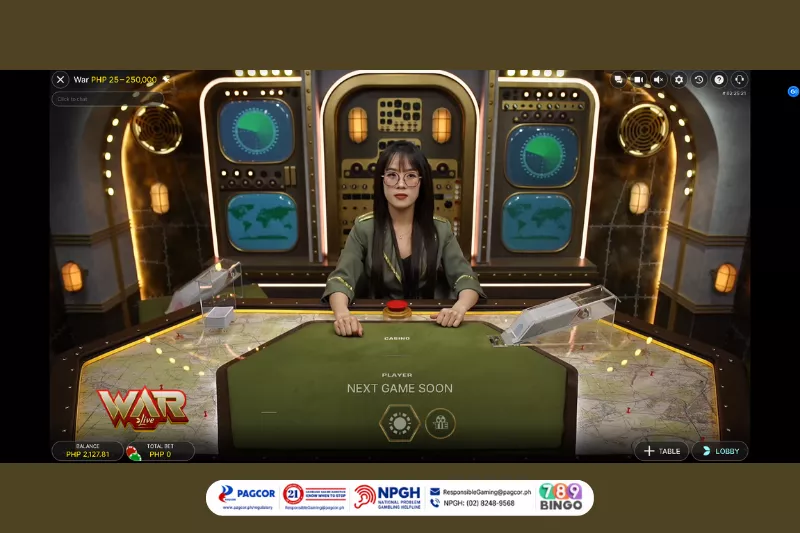
War by Evolution has a simpler betting layout than baccarat, blackjack or poker, but the Tie decision can suddenly increase the amount committed.
Decide before the session how much of the bankroll can be allocated to:
the opening Main Bet
and
a possible additional War wager
rather than treating the extra stake as money that must be found after a Tie occurs.
Surrender reduces the immediate loss to half an original wager but carries the lower published theoretical RTP.
Go to War has the higher published theoretical return but doubles the money committed to that ongoing round.
Neither choice makes the next card predictable.
Avoid increasing future opening bets because a previous War was lost. A dealer Ace in one round does not make a lower dealer card due in the next.
The Tie side bet also should not be chased because a previous Tie occurred. Consecutive Tie payouts increase precisely because repeated matching ranks are uncommon.
Use disposable entertainment funds, set deposit and session limits when appropriate, and use timeout or self-exclusion controls when play is no longer within the intended budget.
Gambling can be addictive; know when to stop.
Frequently Asked Questions
What is the RTP of War?
Evolution's published theoretical figures depend on both wager and Tie decision:
- Go to War Main Bet — 96.56%
- Surrender Main Bet — 96.27%
- Tie Side Bet — 92.05%
There is therefore no single RTP that accurately describes every possible way to play the table.
What happens when the first cards tie?
A Main Bet holder can either Surrender or Go to War.
Surrender forfeits half the Main Bet.
Going to War requires another wager equal to the original stake and continues the card comparison. Evolution automatically applies Surrender if no choice is entered in time.
How does War reach a 200:1 payout?
The optional Tie wager uses escalating payouts for consecutive Ties:
10:1 → 25:1 → 50:1 → 200:1
The 200:1 amount applies to the published fourth-consecutive-Tie level. It is not the payout on an ordinary Player win.
War by Evolution on 789Bingo
War by Evolution has one of the shortest opening rule sets in Evolution‘s live portfolio:
one Player card → one dealer card → higher rank wins
But the page earns its individual value from what happens after an equal rank:
Tie → Surrender or Go to War → doubled exposure → possible consecutive-Tie sequence
That interaction separates War from ordinary high-card tables.
Players who like direct card comparisons can contrast this decision structure with Dragon Tiger, baccarat and other dealer-led games in the live casino collection.
Evolution’s official description confirms that the player only makes the Go to War decision on the first Tie; later Ties continue automatically with the existing doubled stake.
The most useful takeaway is therefore not that War can pay 200:1. The central mechanic is deciding what to do with the Main Bet when two equal ranks turn an otherwise one-card game into a continuing round.
789Bingo is committed to Responsible Gaming. Underage gambling is prohibited; gaming is strictly for eligible persons aged 21 and above. If you or someone you know has a gambling problem, contact the 24/7 National Problem Gambling Helpline at (02) 8248-9568 or PAGCOR at [email protected] . Gambling can be addictive; know when to stop.










Leave a Reply