

Let’s be straight about something upfront. Slots are games of chance. No betting slots 2026 strategy guarantees a win, and anyone who tells you otherwise is selling something. But strategy does shape how long your money lasts, how you experience the swings, and whether you walk away with something or nothing at all.
Every decision you make before hitting that spin button—bet size, game choice, when to stop—determines your session’s trajectory. The machine doesn’t care about you, your bankroll, or your hopes. But you should. Because the math is fixed, yet the human element is where you actually have control. We’ve spent hundreds of hours analyzing the data, testing different approaches, and watching players blow through bankrolls in minutes. Here’s what we’ve learned.
Betting Slots 2026: Wagering Mechanics & Strategy
Max Bet Strategy: When to Use It (and When to Avoid It)
The max bet button is the most dangerous feature in any slot game. It’s also the only way to access certain progressive jackpots and max-pay multiplier tables. So the strategy isn’t “always” or “never”—it’s “know when.”
Here’s the rule for progressive jackpots. On Mega Moolah, any bet size can trigger the Mega Jackpot wheel, but the chance of triggering the bonus wheel scales directly with the bet amount. You do not win a “capped” version of the jackpot on a lower bet; rather, your odds of triggering the jackpot round are lower at smaller stakes. Clarifying this distinction avoids confusion regarding jackpot rules. Some operators even disqualify you from the jackpot entirely. Check the terms before you spin. A mid-range progressive slot offering ₱5 million in potential payout at max bet may only pay ₱50,000 at half-stakes. That’s a difference worth knowing about.
The risk side is straightforward. For games under betting slots 2026 without progressive jackpot eligibility, max betting is mathematically pointless. The RTP doesn’t change. The volatility doesn’t shift. You’re just wagering more money per spin for the same percentage return. The expected loss increases linearly with bet size. A ₱100 bankroll at ₱1 per spin gives you 100 spins. At ₱10 per spin, you get 10. The odds of hitting a significant win don’t improve—you’re just spending more to chase the same outcome.
“But what about the paytable multipliers?” Some slots offer special symbol combinations that only pay at maximum bet. These are usually branded slots with “jackpot” tiers or special feature triggers. Read the paytable. If there’s a “max bet only” symbol in the payout structure, then max betting is required to unlock that specific potential. For everything else, it’s optional.
The optimal approach: reserve max betting for specific progressive games where you’ve already studied the terms and accepted the high variance. For standard play, never touch the max bet button.

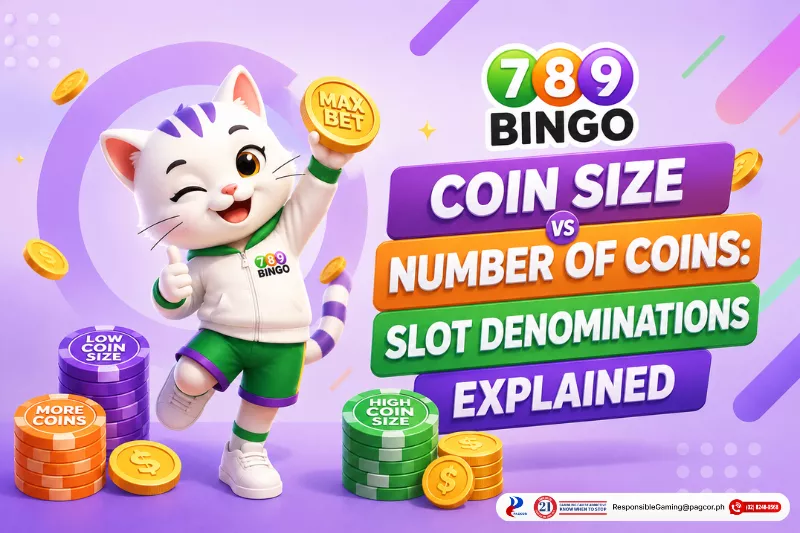
Coin Size vs. Number of Coins: Understanding Denominations
Here’s where the math gets interesting. The formula is simple:
Total Bet Formula:
Total Bet = Denomination × Coins per Line × Active Paylines
Example: ₱0.50 denomination × 2 coins per line × 20 paylines = ₱20 total bet. That’s your cost per spin.
The trap most players fall into involves the “coin” display setting found on many platforms, including Spadegaming titles common in Philippine casinos. When the interface shows your balance and bet sizes in “coins” instead of pesos, the numbers feel smaller. A ₱20 bet displayed as 2,000 coins feels like pocket change. Cognitive psychology research on slot UI design confirms this framing effect distorts judgment, leading players to increase bets without realizing they’re escalating their actual risk. The same ₱20 bet feels more significant when displayed as Pesos. The machine’s math hasn’t changed—only the presentation. But that presentation influences your decision-making.
Denomination's RTP Impact
According to general industry casino operations data, higher-denomination betting slots 2026 games often carry a higher theoretical RTP than their lower-denomination counterparts on the same machine. This isn’t universal, but it’s common enough to matter. A penny slot might run at 92% RTP, while the dollar version of the same game on the same cabinet could sit at 95% or higher. Casinos adjust the PAR (payout) sheets by denomination to optimize revenue per machine.
But there’s a trade-off. Higher denominations typically offer fewer paylines or coins per line. A ₱1 denomination slot might limit you to 5 lines, while the ₱0.10 version allows 50 lines. The total bet could be identical—₱5 either way—but the distribution of risk changes. Fewer lines mean fewer winning combinations. More lines mean more ways to hit, but smaller individual payouts.
The "Lower Denom Max Bet" Fallacy
A recurring debate among players is whether a maximum bet on a low-denomination slot (e.g., ₱5 total bet on a penny game) is better than a minimum bet on a higher denomination (₱5 total on a dollar game) . The answer: it depends on the game’s payout structure. For games with static jackpot prizes like Dragon Link, the Mini and Minor prizes are fixed within a denomination. On a penny machine, the Mini might be ₱100. On a dime machine, that same Mini is ₱1,000 for the same total bet size . The catch is that winning a ₱1,000 Mini is much harder than winning a ₱100 one—the odds drop proportionally. The expected value remains roughly constant.
What this means in practice: don’t let the “denomination” label confuse you. Focus on total bet per spin relative to your bankroll, not whether it’s pennies, nickels, or dollars.
Read the Full Guide: Slot Coin Values & Denomination Mechanics
Calculating Slot Odds, House Edge & Expected Loss
This is the most important math you’ll learn for titles under betting slots 2026:
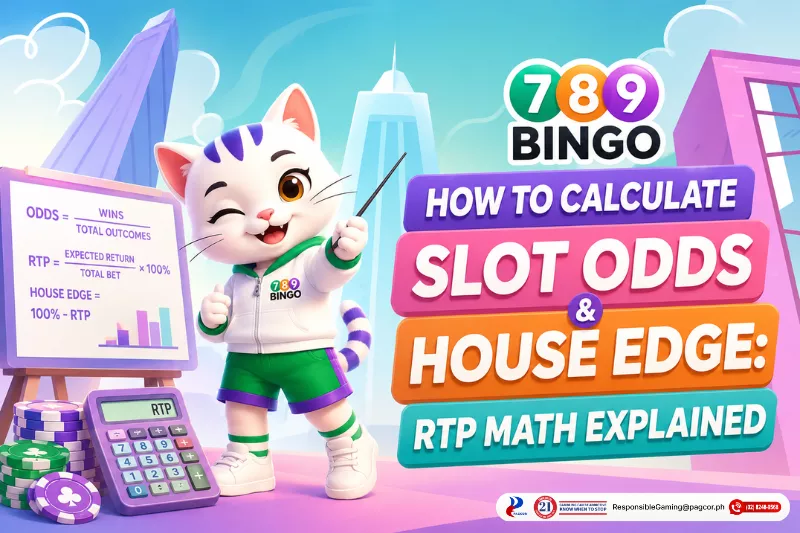
House Edge
House edge is simply the casino’s theoretical advantage over the long term.
House Edge Formula:
House Edge = 100% − RTP
A slot with 96% RTP has a 4% house edge. For every ₱100 wagered, the expected loss is ₱4. That’s the theory. Over millions of spins, it holds. In a single session, variance dominates.
Expected Loss Per Session
Expected Loss Formulas:
Expected Loss = Total Spins × Bet Size × House Edge
Expected Loss = Total Spins × Bet per Spin × (1 − RTP)
Example: You play 200 spins at ₱10 per spin on a 96% RTP slot.
- Total wagered: 200 × ₱10 = ₱2,000
- Expected loss: ₱2,000 × 4% = ₱80
This is your “cost” for that session’s entertainment. You might lose ₱500. You might win ₱500. But over many sessions, the average loss tends toward ₱80 per 200 spins at that bet level.
Session Duration Math
The key to extending playtime is simple: lower your bet size or increase your bankroll.
A ₱1,000 bankroll:
Total Bankroll | Bet Per Spin | Worst-Case Spin Count (0 Wins) | Estimated Session Length (Low Volatility) |
₱1,000 | ₱10.00 | 100 spins | ~15 to 20 minutes |
₱1,000 | ₱5.00 | 200 spins | ~30 to 40 minutes |
₱1,000 | ₱1.00 | 1,000 spins | ~2.5 to 3 hours |
Wins extend the session. A low-volatility game with 35% hit frequency returns small wins often enough to keep the bankroll alive much longer than the “no wins” projection.
Read the Full Guide: How to Calculate Slot Odds & House Edge
Bet Sizing & Payline Systems
Fixed vs. Variable Paylines
How adjusting active paylines alters hit frequency and session costs. Reducing paylines lowers your total bet but also reduces the number of winning combinations. A slot with 20 paylines at ₱1 each costs ₱20 per spin. The same slot with 10 paylines costs ₱10 per spin—but you’ve halved your chances of hitting any winning line. Playing fewer than maximum paylines increases game volatility and reduces hit frequency unnecessarily. Adjusting overall coin size while keeping all paylines active is the industry-recommended best practice. Better hit frequency for the same total bet.
Stop-Loss Betting Limits
Setting automated session caps to protect bankrolls during downswings. A stop-loss is a fixed amount you’re willing to lose per session. Once you hit that number, you stop playing. No exceptions. According to experienced players who documented hundreds of sessions, applying a strict stop-loss rule eliminates the single biggest cause of bankroll destruction—chasing losses. Set yours at 50% of session bankroll. When it’s gone, the session is over.
Betting Progression Systems
Fact-checking Martingale and flat-betting systems on slot mechanics. Martingale—doubling bets after losses—only works on even-money games where wins cover previous losses. Slots don’t work that way. Wins are random, and the payout structure isn’t even-money. Martingale on slots is mathematically insane. Flat-betting (same wager every spin) is the only rational approach. It prevents over-commitment during cold streaks and preserves your bankroll for the long game.
Denomination Strategies
Moving between penny, nickel, quarter, and dollar slots effectively. According to industry testing, the most bankroll-friendly approach is to find the denomination where your preferred total bet per spin aligns with a 1% bankroll rule. If your bankroll is ₱5,000, that’s ₱50 per spin maximum. That could be a ₱1 denomination × 50 lines, or a ₱0.10 denomination × 500 lines—unlikely. Match total bet to bankroll, not denomination label.
Risk Management & Multiplier Betting
Matching Bets to Volatility
Aligning bankroll depth with high vs. low variance machines. Low-volatility slots produce wins on roughly 35–45% of spins. High-volatility slots win on 15–25% of spins. A ₱100 bankroll at ₱1 per spin yields about 100 spins on low-volatility games. At ₱0.25 per spin, you get 400 spins. High-volatility games need larger bankrolls because dry spells are longer and more extreme.
Risk vs. Reward Ratios
Balancing base-game spin costs against bonus round trigger rates. The bonus round is where most slot value lives—often producing 60–80% of total game payout. If a bonus triggers every 150 spins on average, you need enough bankroll to survive those 150 base-game spins. Your bet size should reflect this. If a bonus round average payout is 80× your bet, and it triggers every 150 spins, then each spin’s “bonus value” is roughly 0.53× your bet (80/150). That’s separate from base-game returns. The lower your bet, the lower the average bonus payout—but your bankroll lasts longer to chase it.
Setting a Slot Budget
Session allocation rules to survive long dry spells between wins. The 1% rule works: your bet size shouldn’t exceed 1% of your session bankroll for medium-volatility games. For low-volatility, 2% can work. For high-volatility, 0.5% works. This gives you 100–200 spins per session minimum, even on a cold machine.
Bonus Round Betting Mechanics
How your triggering base bet impacts free spins and multiplier value. Important rule: your triggering bet determines the value of free spins. If you’re betting ₱1 per spin when the bonus triggers, those free spins are worth ₱1 each. If you’re betting ₱10, they’re worth ₱10 each. This is why some players increase their bet size just before the expected bonus trigger point—but be careful. The RNG doesn’t care about your expectation. The trigger happens when it happens with betting slots 2026.
Advanced Betting Systems & Tracking
Live Slot Betting
Adjusting wager sizes when playing physical or live-streamed slot setups. The same rules apply online and offline. The math doesn’t change. The physical environment might influence your psychology—the noise, the lights, the crowd—but the RNG doesn’t know you’re there. Stay disciplined. Use the same bet-sizing rules as online.
Payout Percentage Tracking
Logging session returns to verify real-world performance against theoretical RTP. Professional players track every session: total bets, total wins, spins count, RTP achieved. Over 100–200 sessions, your personal RTP should approximate the game’s theoretical number. If you’re consistently below 90%, the game’s RTP might be different from what you expected, or you’re playing high-volatility games with extreme variance. Either way, the data tells a story.
Betting on Multiplier Slots
How scaling bets during feature cascades impacts bankroll velocity. Some betting slots 2026 feature cascading reels where consecutive wins increase multipliers. This doesn’t change the RTP, but it increases volatility significantly. Manage your bet size accordingly—drop your bet by 50% when playing these games to account for the wider payout distribution.
Bankroll Preservation Tactics
Practical techniques to lock in profits after a big win. The “cash-out and play with winnings” strategy: when you hit a large win, withdraw the original bankroll amount and continue playing only with the profit. This guarantees you can’t lose your initial capital. It also forces you to handle the psychological shift of playing with house money—which is exactly the right mindset.
Bet Sizing Quick-Reference
Quick Bet Calculator:
Session Bankroll | Low Volatility (2% Max Bet) | Medium Volatility (1% Max Bet) | High Volatility (0.5% Max Bet) |
₱500 | ₱10.00 | ₱5.00 | ₱2.50 |
₱1,000 | ₱20.00 | ₱10.00 | ₱5.00 |
₱2,500 | ₱50.00 | ₱25.00 | ₱12.50 |
₱5,000 | ₱100.00 | ₱50.00 | ₱25.00 |
₱10,000 | ₱200.00 | ₱100.00 | ₱50.00 |
Responsible Gaming: Betting slots 2026 play is entertainment. Set deposit limits, use time-outs, and never chase losses. PAGCOR Guarantee and PAGCOR-licensed operators offer responsible gaming tools to help you stay in control.
Frequently Asked Questions
Does betting higher increase your chances of winning on slots?
No. The RNG is independent of bet size. Higher bets produce proportionally larger payouts but also larger losses. The only exception is progressive jackpots that require max bet to qualify—and even then, the win probability remains unchanged.
What is the difference between coin value and bet level?
Coin value is the denomination per line. Bet level is the number of coins per line. Total bet = coin value × bet level × active paylines.
How do you figure out the house edge on a slot machine?
House edge = 100% – RTP. A 96% RTP slot has a 4% house edge. Multiply your total wagered by the house edge to estimate expected loss.












Leave a Reply