
Key Takeaways
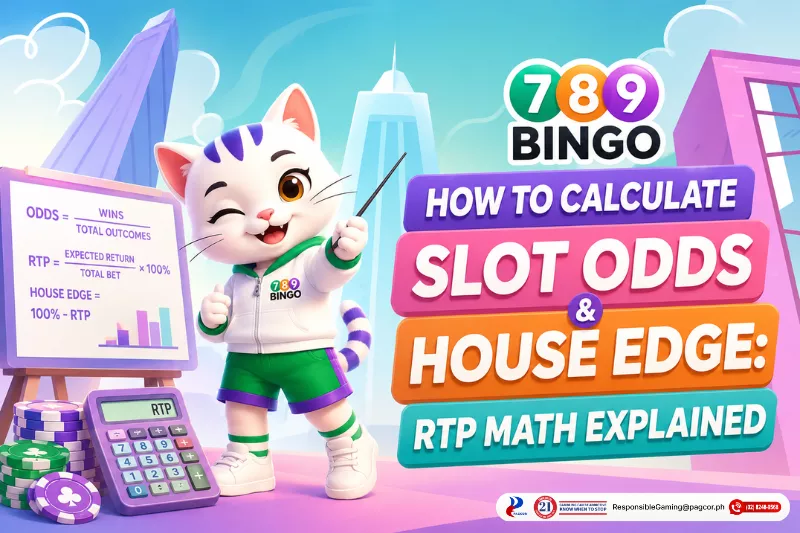
- House Edge = 100% – RTP. A 96% RTP slot has a 4% house edge.
- Expected Loss = Spins × Bet Size × House Edge.
- Hit frequency doesn’t equal low house edge—small payouts can still favor the casino.
- PAGCOR requires all 789Bingo games to publish their RTP.
The flashing lights and exciting sounds can make you forget something important: every spin has a mathematical cost. Understanding how to calculate slot odds doesn’t make you win more, but it helps you play smarter. You’ll know exactly what you’re paying for entertainment. Let’s break down the numbers.
Slot Machine House Edge Explained
Slot machine house edge explained starts with one simple concept: the casino always has an advantage.
The formula:
House Edge Formula:
What this means:
- RTP of 96% = House Edge of 4%.
- For every ₱100 wagered, the casino keeps ₱4 on average.
- Your expected return is ₱96.
The catch: This is over millions of spins. In a short session, anything can happen. You might win big. You might lose everything. The house edge is a long-term average.
PAGCOR regulations: All electronic gaming machines in PAGCOR-licensed casinos must publish their RTP. This includes 789Bingo games.
In certain games, playing below the maximum bet threshold can artificially raise the house edge by disabling top-tier paytable multipliers. Read our analysis on max bet slot strategy to identify which titles require maximum stakes for optimal RTP.

Slot Payout Percentage Math
Slot payout percentage math determines how much the game returns to players over time.
What is RTP?
Return to Player is the theoretical percentage of all wagered money that a slot will pay back. A 96% RTP slot returns ₱96 for every ₱100 wagered—over an infinite number of spins.
How it’s calculated:
- Game developers build a math model.
- They calculate all possible outcomes.
- They weight each outcome by its probability.
- The sum of (probability × payout) equals the RTP.
Why the number matters:
- Higher RTP = Lower house edge.
- Higher RTP = Better long-term value.
- But RTP doesn’t guarantee short-term results.
Regulated minimums: PAGCOR requires a minimum RTP of 75% and a maximum of 98% for electronic gaming machines. The industry standard for online slots is usually 94-97%.
How Do You Calculate the House Edge on a Slot Machine?
How do you calculate the house edge on a slot machine? The formula is straightforward, but finding the numbers can be tricky.
The simple formula:
House Edge Formula:
Example:
- Slot RTP: 95.5%
- House Edge = 1 – 0.955 = 0.045 = 4.5%
If you know the RTP, you know the house edge. But how do you find the RTP?
Finding the RTP at 789Bingo:
- Check the game’s info panel (the “i” button).
- Look for “RTP” or “Return to Player.”
- Read the game rules.
- Contact customer support.
What if the RTP isn’t published? In PAGCOR-licensed casinos, it must be. But some offshore operators hide this information. Always play at licensed sites.
Calculating Expected Loss on Slots
Calculating expected loss on slots helps you understand the real cost of a session.
Mathematical Formula for Slot Expected Loss:
The formula:
Expected Loss Formula:
Example:
- You plan 200 spins at ₱10 each.
- House Edge: 4% (96% RTP)
- Expected Loss = 200 × ₱10 × 0.04 = ₱80
What this means: Over 200 spins, you can expect to lose about ₱80. But this is an average. You might lose ₱500. You might win ₱500. The expected loss is just a guide.
For a higher RTP slot (97%):
- Expected Loss = 200 × ₱10 × 0.03 = ₱60
The difference: 1% higher RTP saves you ₱20 per 200 spins at ₱10. Over a year, this adds up.
For a lower RTP slot (94%):
- Expected Loss = 200 × ₱10 × 0.06 = ₱120
The strategy: Choose slots with the highest RTP you can find. This reduces your expected loss.
Slot Hit Frequency vs RTP
Slot hit frequency vs RTP are two different concepts.
Hit frequency: The percentage of spins that result in a win.
- A 30% hit frequency means you win on 30% of spins.
- Most slots have hit frequencies between 15% and 40%.
RTP: The percentage of all wagered money returned to players.
The relationship:
- A slot can have a high hit frequency (lots of wins) but low RTP.
- Those wins are small—barely exceeding your bet.
- A slot can have a low hit frequency (few wins) but high RTP.
- Those wins are larger when they hit.
Example:
- Slot A: 40% hit frequency, 94% RTP (many small wins).
- Slot B: 15% hit frequency, 97% RTP (fewer large wins).
Which is better? It depends on your preference. Slot A gives you more winning spins, but you lose more over time. Slot B gives you fewer wins, but you keep more when you play.
According to our analysts: Many players prefer higher hit frequency slots because they feel more successful. But mathematically, higher RTP is better, regardless of hit frequency.
How to Figure Out Your Odds on a Video Slot
How to figure out your odds on a video slot requires understanding the game’s math.
Step 1: Find the RTP.
- Check the game info.
- Look for the RTP percentage.
Step 2: Calculate the house edge.
- House Edge = 100% – RTP.
Step 3: Calculate your expected loss per spin.
- Expected Loss per Spin = Bet Size × House Edge.
Example:
- RTP: 96.5%
- House Edge: 3.5%
- Bet Size: ₱20
- Expected Loss per Spin = ₱20 × 0.035 = ₱0.70
Step 4: Estimate your session cost.
- Expected Loss = Expected Loss per Spin × Number of Spins.
- 100 spins at ₱20 = 100 × ₱0.70 = ₱70 expected loss.
Step 5: Consider volatility.
- High volatility means your actual results will vary more.
- Low volatility means results closer to the expected value.
The reality: The odds on any single spin are fixed. You can’t improve them. You can only choose games with better odds.
What Is a Good House Edge for Online Slots?
What is a good house edge for online slots? It depends on the game type.
House Edge Rating | Slot RTP Range | House Edge Range | Average Cost Per ₱1,000 Wagered | Player Advantage Level |
Excellent | 97.0% – 98.5% | 1.5% – 3.0% | ₱15.00 – ₱30.00 | Best-in-class long-term value |
Good | 96.0% – 96.9% | 3.1% – 4.0% | ₱31.00 – ₱40.00 | Industry standard online average |
Average | 95.0% – 95.9% | 4.1% – 5.0% | ₱41.00 – ₱50.00 | Acceptable for feature-heavy slots |
Poor | Below 95.0% | Over 5.0% | ₱50.00+ | High theoretical cost / Avoid |
Benchmarks:
- Excellent: Under 3% (RTP over 97%)
- Good: 3-4% (RTP 96-97%)
- Average: 4-5% (RTP 95-96%)
- Poor: Over 5% (RTP under 95%)
Best-in-class slots:
- 97-98% RTP is the gold standard.
- These games offer the best long-term value.
- 789Bingo offers several high-RTP games.
Why some slots have higher house edge:
- Progressive jackpots require higher contributions.
- Bonus-rich games often have lower base RTP.
- Lower denomination slots often have higher house edge.
The takeaway: Look for RTP of 96% or higher. This keeps the house edge under 4%.
Recognizing the casino’s mathematical edge helps you build a more disciplined approach to every session. Head back to our master Betting Slots Hub for comprehensive guides on bet sizing and risk management.

How Slots Actually Work
Understanding the math helps, but the mechanics matter too.
The RNG:
- Random Number Generator determines each spin’s outcome.
- It runs continuously, even when nobody’s playing.
- The moment you hit spin, it picks the latest number.
- This number maps to a reel position.
The paytable:
- Shows all possible winning combinations.
- Shows the payout for each combination.
- The payout is usually expressed as a multiple of your bet.
The math model:
- Every slot has a fixed paytable.
- The RNG selects outcomes with specific probabilities.
- These probabilities determine the RTP.
Why you can’t predict outcomes:
- The RNG generates numbers at thousands per second.
- The exact time of your spin determines the outcome.
- You can’t know the sequence.
PAGCOR’s role:
- RNGs must be certified by independent labs.
- The game math must be approved.
- Operators can’t change the RTP without approval.
The Psychology of Losing
The math explains why the house wins. The psychology explains why players keep playing.
The gambler’s fallacy:
- “I’ve lost 10 spins, so a win is due.”
- False. Each spin is independent.
- The machine doesn’t track your history.
Loss chasing:
- “I’ll just double my bet to recover my losses.”
- This increases risk. Doubling doesn’t change the odds.
- You’re still losing 4% of every bet.
The near-miss effect:
- A near-miss (two symbols close to a jackpot) feels close.
- It’s not. The RNG selected a specific outcome.
- Near-misses encourage continued play.
The comp illusion:
- “I’m getting free drinks, so I’m breaking even.”
- The cost of the game outweighs the value of comps.
- Your expected loss is still the house edge.
According to our analysts: Players who set loss limits and stick to them enjoy gambling more. Those who chase losses often end up disappointed.
789Bingo's Commitment to Fairness
At 789Bingo, we take transparency seriously.
PAGCOR license:
- We operate under PAGCOR’s regulatory framework.
- All games are certified by independent labs.
- RTPs are published and verified.
Game variety:
- High-RTP slots offer excellent value.
- Progressive slots offer big potential.
- Volatility varies—choose based on your style.
Player tools:
- Deposit limits help you control spending.
- Session limits prevent extended play.
- Self-exclusion options support responsible gambling.
The 789Bingo guarantee: Every game you play is fair. The RNG is certified. The RTP is published. The house edge is transparent.
Final Thoughts
Understanding how to calculate slot odds doesn’t guarantee wins. But it helps you make informed choices. You’ll know the real cost of each spin. You’ll choose games with better value. You’ll manage your bankroll more effectively.
Key takeaways:
- RTP tells you the theoretical return.
- House edge is the casino’s advantage.
- Higher RTP = lower house edge = better value.
- Hit frequency is separate from RTP.
- PAGCOR Guarantee ensures transparency.
At 789Bingo, we want you to play with confidence. Our games publish their RTP. Our RNGs are certified. Our PAGCOR license ensures fairness.
The bottom line: Know the math. Choose high-RTP games. Set a budget. Have fun. And when you win, celebrate—you beat the house edge.
Ready to play smart? Explore the games at 789Bingo. Check each game’s RTP. Choose the best value. Play within your limits. Every spin is fair. Every win is real.
Frequently Asked Questions
How do you calculate the house edge on a slot machine?
Subtract the RTP from 100%. If a slot has 96% RTP, the house edge is 4%.
How to figure out your odds on a video slot?
Find the RTP, calculate the house edge, and multiply by your bet size. This gives your expected loss per spin.
What is a good house edge for online slots?
Under 4% is good. Under 3% is excellent. Look for RTP of 96% or higher.
Does hit frequency affect RTP?
No. Hit frequency is how often you win. RTP is how much you get back over time. A slot can have high hit frequency but low RTP.
Can I improve my odds by betting more?
No. The odds don't change with bet size. But some progressive jackpots require max bet for eligibility.
Does PAGCOR regulate slot RTP?
Yes. PAGCOR requires all electronic gaming machines to publish RTP and have certified RNGs.











Leave a Reply