
Key Takeaways
- Slot volatility determines how often and how much a machine pays out on average.
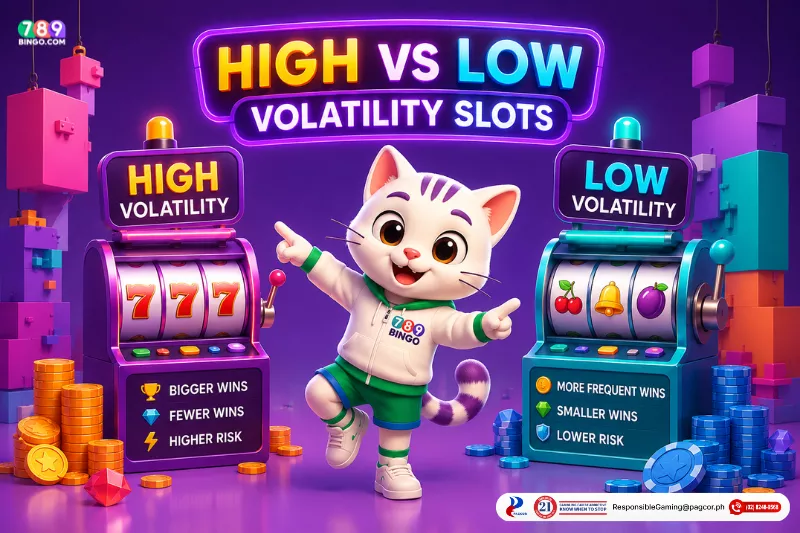
- High volatility means rare but large wins; low volatility means frequent but small wins.
- Your bankroll size and playing style should guide your choice of volatility level.
- 789Bingo offers a wide range of slots across all volatility levels, all PAGCOR-certified.
You’re sitting at your screen. You’ve got ₱1,000 in your account. You want to play slots. But which one? The flashy game with the progressive jackpot? Or the classic three-reel with steady small hits?
The answer depends on one thing: volatility. Understanding high vs low volatility slots separates players who stretch their bankroll from those who burn through it in minutes.
What Is Slot Volatility?
Slot variance explained starts with a simple definition: volatility measures how often a slot pays out and the typical size of those payouts. It’s the risk profile of the game.
Three main categories:
- Low volatility: Frequent small wins. Extended playtime. Lower risk.
- Medium volatility: Balanced approach. Mix of small and occasional larger wins.
- High volatility: Rare wins. But when they hit, they’re big. Higher risk, higher reward.
The roulette analogy: Betting on red or black gives you an 18/38 chance of winning. Low volatility — frequent but small returns. Betting on a single number gives you 1/38 chance. High volatility — rare but massive returns.
Every spin on any slot is random. But the design of the game determines the payout profile. That’s volatility.
How Slot Volatility Affects Your Gameplay
The impact is immediate and practical.
Low volatility experience:
You deposit ₱500. You choose a low-volatility slot. You place ₱5 bets. You win frequently — sometimes ₱2, sometimes ₱15. Your balance fluctuates. It goes down slowly. You get 100 spins for your money. The experience is steady. Relaxing even. You cash out maybe ₱100 or ₱200 if you hit a decent streak. Maybe you lose it all. But it took time.
High volatility experience:
Same deposit: ₱500. Same bet size: ₱5. You spin. You lose. You spin again. Lose again. Ten spins. Twenty. Your balance drops to ₱400, then ₱300, then ₱200. You haven’t won anything meaningful. Thirty spins. Your balance is ₱100. You’re starting to feel frustrated. Then spin 35 hits. The screen explodes. You win ₱800. Your balance jumps to ₱900. You cash out.
The emotional difference:
Low volatility = less stress. More consistent action. You feel like you’re “playing” longer. High volatility = higher stress. Longer dry spells. But a bigger payoff when it hits. Some players love the adrenaline. Others hate the volatility.
High Volatility Slots: Big Risk, Big Reward
Best high volatility slots appeal to players with larger bankrolls and higher risk tolerance.
Who should play them:
- Players with a bankroll of at least ₱5,000 or more
- Those who can handle 50–100 spins with no significant wins
- Players chasing large multipliers or progressive jackpots
- Those who play for the thrill of potential big hits
Key characteristics:
- Payouts come rarely — sometimes 1 in 10 spins, sometimes 1 in 100
- Wins are often 50x to 100x your bet or higher
- Progressive jackpots are typically high volatility
- Volatility Index (VI) rating of 8–10 out of 10
Popular examples at 789Bingo:
- Money Coming (JILI) — Medium-high volatility with big potential
- Wild Bounty Showdown (PG Soft) — High volatility with free spins feature
- Fortune Gems (JILI) — Balanced but can swing big
The math: A high-volatility slot might have an RTP of 96%. But you won’t see that 96% in your session. You might lose 90% of your bankroll in 30 minutes. Or you might 5x your money on one spin. The variance is enormous.
Strategy:
- Bet smaller relative to your bankroll (1–2% per spin)
- Don’t chase losses — the next spin is independent
- Set a stop-loss limit (e.g., lose 50% of bankroll, walk away)
- Have a win target (e.g., 3x your bankroll, cash out)
Low Volatility Slots: Consistent Action, Extended Play
Low variance slot machines suit casual players and those clearing bonuses.
Who should play them:
- Players with small bankrolls (₱500–₱2,000)
- Those who want longer playing sessions
- Players clearing wagering requirements
- Casual players who prefer consistent entertainment
Key characteristics:
- Wins come frequently — often every 2–5 spins
- Payouts are small — typically 0.5x to 5x your bet
- Volatility Index (VI) rating of 1–3 out of 10
- Lower risk of rapid bankroll depletion
Popular examples at 789Bingo:
- Lucky 7 series — Classic low volatility
- Fruit Party — High volatility with frequent payouts (up to 256x multipliers)
- Dragon Tiger variants — Steady returns
The math: A low-volatility slot might have an RTP of 95%. You might win 40% of spins. But each win is small. You’ll lose money slowly. Your bankroll lasts longer. But you won’t hit a life-changing jackpot.
Strategy:
- Bet 2–5% of your bankroll per spin
- Play longer sessions without worrying about ruin
- Accept that big wins are unlikely
- Focus on wagering requirements — low volatility helps clear them
Medium Volatility: The Goldilocks Option
The middle ground. Not too risky. Not too boring.
Who should play them:
- Players with moderate bankrolls (₱2,000–₱5,000)
- Those who want a mix of wins and excitement
- Players who can’t decide between high and low
- Most recreational players
Key characteristics:
- Wins occur moderately often
- Payouts range from small to decent size
- Volatility Index (VI) rating of 4–7 out of 10
- Balanced risk profile
Popular examples at 789Bingo:
- Gonzo’s Quest — Medium-to-High Volatiliy volatility with cascading reels
- Starburst — Low volatility
- Book of Dead — High volatility
Strategy:
- Bet 2–3% of your bankroll per spin
- Adjust your bet size based on session performance
- Combine with bonuses for extra value
How to Check the Volatility of a Slot Game
How to check the volatility of a slot game isn’t always obvious. Some operators display it. Others don’t.
Method 1: Game Information
Most online slots have an “i” or “info” button. Click it. Look for volatility, variance, or risk level. 789Bingo displays this for every game.
Method 2: Pay Table Analysis
Look at the paytable. Note the difference between smallest and largest payouts. Big gaps suggest high volatility. Small gaps suggest low volatility.
Method 3: Google Search
Search the game name + “volatility” or “variance.” Player reviews and forums often discuss this.
Method 4: Demo Play
Try the slot in demo mode. Play 50–100 spins. Watch the pattern. Frequent small wins? Low volatility. Long dry spells with occasional big hits? High volatility. This is the most practical method.
Method 5: Developer Documentation
Some providers publish volatility ratings. NetEnt, Microgaming, and others often include volatility in game descriptions.
Volatility vs. RTP: What's the Difference?
Players often confuse these two concepts. They’re related but distinct.
Volatility = distribution of wins
- How often do wins occur?
- How large are those wins?
- High volatility = infrequent large wins
- Low volatility = frequent small wins
RTP = percentage returned over time
- A 96% RTP means the game returns 96% of all wagered amounts over infinite spins
- RTP is a long-term average
- Volatility affects when you receive those returns
The key difference:
Two slots can have the same RTP (96%) but different volatility. Slot A pays out small amounts frequently. Slot B pays out large amounts rarely. Over 1 million spins, both return 96%. But your experience differs dramatically.
Example:
- Slot A (Low volatility, 96% RTP): You bet ₱1,000 over 200 spins. You win ₱950. You lose ₱50. Boring but consistent.
- Slot B (High volatility, 96% RTP): You bet ₱1,000 over 200 spins. You win nothing for 150 spins. Then you hit a ₱2,000 win. You’re up ₱1,000. Then you lose it all on the next 50 spins. You end with ₱950. The RTP is the same. The experience is completely different.
Which Slot Volatility Is Best for Small Bankrolls?
Which slot volatility is best for small bankrolls? The answer is clear: low volatility.
Why:
- More spins per peso
- Lower risk of total loss
- More consistent experience
- Less emotional stress
The math for a ₱1,000 bankroll:
- Low volatility (95% RTP, 30% hit frequency): 200 spins at ₱5. You win 60 times. Average win ₱8. You lose ₱100 over 200 spins. Session lasts 30 minutes.
- High volatility (95% RTP, 10% hit frequency): 200 spins at ₱5. You win 20 times. Average win ₱25. You could hit a ₱500 win early. Or you could hit nothing and lose ₱1,000 in 10 minutes.
Recommendation: If you have ₱1,000 or less, play low-to-medium volatility. Save high volatility for larger bankrolls.
What Is the Difference Between High and Low Variance Slots?
What is the difference between high and low variance slots? Let’s break it down with concrete examples.
Metric | Low Volatility | High Volatility |
Win Frequency | High (every 2–5 spins) | Low (every 10–50+ spins) |
Payout Size | Small (0.5x to 5x bet) | Large (50x to 1,000x+ bet) |
Ideal Bankroll | Small (₱500 – ₱2,000) | Large (₱5,000+) |
Primary Goal | Extended playtime / Clearing bonuses | Jackpot hunting / Big win multipliers |
Risk Profile | Low (slow balance depletion) | High (rapid variance swings) |
Low variance scenario:
- You bet ₱10 per spin
- You win 1 in 3 spins on average
- Wins range from ₱2 to ₱30
- You play 100 spins for ₱1,000
- You win 33 times, average win ₱15 = ₱495 total
- You lose ₱505 total
- Session lasts 20 minutes
High variance scenario:
- You bet ₱10 per spin
- You win 1 in 10 spins on average
- Wins range from ₱10 to ₱500
- You play 100 spins for ₱1,000
- You win 10 times, average win ₱95 = ₱950 total
- You lose ₱50 total
- But the distribution is skewed: 9 wins average ₱20, 1 win pays ₱770
- Session lasts 20 minutes, but you hit a big one
The key difference: In low variance, you know what to expect. In high variance, you don’t. The RTP might be identical. The experience is worlds apart.
High-volatility games are often the best choice when hunting for significant returns. Learn more about these high-risk mechanics in our breakdown of how progressive jackpots payout.

PAGCOR and Slot Fairness
789Bingo operates under PAGCOR regulations. This ensures:
- Games are certified by independent labs (eCOGRA, GLI, iTech Labs)
- RTP and volatility are accurately represented
- Operators cannot manipulate outcomes or volatility
- Player funds are protected
Game provider standards: Our partners — JILI, Pragmatic Play, CQ9 — publish volatility ratings. They’re transparent about game math. Independent labs verify the numbers.
Regulatory oversight: PAGCOR requires all electronic gaming machines to maintain a minimum theoretical RTP of 75% and a maximum of 98%. Volatility is set during game development. Operators can’t change it.
Choosing the Right Slot for Your Style
Your bankroll:
- ₱500–₱1,000: Low volatility only
- ₱1,000–₱2,000: Low to medium volatility
- ₱2,000–₱5,000: Medium to high volatility
- ₱5,000+: Any volatility
Your goals:
- Extend playtime: Low volatility
- Chase big wins: High volatility
- Balance: Medium volatility
- Clear bonuses: Low to medium volatility
Your personality:
- Patient and steady: Low volatility
- Risk-taker and thrill-seeker: High volatility
- Somewhere in between: Medium volatility
The practical test: Try a slot in demo mode. Watch the pattern. Does it match your expectations? If you’re frustrated by long dry spells, choose lower volatility. If you’re bored by small wins, choose higher volatility.
Choosing the right variance level is essential for long-term session sustainability. Explore our master Gambling Slots Hub for more tips on maximizing your gameplay experience.

Final Thoughts
Understanding high vs low volatility slots is essential for bankroll management. Choose games that match your budget and goals. Don’t let a flashy theme or progressive jackpot distract you from the fundamental risk profile.
At 789Bingo, verifiable under PAGCOR Guarantee, we offer slots across all volatility levels. Every game is certified. Every RNG is tested. Every outcome is fair.
Key takeaways:
- Low volatility: Frequent small wins, longer playtime, lower risk
- High volatility: Rare big wins, shorter sessions, higher risk
- Match volatility to your bankroll and playing style
- PAGCOR ensures games operate fairly
The best slot isn’t the one with the biggest jackpot. It’s the one that fits your budget and delivers the experience you want. Play smart. Spin responsibly.
Ready to find your perfect slot? Browse the full game library at 789Bingo. Filter by volatility, RTP, and provider. Every game is certified, every spin is random, every win is real.
By 789Bingo Team
Frequently Asked Questions
What is the difference between high and low variance slots?
High variance means rare but large wins; low variance means frequent but small wins. Both can have the same RTP.
Which slot volatility is best for small bankrolls?
Low volatility. It gives you more spins and reduces the risk of losing everything quickly.
How to check the volatility of a slot game?
Check the game info (i-button), Google the game name + "volatility," or try the demo mode.
Is high volatility better for winning big?
High volatility gives you the potential for big wins. But they come rarely. The RTP is the same as low volatility games.
Can I clear wagering requirements better with low volatility slots?
Yes. Low volatility gives you more spins, which helps you meet wagering requirements faster and with less risk.
Does PAGCOR regulate slot volatility?
Yes. PAGCOR requires all electronic games to be certified by independent labs. Volatility is part of that certification.











Leave a Reply